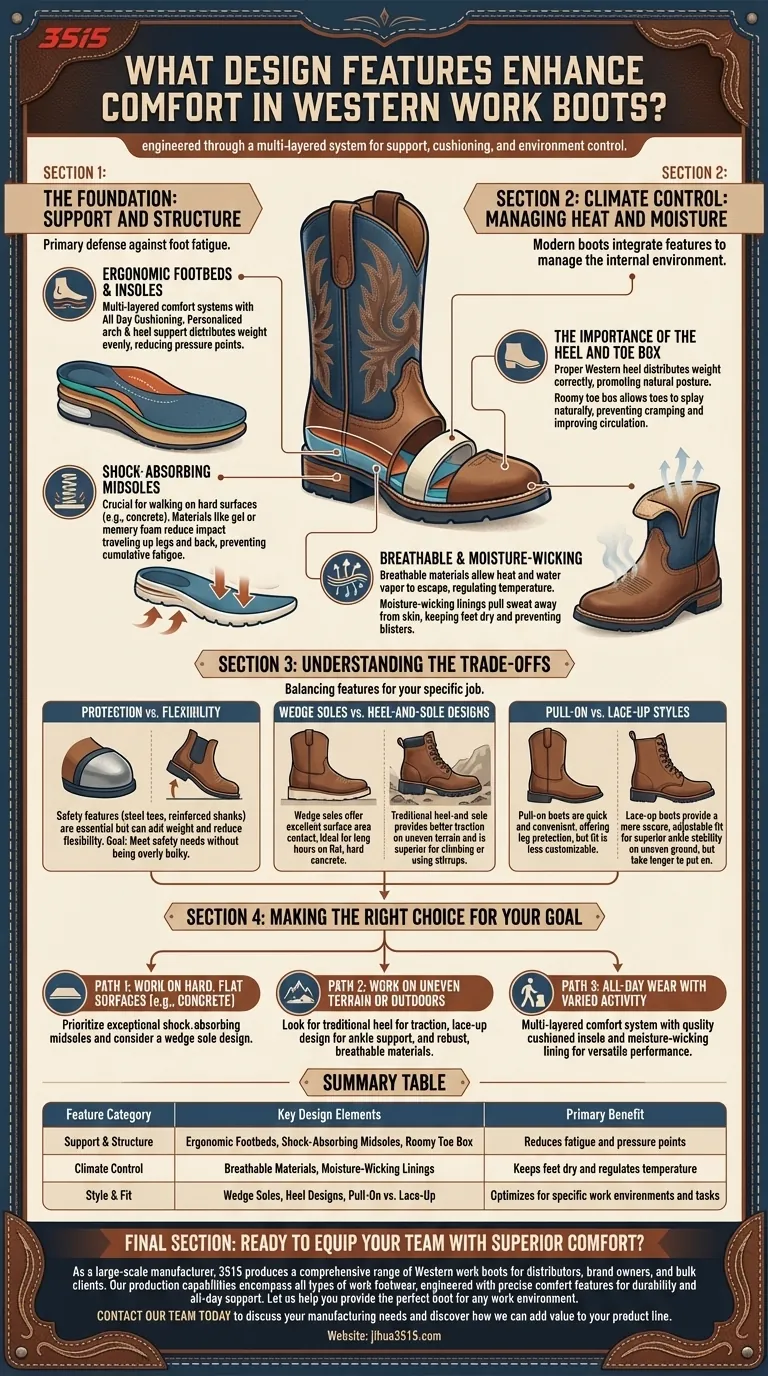
In essence, comfort in Western work boots is engineered through a multi-layered system that focuses on support, cushioning, and environment control. Key features include ergonomic footbeds, shock-absorbing midsoles, roomy toe boxes, and moisture-wicking materials designed to reduce fatigue over long hours of wear.
The core principle is not about a single feature, but how a combination of structural support, impact absorption, and climate control work together. A truly comfortable boot manages pressure, reduces shock, and keeps your foot dry and stable from morning to night.
The Foundation: Support and Structure
A boot's underlying structure is the primary defense against foot fatigue. Without a solid, ergonomic foundation, cushioning alone is a temporary fix.
Ergonomic Footbeds and Insoles
The footbed, or insole, is the layer your foot directly contacts. Quality boots use multi-layered comfort systems, often with All Day Cushioning technology.
These insoles are designed to provide personalized arch and heel support, which is critical for distributing weight evenly and reducing pressure points during long shifts.
Shock-Absorbing Midsoles
The midsole is the component that absorbs the shock of walking on hard surfaces. This feature is crucial for warehouse workers, drivers, and anyone working on concrete.
Materials like gel or memory foam are often used here to reduce the impact that travels up your legs and back, preventing cumulative fatigue.
The Importance of the Heel and Toe Box
A proper Western heel is designed to distribute weight correctly, promoting a more natural posture and reducing strain.
Simultaneously, a roomy toe box allows your toes to splay naturally. This prevents cramping and improves circulation, which is vital for all-day comfort.
Climate Control: Managing Heat and Moisture
A boot can have perfect support, but if it's hot and damp inside, it will never be comfortable. Modern Western work boots integrate features to manage the internal environment.
Breathable and Moisture-Wicking Materials
High-quality boots use breathable materials in their construction. This allows heat and water vapor (sweat) to escape, regulating the temperature inside the boot.
Linings are often made of moisture-wicking fabrics that pull sweat away from the skin, keeping your feet dry and preventing the blisters and discomfort caused by friction.
Understanding the Trade-offs
Choosing the right boot involves balancing features. Not every comfort feature is ideal for every job, and some come with inherent compromises.
Protection vs. Flexibility
Safety features like steel toes and reinforced shanks are non-negotiable in many environments, but they can add weight and reduce flexibility compared to a non-safety boot. The goal is to find a boot that meets safety requirements without feeling overly bulky or restrictive.
Wedge Soles vs. Heel-and-Sole Designs
Wedge soles offer excellent surface area contact, making them very comfortable for long hours on flat, hard surfaces like concrete.
However, a traditional heel-and-sole design provides better traction on uneven terrain and is superior for climbing or using stirrups. The choice depends entirely on your primary work environment.
Pull-On vs. Lace-Up Styles
Pull-on boots are convenient and quick, with tall shafts that offer excellent leg protection. The fit, however, is less customizable.
Lace-up boots provide a more secure and adjustable fit around the ankle and instep, offering superior stability for walking on uneven ground, but they take more time to put on and take off.
Making the Right Choice for Your Goal
Your specific work environment and daily tasks should dictate which comfort features you prioritize.
- If your primary focus is working on hard, flat surfaces (e.g., concrete floors): Prioritize boots with exceptional shock-absorbing midsoles and consider a wedge sole design for even pressure distribution.
- If your primary focus is working on uneven terrain or outdoors: Look for a traditional heel for traction, a lace-up design for superior ankle support, and robust, breathable materials.
- If your primary focus is all-day wear with varied activity: A multi-layered comfort system with a quality cushioned insole and moisture-wicking lining will provide the most versatile performance.
Ultimately, the most comfortable Western work boot is the one that correctly matches its engineered features to the demands of your workday.
Summary Table:
| Feature Category | Key Design Elements | Primary Benefit |
|---|---|---|
| Support & Structure | Ergonomic Footbeds, Shock-Absorbing Midsoles, Roomy Toe Box | Reduces fatigue and pressure points |
| Climate Control | Breathable Materials, Moisture-Wicking Linings | Keeps feet dry and regulates temperature |
| Style & Fit | Wedge Soles, Heel Designs, Pull-On vs. Lace-Up | Optimizes for specific work environments and tasks |
Ready to equip your team with superior comfort?
As a large-scale manufacturer, 3515 produces a comprehensive range of Western work boots for distributors, brand owners, and bulk clients. Our production capabilities encompass all types of work footwear, engineered with the precise comfort features detailed above to ensure durability and all-day support for your customers.
Let us help you provide the perfect boot for any work environment. Contact our team today to discuss your manufacturing needs and discover how we can add value to your product line.
Visual Guide
Related Products
- Durable Goodyear Welt Leather Work Boots for Wholesale & Private Label
- Durable Leather Work Boots for Wholesale & Custom Manufacturing
- Durable Leather Work Boots for Wholesale & Custom OEM Manufacturing
- Durable Moc-Toe Wedge Work Boots | Wholesale Manufacturing for Brands
- Wholesale Leather Work Boots with Customizable Wedge Sole for Brands
People Also Ask
- What is the difference between full-grain and top-grain leather? Premium Material Guide for Boot Manufacturers
- What are the advantages of leather as an upper material for work boots? Unmatched Durability & Custom Comfort
- Why is it important to waterproof leather work boots? Protect Your Investment and Performance
- How should new leather work boots be broken in? A Guide to Comfort and Durability
- What are the advantages of leather uppers in work boots? Unmatched Durability & Protection