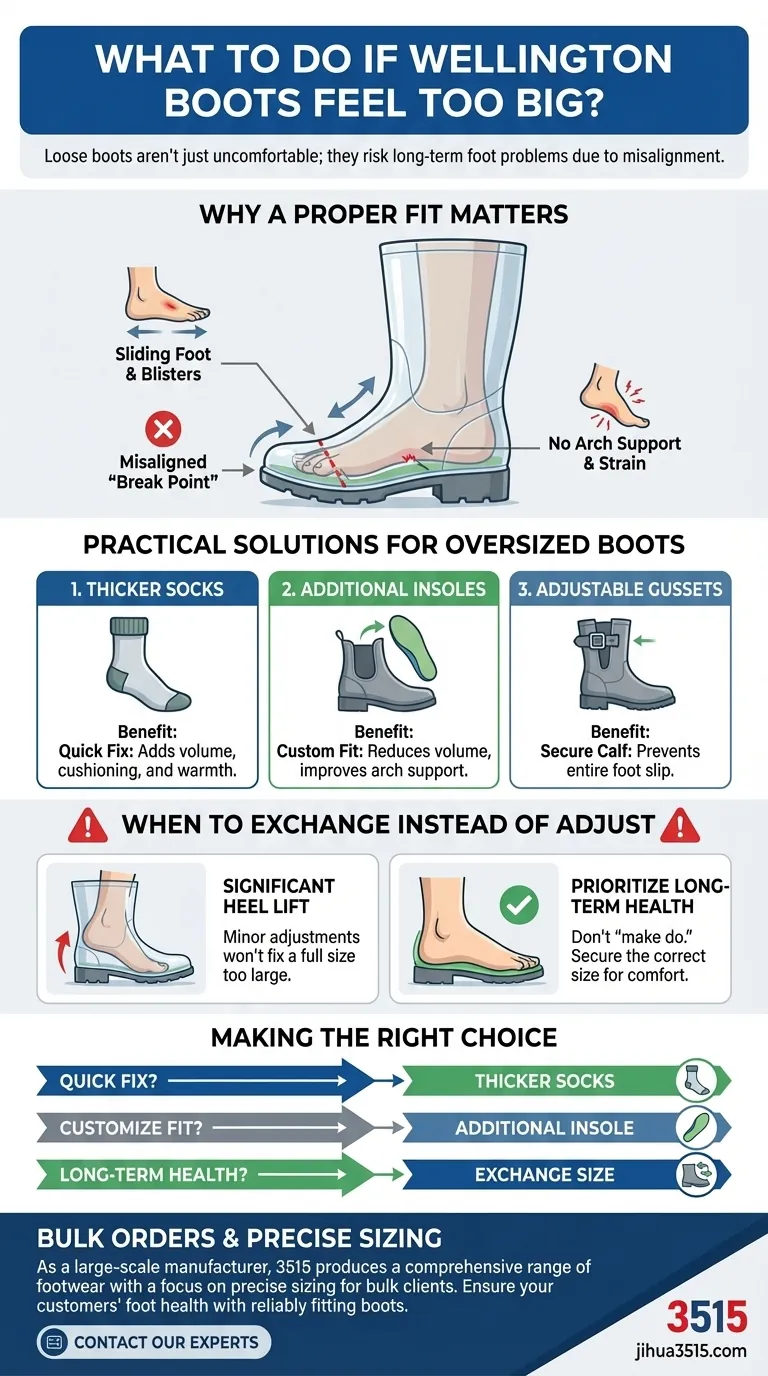
If your Wellington boots feel too big, you have several effective options. The quickest fixes are to wear thicker thermal or hiking socks to fill excess space or to add a second insole for a more custom fit. For a more permanent solution, you can exchange them for a half-size smaller or choose a model with an adjustable gusset to better secure your calf and foot.
The core issue with an oversized boot isn't just the loose feeling; it's the misalignment between your foot's natural flex point and the boot's structure, which can lead to discomfort and long-term foot problems.
Why a Proper Fit is Non-Negotiable
A boot that is too large forces your foot to work harder with every step. Understanding the specific mechanical problems this causes is the first step to finding the right solution.
The Problem with Foot Movement
When a boot is too big, your foot slides forward and backward inside. This constant friction is the primary cause of blisters and general discomfort, especially during extended wear.
Your toes may also instinctively grip to stabilize your foot, leading to strain in your arches and fatigue over the course of a day.
The Impact of a Misaligned "Break Point"
Every boot is designed with a "break point"—the spot across the forefoot where it naturally flexes. In a well-fitting boot, this aligns perfectly with the natural bend of your foot at the ball.
When the boot is too large, your foot bends in one place while the boot tries to bend in another. This mismatch prevents proper support and function.
The Risk to Your Arch Support
The most significant danger of a poor fit is the strain on your foot's arch. The boot's built-in arch support is rendered useless if it isn't positioned correctly under your foot.
This misalignment can lead to painful conditions like arch inflammation, the development of flat feet, and even plantar fasciitis, a common and persistent foot ailment.
Practical Solutions for Oversized Boots
Before deciding to return your boots, you can try a few adjustments. These methods are most effective when the boot is only slightly too large.
The Simplest Fix: Thicker Socks
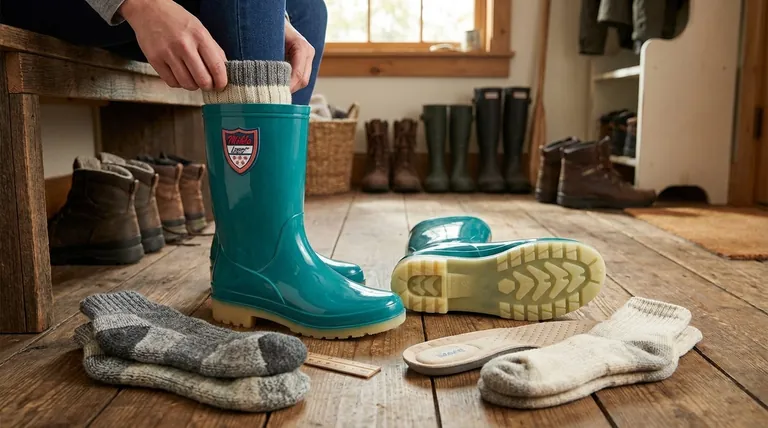
Wearing a pair of thick hiking, thermal, or ski socks is the easiest way to fill extra volume inside the boot.
This not only makes the boot feel snugger but also adds cushioning and warmth, which is often a welcome benefit when wearing Wellingtons.
Adding Insoles for a Custom Fit
Placing an additional insole on top of the existing one can significantly reduce the boot's internal volume.
This has the dual benefit of improving the fit while also allowing you to add more cushioning or specialized arch support, creating a more comfortable and ergonomic environment for your foot.
Leveraging Adjustable Features
Many modern Wellington boots come with an adjustable gusset or buckle on the side of the calf.
Tightening this feature creates a more secure fit around your leg, which can help prevent your entire foot from sliding down and forward into the toe box.
When to Exchange Instead of Adjust
While socks and insoles are excellent tools, they have their limits. It is critical to recognize when a boot is simply the wrong size.
The Limit of Minor Adjustments
If your heel lifts out of the boot significantly with every step, no amount of sock thickness or insoles will fix the fundamental problem.
These adjustments are meant to fine-tune a fit that is close, not to correct for a boot that is a full size or more too large.
Prioritizing a Long-Term Solution
Attempting to "make do" with a poorly fitting boot will almost always lead to regret. Discomfort and potential foot issues are not worth the inconvenience of an exchange.
Most retailers have a clear return or exchange policy for unworn boots. Securing the correct size is always the best investment in your comfort and health.
Making the Right Choice for Your Situation
Use your specific goal to guide your decision on how to address your oversized boots.
- If your primary focus is a quick fix for a slightly loose feel: Start by wearing a thicker pair of socks to add volume and cushioning.
- If your primary focus is reducing volume and adding support: Use an additional insole to create a snugger, more customized fit.
- If your primary focus is long-term comfort and foot health: Exchange the boots for a smaller size if you experience significant heel slip or discomfort.
Ultimately, a secure and properly aligned fit is the foundation for comfortable and functional footwear.
Summary Table:
| Solution | Best For | Key Benefit |
|---|---|---|
| Thicker Socks | Quick Fix / Slightly Loose | Adds volume & warmth instantly |
| Additional Insole | Reducing Volume / Adding Support | Customizes fit & improves cushioning |
| Adjustable Gusset | Preventing Foot Slip | Secures calf for a tighter fit |
| Exchange for Smaller Size | Significant Heel Lift / Long-Term Health | Ensures proper alignment & support |
Struggling with bulk orders of poorly fitting footwear? As a large-scale manufacturer, 3515 produces a comprehensive range of Wellington boots and other footwear with a focus on precise sizing and durable comfort for distributors, brand owners, and bulk clients. Let us provide you with reliably fitting, high-quality boots that protect your customers' foot health. Contact our experts today to discuss your manufacturing needs.
Visual Guide
Related Products
- Durable Waterproof Rain Boots | Custom Manufacturer for Wholesale & Brands
- Durable Goodyear Welt Leather Work Boots for Wholesale & Private Label
- Wholesale Durable Leather Work Boots | 8-Inch Goodyear Welt Manufacturer
- High-Traction Suede Tactical Boots Wholesale & Custom Manufacturing
- Premium Wholesale Tactical Style Safety Shoes Boots with Quick Lacing
People Also Ask
- What are the main materials for waterproof rain boots? Choose the Right Material for Durability & Comfort
- What is the overall recommendation for choosing rain boot materials? A Guide to Rubber vs. PVC
- How does boot height affect waterproofing? Choose the Right Height for Ultimate Protection
- Why are rain boots more flexible and comfortable than snow boots? The Key Differences Explained
- What are the best types of shoes for different gardening conditions? Find Your Perfect Match.