
Motorcycle boots provide specialized defense against three distinct mechanical threats: abrasive road friction, crushing impact forces, and unnatural twisting of the ankle. Unlike casual footwear, they are engineered with reinforced structures to maintain structural integrity and remain secured to your feet during high-velocity incidents.
The Core Takeaway While casual shoes act as simple coverings, dedicated motorcycle boots function as mechanical safety devices. Their primary value lies in limiting joint movement to prevent ligament damage and withstanding crushing pressures—specifically up to 400 lbs for CE-rated models—that would shatter standard footwear.
Structural Integrity and Impact Management
Crushing Force Resistance
In a crash, the most common injury mechanism involves the motorcycle falling onto the rider's leg.
CE-rated motorcycle boots are designed to withstand up to 400 lbs of lateral crushing pressure. This structural rigidity prevents the bones in the foot and ankle from being pulverized by the weight of the bike.
Reinforced Critical Zones
Standard shoes are soft and pliable; motorcycle boots feature rigid armor in high-risk areas.
You will typically find reinforced toe boxes and heel cups to shield the foot from direct impacts. Additionally, armor plates on the shin protect against major fractures during a collision or from debris kicked up by other vehicles.
Deflecting Road Debris
Protection is required even when you are not crashing.
Boots serve as a hard shield against flying rocks and debris encountered at highway speeds. Without this hardened layer, a simple stone strike can cause significant pain or distraction, compromising your control of the machine.
Joint Stabilization and Torsion Control
Preventing Unnatural Rotation
The most complex injuries often result from the ankle twisting or hyperextending during a slide.
High-quality boots utilize torsion control systems. These are external hinges or stiffeners that allow the ankle to flex for shifting gears but physically stop it from twisting laterally, preventing severe ligament tears and breaks.
Sole Rigidity and Stability
A motorcycle boot requires a shank-reinforced sole that is significantly stiffer than a sneaker.
This rigidity prevents the foot from curling around the footpeg, which causes fatigue. More importantly, it provides a stable platform when putting your feet down on uneven or slippery surfaces, preventing the bike from tipping over.
Abrasion Resistance and Retention
Surviving the Slide
When a rider hits the pavement, friction generates immense heat and tearing forces.
Motorcycle boots use abrasion-resistant materials—such as thick leather or high-tech synthetics—that will not grind through or melt into the skin during a high-speed slide.
Footwear Retention
The best armor is useless if it flies off upon impact.
Casual shoes, particularly slip-ons or loosely laced sneakers, frequently eject during an accident. Motorcycle boots are designed with secure closure systems to stay on your feet throughout the duration of a crash, ensuring the protection remains in place.
Understanding the Trade-offs
Rigidity vs. Walking Comfort
There is an inverse relationship between safety and off-bike comfort.
Boots with maximum torsion control and crush protection (often used for racing) are extremely stiff and can be difficult to walk in. They are specialized tools for riding, not for hiking or all-day office wear.
Weatherproofing vs. Breathability
Many boots offer waterproofing to keep feet dry in rain, which is a significant comfort and safety factor.
However, waterproof membranes can trap heat. In hot climates, a fully waterproof boot may cause feet to sweat excessively, potentially leading to discomfort or blisters during long rides.
Making the Right Choice for Your Goal
To select the right boots, you must balance your need for mechanical protection against your destination requirements.
- If your primary focus is Maximum Safety: Prioritize high boots with rigid external torsion control structures and shin armor, accepting that they will be stiff for walking.
- If your primary focus is Commuting and Convenience: Look for "shorty" or casual-styled moto boots that hide reinforced ankles and toes inside a more flexible, walkable chassis.
- If your primary focus is All-Weather Riding: Select boots with a certified waterproof membrane and a non-slip sole to manage wet, slippery road surfaces.
True protection requires a boot that is rigid enough to support the bike's weight yet comfortable enough that you will choose to wear it every time you ride.
Summary Table:
| Protective Benefit | Key Feature | Purpose |
|---|---|---|
| Crushing Force Resistance | Withstands up to 400 lbs of pressure | Prevents foot and ankle bones from being crushed |
| Abrasion Resistance | Thick leather/synthetics | Survives high-speed slides without grinding through |
| Joint Stabilization | Torsion control systems | Prevents unnatural ankle twisting and ligament tears |
| Impact Management | Reinforced toe boxes, heel cups, shin armor | Shields against direct impacts and flying debris |
| Footwear Retention | Secure closure systems | Ensures boots stay on during a crash for continuous protection |
Ready to equip yourself with superior protection?
As a large-scale manufacturer, 3515 produces a comprehensive range of high-performance motorcycle boots for distributors, brand owners, and bulk clients. Our production capabilities encompass all types of protective footwear, ensuring durability, safety, and comfort.
Contact us today to discuss your needs and discover how we can provide the right safety solutions for your market.
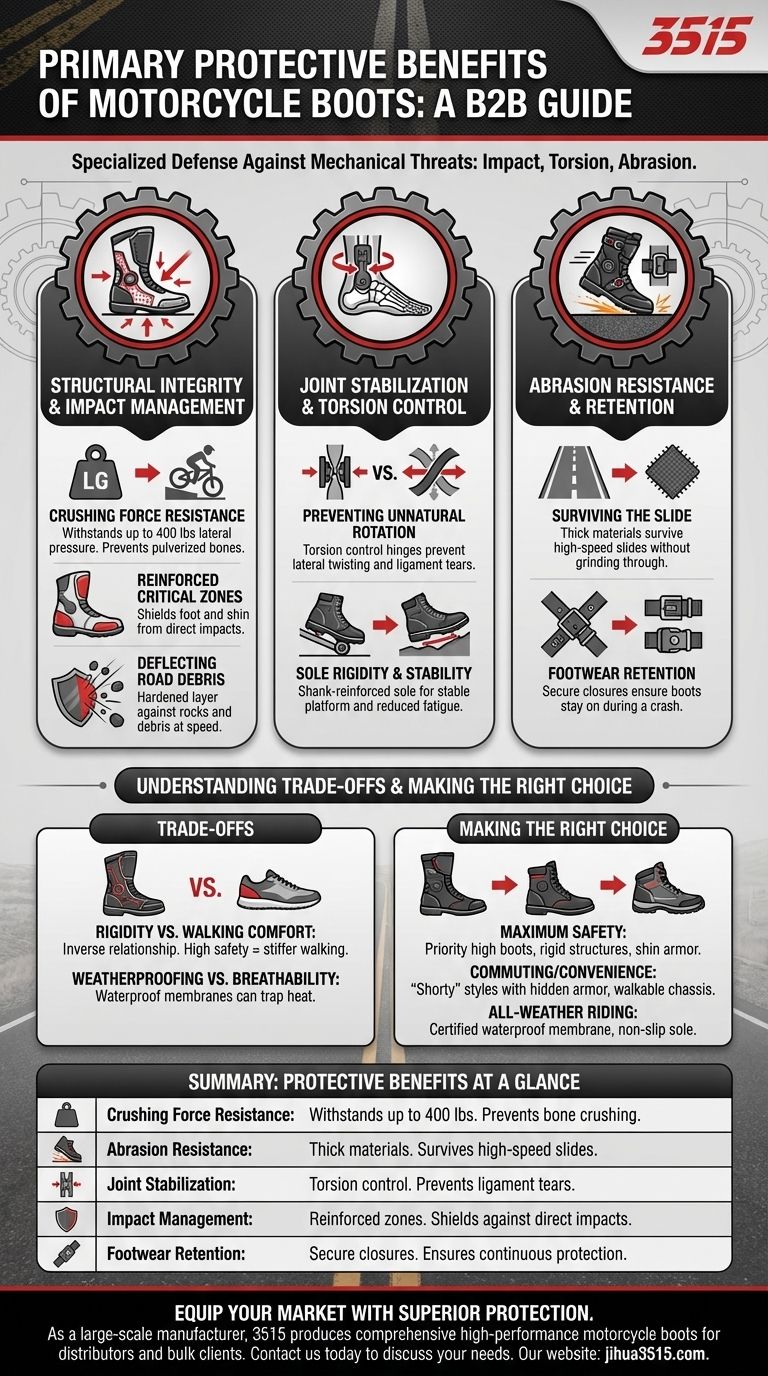
Visual Guide
Related Products
- Wholesale Tactical Boots High-Traction & Reflective for Bulk & Brand Orders
- High Performance Fire-Retardant Waterproof Safety Boots
- Durable Goodyear Welt Leather Work Boots for Wholesale & Private Label
- Wholesale High-Traction Camo Boots - Custom Manufacturer for Brands
- Heavy-Duty Waterproof Nubuck Safety Boots Safety Shoes for Bulk Supply
People Also Ask
- How do tactical boots protect against injuries? Discover the Integrated Safety System
- Are tactical boots suitable for hiking? Discover the Ultimate Footwear for Rugged Trails
- How does the extraction of sociodemographic factors via NLP influence the design of tactical boots and work shoes?
- Why is the management of Initial Inventory (II) critical in the production and supply of tactical boots?
- How is the compatibility of polymer materials demonstrated in smart footwear? Enhancing Tactical & Training Performance



















