
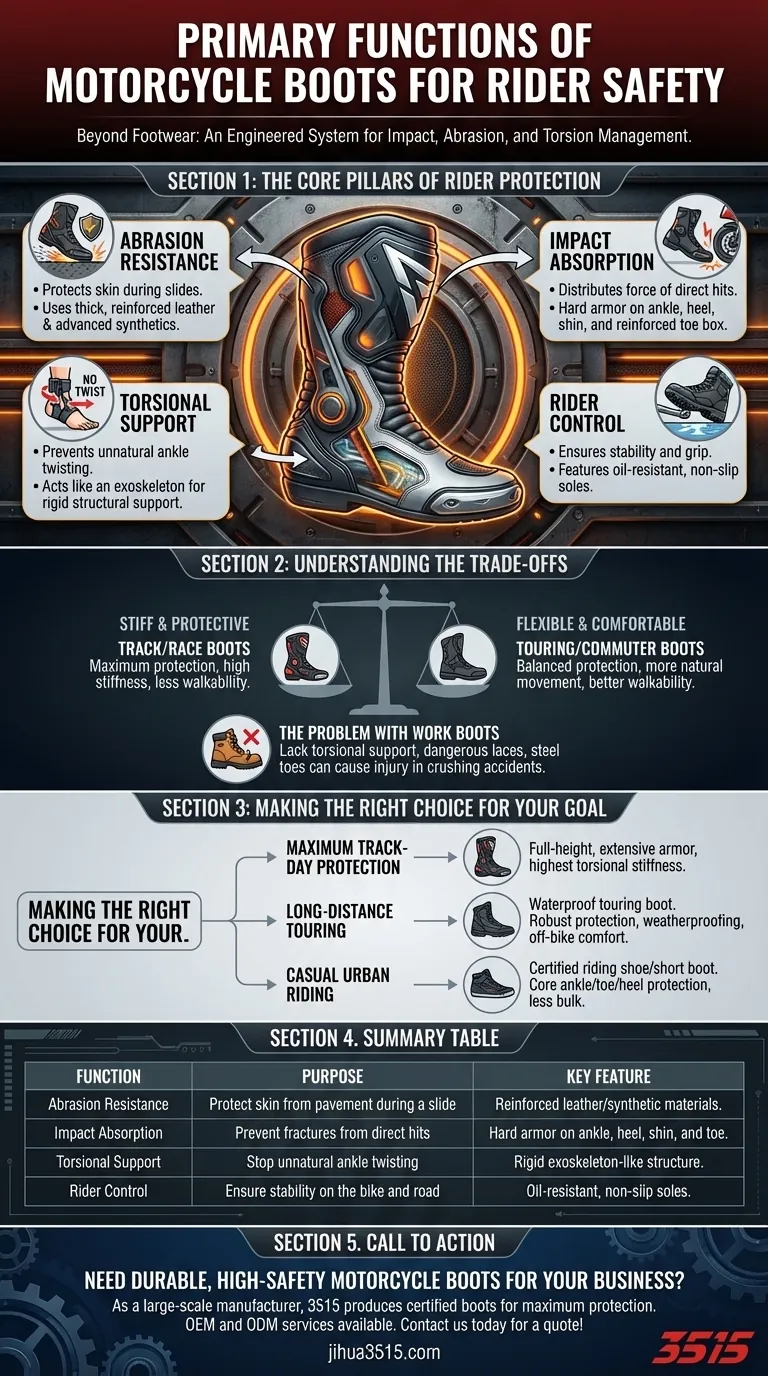
Beyond simple footwear, motorcycle boots are a highly specialized piece of safety equipment designed to manage the violent forces of a crash. Their primary functions are to provide impact absorption, abrasion resistance against pavement, and crucial structural support to prevent the ankle and foot from twisting unnaturally.
A standard boot protects you from the elements; a true motorcycle boot is an engineered system designed to protect your bones, ligaments, and skin from the three distinct threats of a motorcycle accident: impact, abrasion, and torsion.
The Core Pillars of Rider Protection
To understand the value of motorcycle-specific boots, it's essential to break down the specific jobs they are designed to perform during an incident.
Resisting Abrasive Forces
When a rider falls, especially at speed, they don't just stop. They slide.
Regular footwear, even leather work boots, can be shredded away in seconds by the friction of sliding on asphalt. Motorcycle boots use thick, reinforced leather and advanced synthetic materials to withstand this abrasion, protecting the skin underneath.
Absorbing and Distributing Impact
A crash often involves the foot or ankle striking the ground, the motorcycle, or another vehicle.
Motorcycle boots incorporate armor and reinforced structures in high-risk areas. Hard armor over the ankle, heel, and shin, along with reinforced toe boxes, helps absorb and distribute the force of a direct impact, preventing fractures.
Preventing Torsional Injuries
One of the most critical and unique functions of a motorcycle boot is providing torsional rigidity. This is the resistance to twisting.
During a fall, the rider's body can rotate while the foot is trapped, leading to severe ligament damage and complex bone fractures. A well-designed boot acts like an exoskeleton, preventing the ankle from rotating or bending in ways it was not meant to.
Ensuring Rider Control
Safety isn't just about crashing; it's also about prevention.
Motorcycle boots feature oil-resistant, non-slip soles that provide a secure grip on the footpegs during a ride and on the pavement when stopped. This stability is a key component of active safety that helps the rider maintain control.
Understanding the Trade-offs
Choosing the right boot involves balancing maximum protection with practical usability. No single boot is perfect for every situation.
Protection vs. Walkability
The most protective boots, like those used for racing, are extremely stiff to provide the best torsional support. This same stiffness makes them cumbersome and uncomfortable to walk in for any length of time.
Riders must consider how much time they will spend off the bike. Touring and commuter boots are designed to offer a compromise, providing substantial protection while allowing for more natural movement.
The Problem with Standard Work Boots
Many riders assume a sturdy pair of work boots will suffice. This is a dangerous misconception.
While they may resist some abrasion, they lack torsional support, have laces that can snag on controls, and often feature steel toes. In certain types of crushing accidents, a steel toe can bend and sever toes rather than protecting them.
Making the Right Choice for Your Goal
Your selection should be directly tied to your primary riding style and the level of risk you are willing to accept.
- If your primary focus is maximum track-day protection: Seek out full-height race boots with extensive external armor and the highest degree of torsional stiffness.
- If your primary focus is long-distance touring: Look for boots that balance robust protection with weatherproofing (like a waterproof membrane) and off-the-bike comfort.
- If your primary focus is casual urban riding: Consider certified riding shoes or short boots that offer core ankle, toe, and heel protection without the bulk of a full-height boot.
Investing in proper motorcycle footwear is a direct investment in your ability to control your machine and walk away from an accident.
Summary Table:
| Function | Purpose | Key Feature |
|---|---|---|
| Abrasion Resistance | Protect skin from pavement during a slide. | Reinforced leather/synthetic materials. |
| Impact Absorption | Prevent fractures from direct hits. | Hard armor on ankle, heel, shin, and toe. |
| Torsional Support | Stop unnatural ankle twisting. | Rigid exoskeleton-like structure. |
| Rider Control | Ensure stability on the bike and road. | Oil-resistant, non-slip soles. |
Need Durable, High-Safety Motorcycle Boots for Your Business?
As a large-scale manufacturer, 3515 produces a comprehensive range of certified motorcycle boots designed for maximum rider protection. We provide OEM and ODM services for distributors, brand owners, and bulk clients, ensuring your products meet the highest standards of abrasion resistance, impact absorption, and torsional support.
Contact us today to discuss your production needs and get a competitive quote!
Visual Guide
Related Products
- Wholesale Tactical Boots High-Traction & Reflective for Bulk & Brand Orders
- High Performance Fire-Retardant Waterproof Safety Boots
- Durable Goodyear Welt Leather Work Boots for Wholesale & Private Label
- Wholesale High-Traction Camo Boots - Custom Manufacturer for Brands
- Heavy-Duty Waterproof Nubuck Safety Boots Safety Shoes for Bulk Supply
People Also Ask
- How do tactical boots protect against injuries? Discover the Integrated Safety System
- What types of boots are used by Bravo in SEAL Team? Salomon & Merrell for Elite Performance
- What is the necessity of high-performance tactical boots in exoskeletons? Enhancing Load Efficiency and Safety
- What factors should be considered when choosing tactical boots for different terrains? Match Your Boot to the Mission.
- What materials are used in tactical boot uppers? A Guide to Durability & Performance



















