
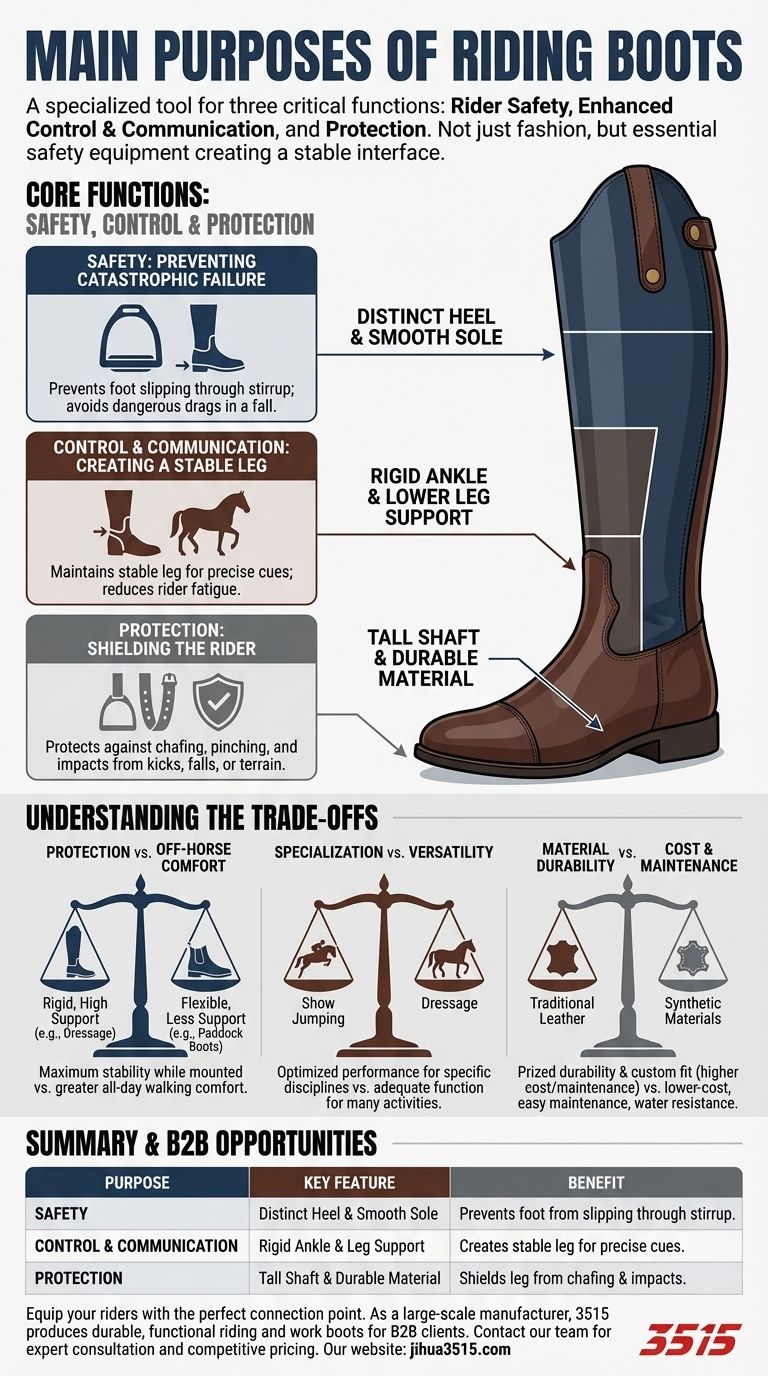
At its core, a riding boot is a specialized tool designed to provide three critical functions: rider safety, enhanced control and communication with the horse, and protection from the elements and equipment. Unlike standard footwear, every aspect of its design, from the distinct heel to the tall shaft, serves a specific purpose to make riding safer and more effective.
The fundamental purpose of a riding boot is not fashion, but function. It is a critical piece of safety equipment that creates a stable and secure interface between the rider's leg and the horse, preventing dangerous accidents while enabling clear communication.

The Core Functions: Safety and Control
A common misconception is that riding boots are primarily about a traditional look. While style is a component, the design is dictated by the non-negotiable demands of safety and performance in the saddle.
Preventing a Catastrophic Failure
The single most important safety feature of any riding boot is its distinct heel and smooth sole. The heel is designed to be deep enough to catch on the stirrup iron, preventing the rider's foot from accidentally slipping all the way through.
This prevents a rider from being dragged in the event of a fall, which is one of the most dangerous situations in equestrian sports.
Creating a Stable Leg for Clear Communication
A riding boot provides crucial support to the ankle and lower leg. This rigidity helps the rider maintain a correct and stable leg position.
A stable leg is the primary tool for communicating with the horse. The boot creates a consistent surface for applying subtle pressure and cues, translating the rider's intent into the horse's action with greater precision and reducing rider fatigue.
Protecting the Rider's Body
The tall shaft of a long riding boot serves a very practical purpose: it protects the rider's leg from chafing and pinching from the stirrup leathers.
Furthermore, the sturdy construction, often from durable leather, provides a layer of protection against impacts, whether from an accidental kick, a fall, or navigating rough terrain.
Understanding the Trade-offs
Choosing the right boot involves balancing competing needs. No single boot is perfect for every situation, and understanding the inherent compromises is key to making an informed decision.
Protection vs. Off-Horse Comfort
Highly supportive and rigid boots, like those used for dressage or military parades, offer maximum ankle stability and protection. However, this rigidity makes them stiff and often uncomfortable for extended walking.
Softer boots or ankle-high "paddock boots" offer greater flexibility and all-day comfort but provide less lower-leg support while mounted.
Specialization vs. Versatility
Boots are often specialized for a particular discipline. Show jumping boots may allow for more ankle flexion, while dressage boots are typically much stiffer to encourage a long, still leg position.
A general-purpose riding boot will function adequately for many activities but will not offer the optimized performance of a specialized design.
Material Durability vs. Cost and Maintenance
Traditional leather boots are prized for their durability, flexibility, and ability to mold to the rider's leg over time. They represent a significant investment and require regular care.
Synthetic materials offer a lower-cost, easier-to-maintain alternative and are often better for wet conditions, but they may not offer the same longevity or custom fit as high-quality leather.
Making the Right Choice for Your Goal
Your primary riding activity should dictate your choice of boot. Focus on the function you need most.
- If your primary focus is safety and casual riding: A pair of ankle-high paddock boots combined with half-chaps offers the essential heel for safety, good comfort for groundwork, and protection from chafing.
- If your primary focus is formal competition (dressage or show jumping): Invest in a pair of tall, long riding boots appropriate for your discipline to get the necessary leg support and traditional appearance.
- If your primary focus is all-weather trail riding or ranch work: Look for a durable, waterproof boot with a defined riding heel and a sole that provides more tread for stability on the ground.
Ultimately, view your riding boots as the essential connection point that ensures your safety and clarifies your command.
Summary Table:
| Purpose | Key Feature | Benefit |
|---|---|---|
| Safety | Distinct Heel & Smooth Sole | Prevents foot from slipping through stirrup, avoiding dangerous drags |
| Control & Communication | Rigid Ankle & Leg Support | Creates a stable leg for precise cues and reduces rider fatigue |
| Protection | Tall Shaft & Durable Material | Shields leg from chafing, pinching, and impacts |
Equip your riders with the perfect connection point. As a large-scale manufacturer, 3515 produces a comprehensive range of riding and work boots for distributors, brand owners, and bulk clients. Our production capabilities ensure durable, functional, and purpose-built footwear that prioritizes safety and performance. Let's discuss how we can meet your specific needs — contact our team today for expert consultation and competitive pricing.
Visual Guide
Related Products
- Premium Wholesale Tactical Style Safety Shoes Boots with Quick Lacing
- Wholesale High-Traction Camo Boots - Custom Manufacturer for Brands
- Durable Goodyear Welt Leather Work Boots for Wholesale & Private Label
- Wholesale Tactical Boots High-Traction & Reflective for Bulk & Brand Orders
- High-Traction Suede Tactical Boots Wholesale & Custom Manufacturing
People Also Ask
- How are gait analysis research findings applied to the functional design of safety shoes and tactical boots?
- How do quality certification standards for safety shoes reduce perceived risk? Buy Online with Technical Certainty
- Why is the synchronization of craftsmanship and UX development emphasized for bulk customization of safety shoes?
- How does anthropomorphic design influence material selection? Enhance Footwear Performance through Biological Alignment
- How can specialized footwear mitigate safety risks? High-Volume OEM/ODM Solutions since 1951



















