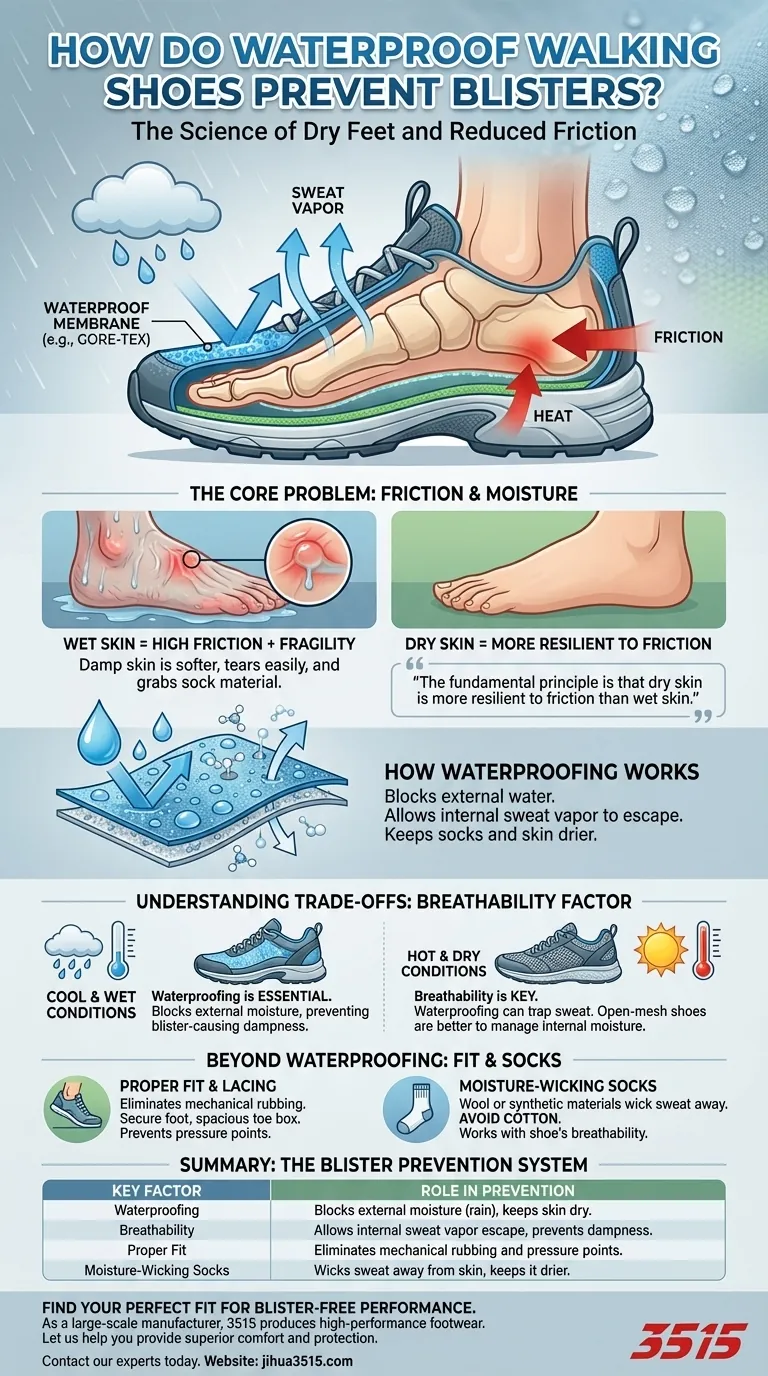
At their core, waterproof walking shoes prevent blisters by creating a dry internal environment for your foot. Blisters are caused by friction, and this friction is significantly increased when skin is damp. By blocking external water from rain, puddles, or wet grass, these shoes keep your socks and skin drier, drastically reducing the primary cause of blister formation.
The fundamental principle is that dry skin is more resilient to friction than wet skin. While waterproof shoes excel at blocking external moisture, true blister prevention requires a holistic approach that also considers breathability for internal sweat and a precise fit to eliminate mechanical rubbing.
The Core Problem: Friction and Moisture
How Blisters Form
A blister is your body's defense mechanism against friction. When a specific spot on your foot repeatedly rubs against your sock or shoe, the outer layer of skin separates from the inner layers. The body then fills this gap with fluid to cushion the underlying tissue, creating the painful bubble we know as a blister.
The Role of Moisture
Moisture is the single greatest accelerator of this process. Damp skin is much softer and more fragile than dry skin. It also has a higher coefficient of friction, meaning it "grabs" onto the sock material more readily, exacerbating the rubbing and shearing forces that cause blisters.
How Waterproofing Directly Addresses This
The Waterproof, Breathable Membrane
Modern waterproof shoes typically use an internal membrane, or "bootie," made of a material like GORE-TEX. This membrane contains billions of microscopic pores that are too small for liquid water droplets to pass through, but large enough for water vapor (sweat) to escape.
Maintaining a Drier Foot
By blocking external water, this membrane is your first line of defense against the moisture that weakens skin. Keeping your socks and feet dry is the most effective step in maintaining low friction between your skin and your footwear, allowing you to walk comfortably for longer distances in wet conditions.
Understanding the Trade-offs: The Breathability Factor
The Two-Way Moisture Problem
Moisture doesn't just come from the outside; your feet produce a significant amount of sweat. An effective shoe must manage moisture from both directions.
The Limits of "Breathability"
While waterproof membranes are designed to be breathable, they can never be as breathable as a shoe without a membrane, such as a trail runner with a mesh upper. The process of moving water vapor out of the shoe is slower than the ventilation provided by an open-weave fabric.
When Waterproofing Can Backfire
In hot, dry conditions, a waterproof shoe can become a liability. If you are sweating faster than the membrane can vent the moisture, the inside of your shoe will become damp from your own sweat. This creates the exact high-friction environment you were trying to avoid, potentially causing blisters even on a sunny day.
Beyond Waterproofing: The Critical Importance of Fit
Reducing Mechanical Friction
Even with perfect moisture management, a poorly fitting shoe will cause blisters. If your heel lifts with every step or your toes jam into the front of the shoe, you are creating intense, localized friction points. A proper fit ensures your foot is secure without being constricted.
Accommodating Foot Swell
Over the course of a long walk, your feet will naturally swell. A shoe with a supportive foundation and a sufficiently spacious toe box accommodates this swelling. This prevents the shoe from becoming too tight midway through your hike, which would create new, painful pressure points.
The Essential Role of Socks
Never underestimate your socks. The best shoes can be defeated by poor socks. Cotton socks should be avoided as they absorb moisture and hold it against your skin. Instead, choose socks made from wool or synthetic materials that wick sweat away from your skin, working in tandem with your shoe's breathability features.
Making the Right Choice for Your Conditions
Choosing the right shoe is about matching its features to your most common environment.
- If your primary focus is hiking in consistently wet and cool conditions: A waterproof shoe is your best defense against blisters caused by external moisture.
- If your primary focus is hiking in hot, dry, or arid climates: A highly breathable, non-waterproof shoe will likely prevent more blisters by managing sweat more effectively.
- If your primary focus is all-around performance in mixed conditions: A waterproof shoe is a versatile choice, but pay close attention to sock selection to help manage internal moisture.
- If you experience blisters regardless of the weather: Your primary issue is almost certainly shoe fit, lacing technique, or improper socks, not waterproofing.
Understanding the interplay of moisture, breathability, and fit is the key to ensuring every walk is a comfortable one.
Summary Table:
| Key Factor | Role in Blister Prevention |
|---|---|
| Waterproofing | Blocks external moisture (rain, puddles) to keep skin dry and reduce friction. |
| Breathability | Allows internal sweat vapor to escape, preventing a damp environment. |
| Proper Fit | Eliminates mechanical rubbing and pressure points on the foot. |
| Moisture-Wicking Socks | Works with the shoe to pull sweat away from the skin, keeping it drier. |
Find Your Perfect Fit for Blister-Free Performance
As a large-scale manufacturer, 3515 produces a comprehensive range of high-performance footwear for distributors, brand owners, and bulk clients. Our production capabilities encompass all types of waterproof and breathable walking shoes and boots, designed with the precise engineering needed to manage moisture and ensure a perfect fit.
Let us help you provide your customers with superior comfort and protection.
Contact our experts today to discuss your footwear needs and discover how our manufacturing solutions can enhance your product line.
Visual Guide
Related Products
- Wholesale Premium Waterproof Nubuck Safety Shoes Boots
- Heavy-Duty Waterproof Nubuck Safety Boots Safety Shoes for Bulk Supply
- Durable Waterproof Rain Boots | Custom Manufacturer for Wholesale & Brands
- Wholesale Waterproof Tactical Boots Custom Suede & High-Traction Soles
- Premium Wholesale Waterproof Safety Boots High Performance Protection for Industrial Markets
People Also Ask
- Why are waterproof safety boots recommended for certain work environments? Essential Protection for Wet & Hazardous Jobs
- What materials are commonly used in waterproof boots? The Complete Guide to Durable, Breathable Protection
- What are the drawbacks of waterproof boots? The Breathability vs. Protection Trade-Off
- What is the advantage of one-piece construction in waterproof boots? Unbeatable Seamless Protection
- What is the difference between waterproof, water-resistant, and water-repellent boots? Choose the Right Protection for Your Feet