
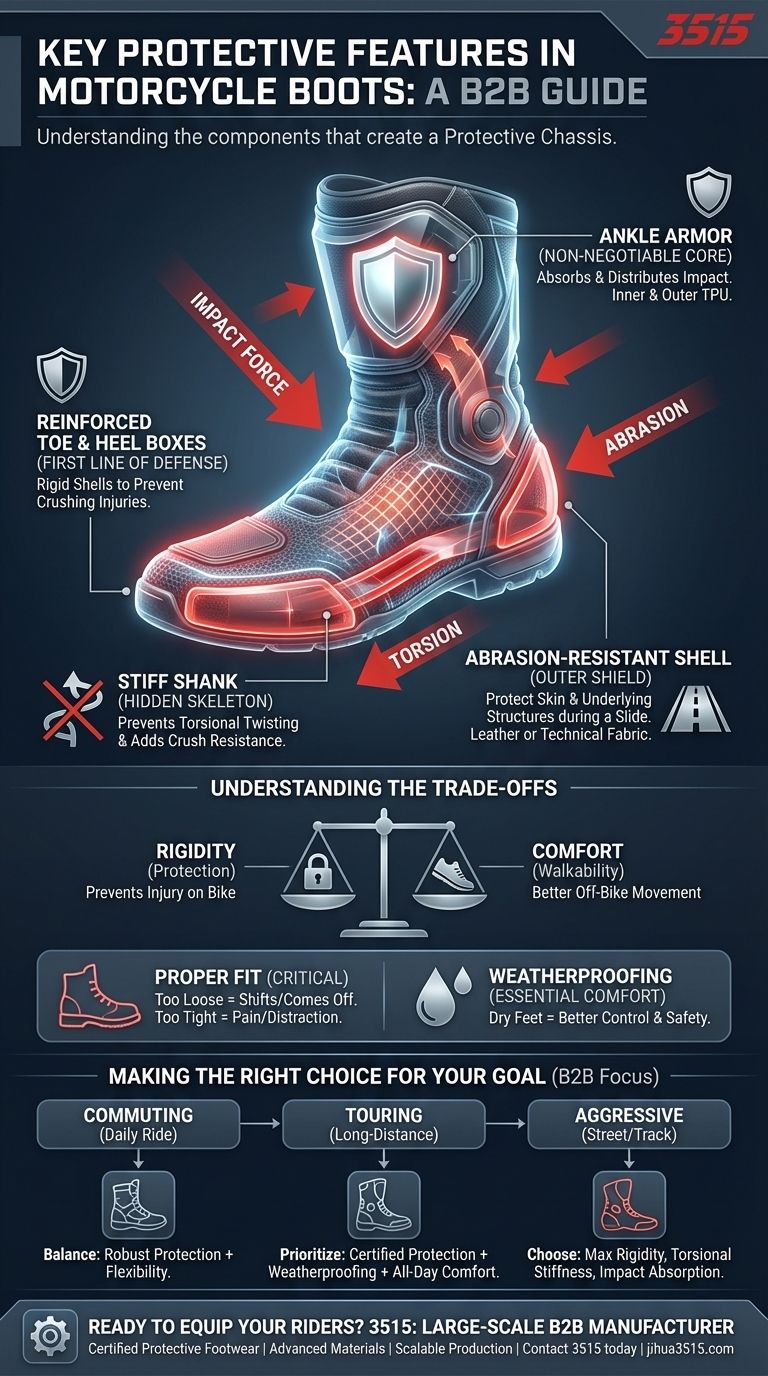
The most critical protective features in any motorcycle boot are robust ankle armor, reinforced toe and heel boxes, and a stiff, anti-twist sole. These components work together to shield your feet and ankles from the three primary forces in a crash: impact, abrasion, and torsion.
A true motorcycle boot is not just footwear; it is a piece of technical safety equipment. Its primary job is to create a protective chassis around your foot that resists crushing, twisting, and impact forces that a standard shoe or boot simply cannot withstand.
The Anatomy of Protection: Beyond a Simple Boot
To make an informed decision, you need to understand how each protective element functions. Think of a boot not as a single item, but as an integrated safety system.
Ankle Armor: The Non-Negotiable Core
Your ankle is a complex joint with limited natural protection, making it highly vulnerable in a crash.
Quality motorcycle boots incorporate armor on both the inner and outer sides of the ankle. This is often made of hardened TPU (thermoplastic polyurethane) and is designed to absorb and distribute the force of a direct impact.
Toe and Heel Reinforcement: Your First Line of Defense
Your foot can easily be crushed between the motorcycle and the road or another object.
To prevent this, boots feature reinforced "boxes" in the toe and heel areas. These internal structures create a rigid shell that maintains its shape under heavy impact or crushing weight, protecting the delicate bones within.
The Shank: The Boot's Hidden Skeleton
The sole of the boot is just as important as its upper. A key feature hidden within it is the shank.
This is a strip of rigid material, often steel or composite, embedded in the sole. It serves two vital purposes: it prevents the sole from twisting torsionally, protecting your foot from being bent at unnatural angles, and it adds crush resistance if the bike lands on your foot.
Abrasion Resistance: The Outer Shell
During a slide, your gear is the only thing between you and the pavement.
The boot's outer material, whether it's full-grain leather or advanced technical fabric, must be highly resistant to abrasion. This outer shell protects the inner armor and, most importantly, your skin.
Understanding the Trade-offs
Choosing the right boot involves balancing maximum protection with real-world usability. Understanding the compromises is key to finding the right pair for you.
The Rigidity Dilemma
The most protective boots are often the most rigid. This is excellent for preventing injury on the bike but can make walking uncomfortable.
You must decide where you sit on the spectrum. A track boot offers maximum rigidity, while a touring or commuter boot might trade a small amount of stiffness for better off-bike comfort.
The Importance of Proper Fit
A protective feature is useless if the boot doesn't fit correctly.
A boot that is too loose can shift or even come off entirely during a crash, rendering its armor useless. A boot that is too tight creates painful pressure points, becoming a dangerous distraction while riding.
Weatherproofing and Comfort
Riding with cold, wet feet is not just uncomfortable; it's a safety issue.
Distraction and numbness reduce your ability to operate the controls effectively. Look for boots with a quality waterproof and breathable membrane if you plan to ride in varied conditions.
Making the Right Choice for Your Goal
Assess your primary type of riding to determine the right balance of features for your specific needs.
- If your primary focus is daily commuting: Look for a certified boot that balances robust ankle, heel, and toe protection with enough flexibility for short walks.
- If your primary focus is long-distance touring: Prioritize certified protection combined with excellent weatherproofing and proven all-day comfort.
- If your primary focus is aggressive street or track riding: Choose the most rigid, highly armored boot possible, prioritizing torsional stiffness and impact absorption above all else.
Ultimately, the best boot is the one you will wear on every single ride, so choose the most protective option that fits both your foot and your riding style.
Summary Table:
| Key Feature | Purpose | Importance |
|---|---|---|
| Ankle Armor | Absorbs and distributes impact force on the ankle joint. | Non-negotiable; protects a highly vulnerable area. |
| Reinforced Toe/Heel | Creates a rigid shell to prevent crushing injuries. | First line of defense against impact with objects. |
| Stiff Shank (in sole) | Prevents torsional twisting and adds crush resistance. | Protects foot from unnatural bending; the boot's skeleton. |
| Abrasion-Resistant Shell | Shields the foot and armor during a slide on pavement. | Essential for protecting skin and underlying structures. |
Ready to Equip Your Riders with Superior Protection?
As a large-scale manufacturer, 3515 produces a comprehensive range of certified protective footwear for distributors, brand owners, and bulk clients. Our production capabilities encompass all types of motorcycle boots and technical riding gear, engineered with the critical safety features outlined above.
We combine advanced materials, rigorous testing, and scalable manufacturing to deliver the safety and quality your customers demand.
Contact 3515 today to discuss your production needs and bring high-performance, reliable motorcycle boots to your market.
Visual Guide
Related Products
- Wholesale Tactical Boots High-Traction & Reflective for Bulk & Brand Orders
- High Performance Fire-Retardant Waterproof Safety Boots
- Durable Goodyear Welt Leather Work Boots for Wholesale & Private Label
- Wholesale High-Traction Camo Boots - Custom Manufacturer for Brands
- Heavy-Duty Waterproof Nubuck Safety Boots Safety Shoes for Bulk Supply
People Also Ask
- How do tactical boots protect against injuries? Discover the Integrated Safety System
- Importance of Professional Tactical Boots in Loess Gully Regions: Ensure Safety and Precision for Field Monitoring
- What is the role of high-frequency acquisition hardware in technical skill analysis for outdoor and tactical boots?
- What role do heavy-duty footwear play in identity expression? Subvert Aesthetic Norms with Tactical & Industrial Style
- What factors should be considered when choosing tactical boots for different terrains? Match Your Boot to the Mission.



















