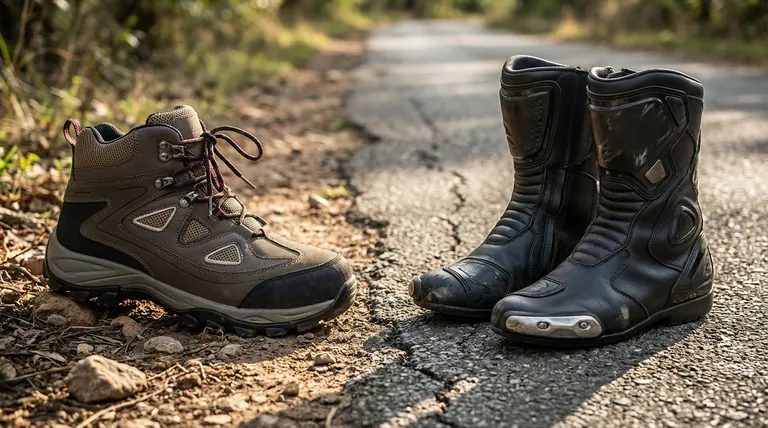
The fundamental difference is their core purpose. Motorcycle boots are purpose-built safety equipment designed to protect against high-energy impacts, abrasion, and crushing forces common in a vehicle crash. Hiking boots are tools designed to provide grip, support, and flexibility for walking over uneven natural terrain. While both are durable, they are engineered to handle entirely different types of stress.
Hiking boots are designed to allow your foot and ankle to flex naturally while walking. Motorcycle boots are designed to prevent your foot and ankle from flexing in unnatural, injury-causing ways during a crash.
The Anatomy of Motorcycle-Specific Protection
To understand why purpose-built gear is critical, we must look at the specific hazards of riding a motorcycle. The boot is not just footwear; it is a piece of armor engineered for a very specific environment.
Torsional Rigidity and Impact Armor
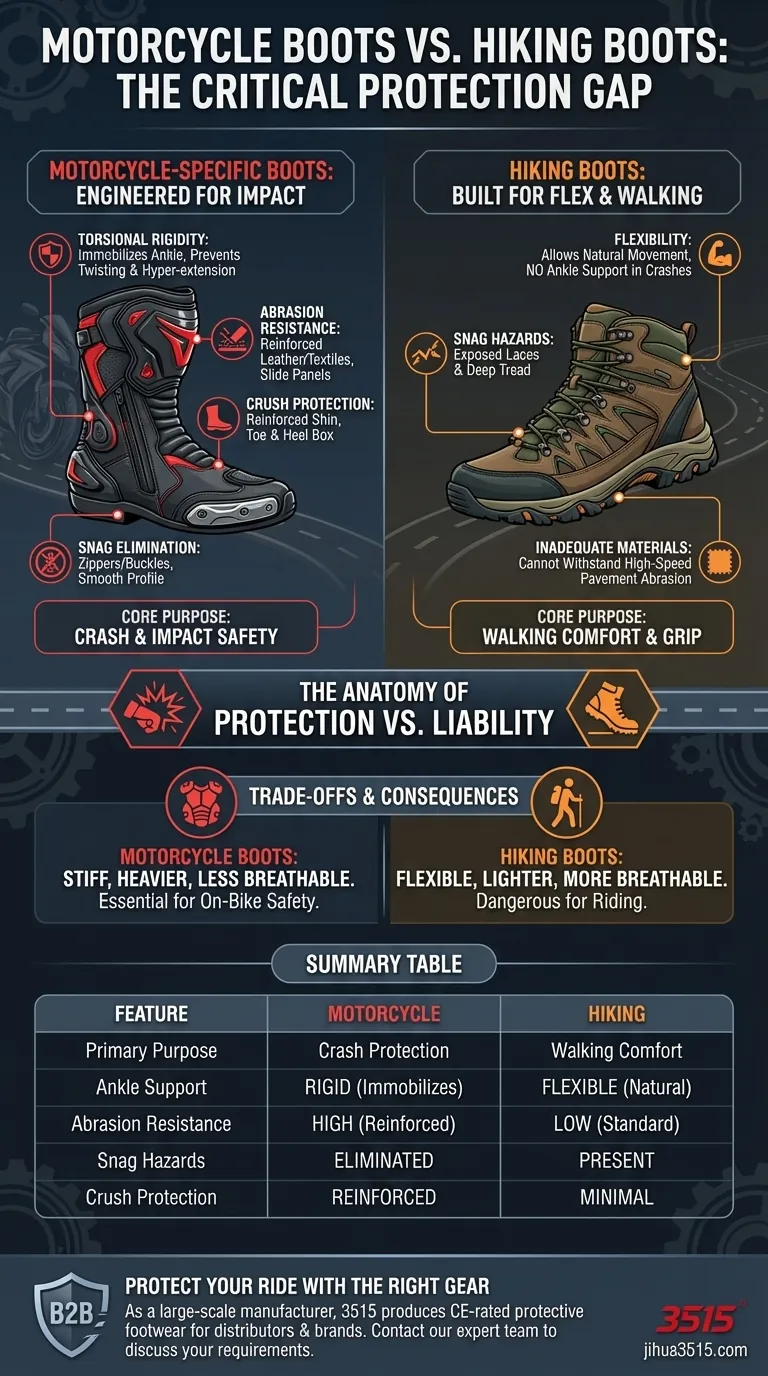
A primary function of a motorcycle boot is to prevent the ankle from twisting, hyper-extending, or being crushed. This is achieved through torsional rigidity.
The boot incorporates a stiff structure, often with hard shells and reinforced bindings around the ankle joint. This system is designed to immobilize the ankle, protecting it from the immense twisting forces that occur when the bike falls or during a tumbling crash.
Abrasion and Slide Resistance
Sliding on asphalt is a common crash scenario. Pavement acts like a high-speed belt sander, and materials not designed for it will disintegrate in seconds.
Motorcycle boots use panels of highly abrasion-resistant material, such as reinforced leather or advanced textiles. They also feature reinforced stitching and often include hard plastic or metal sliders on key impact points to help the boot slide rather than catch and tear.
Shin and Crush Protection
Motorcycle boots typically extend up the leg and include a reinforced shin guard. This complements the armor in riding pants and protects against impacts from road debris or the motorcycle itself.
The entire structure of the boot, especially in the toe and heel box, is heavily reinforced to prevent it from collapsing under the weight of a motorcycle, a critical feature hiking boots lack.
Eliminating Snag Hazards
A boot that gets caught on a motorcycle's footpeg, shifter, or brake pedal can cause a crash, especially at a stop.
For this reason, proper motorcycle boots do not have exposed laces. They use zippers, buckles, or hook-and-loop systems that create a smooth, snag-free exterior profile. Their soles are also designed with a tread that provides grip on pegs and pavement without being so aggressive that it could get caught.
Why Hiking Boots Fall Short in a Crash
Using a hiking boot for motorcycle riding addresses the need for footwear but fails to address the need for protection. Their design features actually introduce specific risks.
Built for Flex, Not Impact
The flexibility that makes a hiking boot comfortable for walking is a significant liability in a crash. It offers no resistance to the ankle-breaking twists and hyper-extensions that moto boots are built to prevent.
The ankle support in a hiking boot is meant to prevent a minor sprain on a trail, not the catastrophic failure of bones and ligaments from a high-energy impact.
The Danger of Laces and Aggressive Tread
The long, exposed laces on nearly all hiking boots are a severe snagging hazard. They can easily get wrapped around a foot control, preventing you from putting your foot down or causing you to lose control.
Furthermore, the deep, aggressive tread designed for gripping dirt and mud can easily get caught on the serrated metal of a motorcycle's footpegs, with similar dangerous results.
Inadequate Materials
The leather and fabric used on hiking boots, while durable for their intended use, cannot withstand high-speed abrasion on pavement. They will be ground away quickly, exposing your foot to severe injury. They also lack any armor to distribute the force from a direct impact.
Understanding the Trade-offs
Choosing the right boot means acknowledging that safety and convenience are often in opposition. The features that make a motorcycle boot protective are the same ones that make it less practical for other activities.
Comfort and Walkability
Motorcycle boots are stiff by design. This rigidity, essential for on-bike protection, makes them cumbersome and often uncomfortable for walking any significant distance. You are trading off-bike comfort for on-bike safety.
Weight and Breathability
The armor, reinforcement, and heavy-duty materials add significant weight and reduce airflow. A dedicated riding boot will almost always be heavier and warmer than a hiking boot, which is designed with breathability in mind.
Cost vs. Consequence
Specialized, CE-rated motorcycle boots are an investment. It can be tempting to use existing hiking boots to save money, but this choice outsources the cost from your wallet to your personal safety, risking injuries that are physically and financially devastating.
How to Apply This to Your Ride
Your choice of footwear should directly correspond to the level of risk you are accepting.
- If your primary focus is maximum safety on the street, track, or trail: You must wear CE-rated motorcycle-specific boots that feature ankle armor, torsional stiffness, and shin protection.
- If your primary focus is commuting or casual riding: At a minimum, choose over-the-ankle riding shoes or boots that cover the ankle, have no exposed laces, and include reinforced toe/heel boxes and ankle pucks.
- If you are considering using hiking boots: Understand that you are choosing footwear with virtually no protection against common motorcycle crash injuries and are introducing specific risks like snagging.
Ultimately, choosing your gear means choosing what you are protecting, and proper equipment is the most reliable defense you have.
Summary Table:
| Feature | Motorcycle Boots | Hiking Boots |
|---|---|---|
| Primary Purpose | Crash & Impact Protection | Walking Comfort & Grip |
| Ankle Support | Rigid, Immobilizes to Prevent Injury | Flexible, Allows Natural Movement |
| Abrasion Resistance | High (Reinforced Leather/Textiles) | Low (Standard Materials) |
| Snag Hazards | Eliminated (No Laces) | Present (Exposed Laces) |
| Crush Protection | Reinforced Toe/Heel/Shin | Minimal |
Protect Your Ride with the Right Gear
As a large-scale manufacturer, 3515 produces a comprehensive range of CE-rated protective footwear for distributors, brand owners, and bulk clients. Our production capabilities encompass all types of motorcycle boots and shoes, engineered with the critical safety features detailed above.
Ready to equip your customers with superior protection? Contact our expert team today to discuss your requirements and discover how 3515 can be your trusted manufacturing partner for high-quality, safety-focused footwear.
Visual Guide
Related Products
- High Performance Fire-Retardant Waterproof Safety Boots
- Wholesale Tactical Boots High-Traction & Reflective for Bulk & Brand Orders
- Premium High-Cut Waterproof Safety Boots Manufacturing & Wholesale Solutions
- Durable Goodyear Welt Leather Work Boots for Wholesale & Private Label
- Wholesale High-Traction Camo Boots - Custom Manufacturer for Brands
People Also Ask
- Why are waterproof safety boots recommended for certain work environments? Essential Protection for Wet & Hazardous Jobs
- What roles do 3D vision systems and industrial robots play in the manufacturing of fire safety boots? Smart Automation
- What is the advantage of one-piece construction in waterproof boots? Unbeatable Seamless Protection
- What is the difference between waterproof, water-resistant, and water-repellent boots? Choose the Right Protection for Your Feet
- What is a drawback of waterproof boots? The Hidden Cost of Trapped Sweat and Heat