
Beyond simple footwear, a true motorcycle boot is a highly specialized piece of safety equipment. Every proper riding boot, regardless of style, must provide three non-negotiable features: significant torsional stiffness to prevent unnatural twisting of your foot, molded armor to protect the vulnerable bones of the ankle, and a durable, oil-resistant sole to ensure stable footing on compromised road surfaces.
The core function of a motorcycle boot is not just to cover your foot, but to protect it from the three primary forces in a crash: impact, abrasion, and torsion. Evaluating a boot on its ability to manage these three threats is the key to making an informed safety decision.
The Three Pillars of Motorcycle Boot Protection
To understand what makes a boot effective, you need to think beyond a simple feature list. A boot's most critical job is to shield you from the specific dangers of a motorcycle accident.
Torsional Stiffness: Preventing Unnatural Twists
This is the single most important feature that separates a real motorcycle boot from a standard work boot. Torsional stiffness is the boot's resistance to twisting along its length.
During a fall, your foot can be trapped or twisted with incredible force. A quality boot acts like an external skeleton, preventing your ankle and foot from flexing or rotating in ways that would cause severe ligament damage or broken bones.
Impact Absorption: Shielding Vulnerable Bones
Your ankles, heels, and toes are highly susceptible to being crushed or shattered by direct impact with the pavement or the motorcycle itself.
Effective boots incorporate molded armor or reinforced padding directly over the ankle bones. Many also include a reinforced heel cup and a protective toe box, often built to a specific safety standard (such as a 200-joule rating) to withstand heavy crushing forces.
Abrasion Resistance: Surviving the Slide
Sliding across asphalt, even at low speeds, can grind through standard materials in seconds. The boot's outer construction is your only defense against this severe abrasion.
Full-grain leather is the benchmark material for its exceptional durability and resistance to tearing. Key stress points, like the inner ankle and gear-shift area, should have double layers or additional reinforcement.
Hallmarks of a Durable, Long-Lasting Boot
A boot's protective features are only as good as its construction. A boot that falls apart during a crash offers no protection at all.
The Sole's Foundation: Stitching vs. Gluing
The method used to attach the sole is a primary indicator of quality. Stitched-down soles, particularly with a Goodyear Welt, are far superior to glued soles.
Stitching creates a mechanical bond that is incredibly strong and has the added benefit of allowing the boot to be resoled, dramatically extending its usable life.
Material Integrity: Full-Grain Leather and Quality Hardware
Look for boots constructed primarily from leather, as it lasts significantly longer than most synthetic alternatives.
Pay attention to the small details. Buckles, eyelets, and zippers should be made of non-tarnishable metals like brass or nickel to resist rust and failure over time.
Grip and Stability: Oil-Resistant Soles
A motorcycle rider constantly encounters slick surfaces, from oil and coolant at intersections to diesel fuel at filling stations.
An oil-resistant sole is essential for maintaining grip and preventing a slip that could lead to a stationary drop or a loss of control. High-quality boots may also carry official slip-resistance ratings (SRA, SRB, or SRC), which verify their performance on slick surfaces.
Understanding the Trade-offs
No single boot is perfect for every situation. Choosing the right one means understanding the inherent compromises between protection, comfort, and features.
Protection vs. Comfort
There is almost always a direct trade-off between maximum protection and off-bike comfort. A full-height race boot offers incredible stiffness and armor but is rigid and awkward to walk in. A shorter, more casual boot is comfortable but offers less protection for your shin and calf.
Weatherproofing and Breathability
A boot with a waterproof membrane is excellent for touring or commuting in wet climates. However, that same membrane will trap heat and reduce breathability, making it less comfortable for riding in hot, dry weather.
Specialized Protections
Features like midsole penetration resistance (to protect from punctures from below) or thermal insulation are critical for adventure and cold-weather riders, respectively. However, they add weight, cost, and stiffness that are unnecessary for a casual street rider.
Making the Right Choice for Your Riding Style
Ultimately, the best boot is the one that matches your specific needs while providing the core, non-negotiable safety features.
- If your primary focus is daily commuting or casual riding: Prioritize a boot with certified ankle protection and torsional stiffness that still offers reasonable off-bike walking comfort.
- If your primary focus is long-distance touring: Look for robust, stitched-sole construction for longevity, along with features like waterproofing and all-day support.
- If your primary focus is high-performance sport or track riding: Maximum torsional rigidity, extensive armor over the shin and ankle, and replaceable toe sliders are non-negotiable.
Investing in a boot that correctly addresses impact, abrasion, and torsion is one of the most important safety decisions a rider can make.
Summary Table:
| Key Feature | Primary Function | What to Look For |
|---|---|---|
| Torsional Stiffness | Prevents unnatural twisting of the foot and ankle | Rigid construction that resists twisting along the boot's length |
| Impact Absorption | Protects vulnerable ankle, heel, and toe bones | Molded armor over ankle bones, reinforced heel cup and toe box |
| Abrasion Resistance | Survives sliding on pavement | Full-grain leather construction, double layers on stress points |
| Durable Construction | Ensures the boot lasts and protects over time | Stitched-down soles (e.g., Goodyear Welt), quality hardware |
| Secure Grip | Prevents slips on slick surfaces | Oil-resistant sole, official slip-resistance ratings (SRA/SRB/SRC) |
Ready to Equip Yourself with the Right Protection?
As a large-scale manufacturer, 3515 produces a comprehensive range of high-quality motorcycle boots designed for distributors, brand owners, and bulk clients. Our production capabilities encompass all types of riding footwear, from durable touring boots to high-performance race models, all built with the essential safety features detailed above.
We can help you provide your customers with boots that offer:
- Superior Safety: Built-in torsional stiffness, impact armor, and abrasion resistance.
- Proven Durability: Utilizing stitched construction and premium materials for long-lasting performance.
- Trusted Grip: Featuring oil-resistant soles for stability on any road surface.
Let's discuss your specific needs and how we can support your business.
Contact us today for OEM/ODM inquiries, bulk pricing, and to learn more about our full catalog.
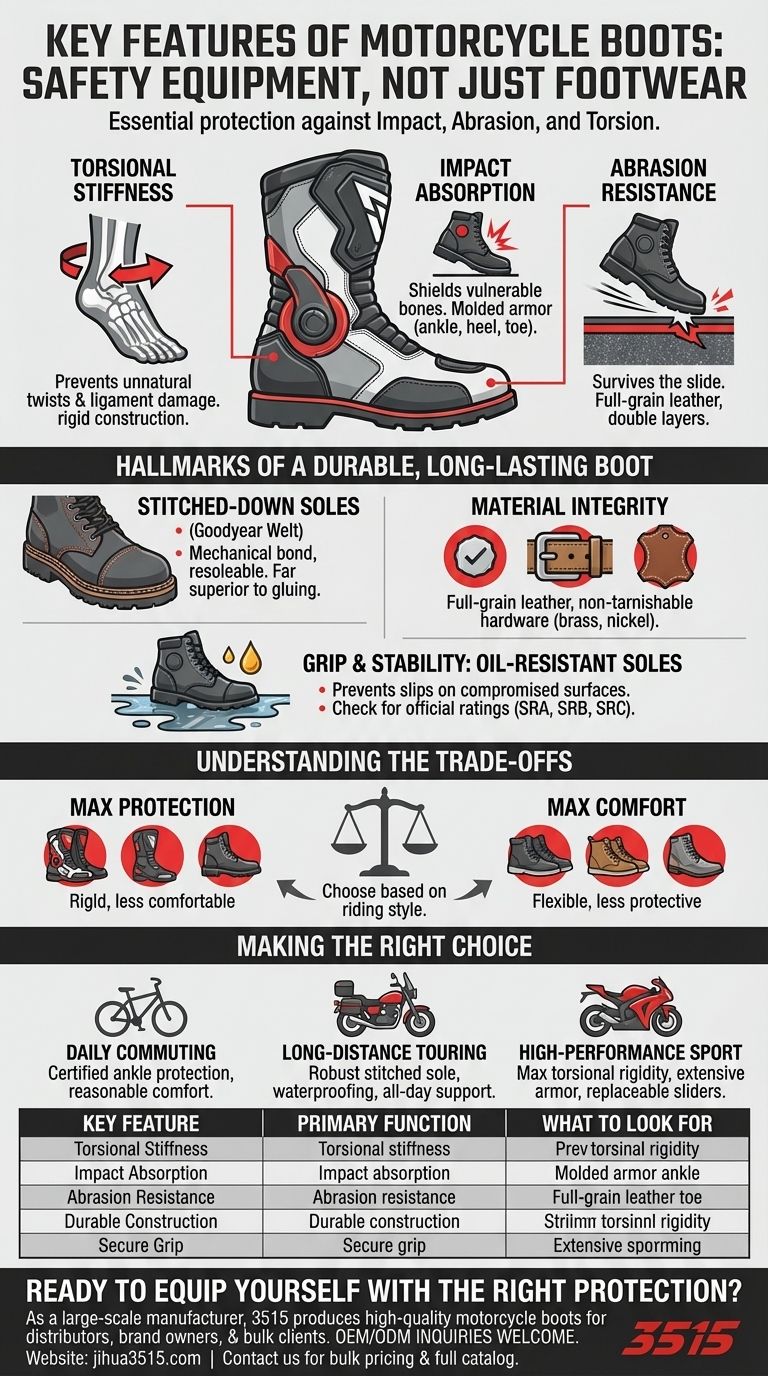
Visual Guide
Related Products
- Wholesale Tactical Boots High-Traction & Reflective for Bulk & Brand Orders
- High Performance Fire-Retardant Waterproof Safety Boots
- Durable Goodyear Welt Leather Work Boots for Wholesale & Private Label
- Wholesale High-Traction Camo Boots - Custom Manufacturer for Brands
- Heavy-Duty Waterproof Nubuck Safety Boots Safety Shoes for Bulk Supply
People Also Ask
- How do tactical boots protect against injuries? Discover the Integrated Safety System
- What makes the traction of tactical boots superior? Unlock the Science of Unbeatable Grip
- What are the important features of tactical boots for military operators? A Guide to Mission-Critical Footwear
- What role does repairable design play in tactical boots? Extend Lifespan & Cut Total Ownership Costs
- What factors should be considered when choosing between tactical boots and sneakers for daily activities? Find Your Perfect Fit



















