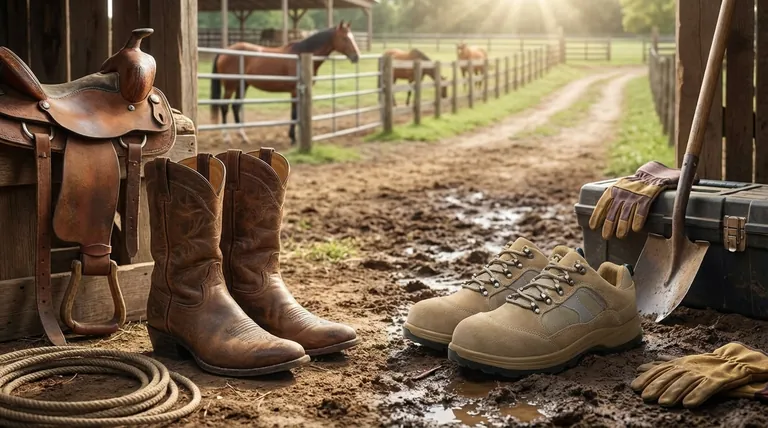
At their core, the difference between traditional cowboy boots and Western-style work boots is their intended environment. Traditional boots are specialized tools for horseback riding, featuring smooth leather soles and angled heels for the stirrup, while Western work boots are built for stability on the ground, with treaded rubber soles and short, wide heels for walking and labor.
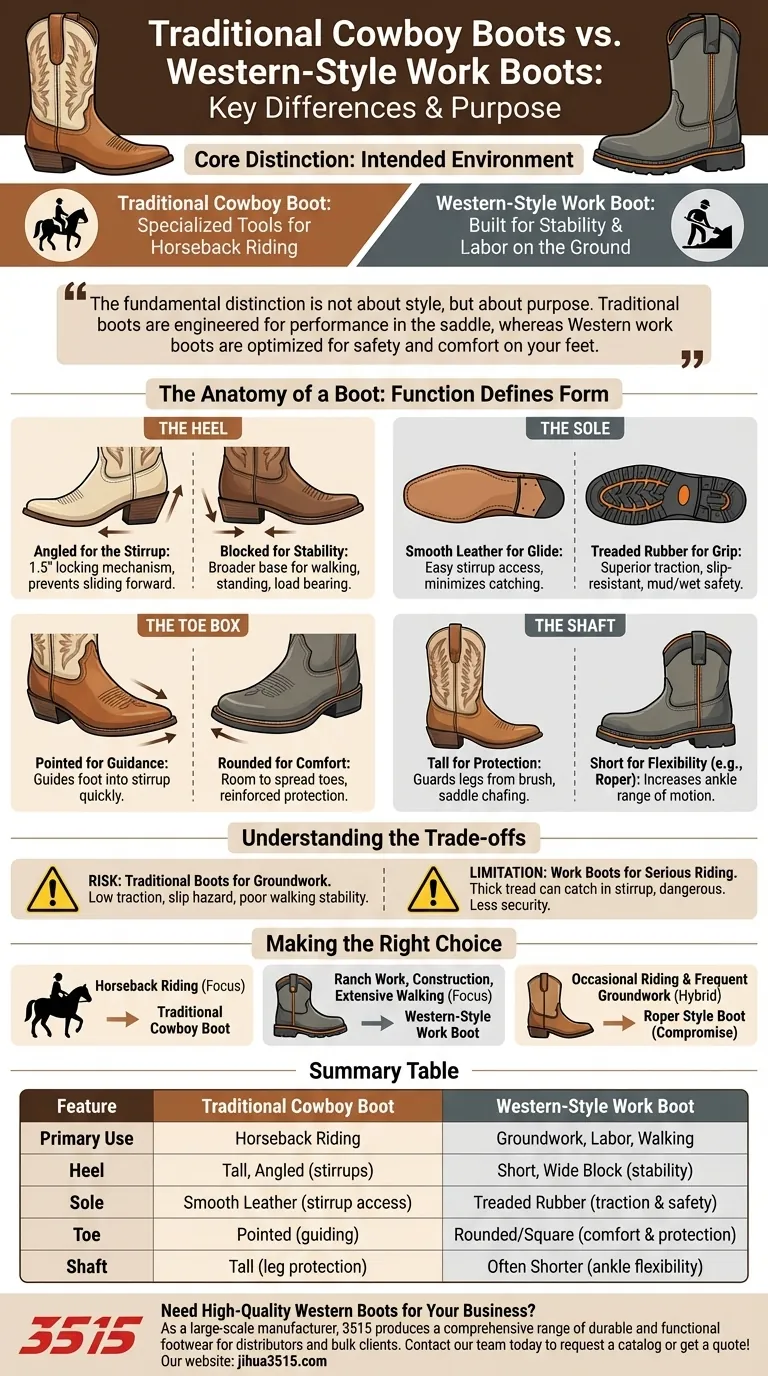
The fundamental distinction is not about style, but about purpose. Traditional boots are engineered for performance in the saddle, whereas Western work boots are optimized for safety and comfort on your feet.
The Anatomy of a Boot: Function Defines Form
To truly understand which boot is right for you, we must look at how the design of each component serves a specific, distinct purpose. The differences are not arbitrary; they are the result of function dictating form.
The Heel: Angled for the Stirrup vs. Blocked for Stability
A traditional cowboy boot features a taller, angled heel, typically around 1.5 inches. This design is intentional; it acts as a locking mechanism, preventing the rider's foot from sliding too far forward through the stirrup, which is a critical safety feature.
In contrast, a Western work boot has a shorter, wider block heel. This lower, broader base provides a much more stable platform for walking on uneven terrain, standing for long hours, and carrying heavy loads, reducing the risk of a turned ankle.
The Sole: Smooth Leather for Glide vs. Treaded Rubber for Grip
The sole is perhaps the most critical functional difference. Traditional boots have a smooth leather outsole. This is essential for riding, as it allows the boot to slide easily in and out of the stirrup without catching.
Western work boots, however, use a treaded rubber outsole. This provides superior traction and is often slip-resistant, a crucial safety requirement for working on surfaces like mud, wet concrete, or slick floors.
The Toe Box: Pointed for Guidance vs. Rounded for Comfort
The classic pointed toe of a cowboy boot serves as a guide, making it easier to find and slip the foot into the stirrup quickly.
Work boots almost always feature a rounded or square toe. This wider toe box provides more room for the toes to spread out, which is essential for all-day comfort when standing or walking. Many also include reinforced steel or composite toes for protection from impacts.
The Shaft: Tall for Protection vs. Short for Flexibility
The tall shaft of a traditional boot, extending to the mid-calf, is designed to protect the rider's legs from brush, thorns, and chafing against the saddle.
Many Western work boots, particularly the "roper" style, have a shorter shaft. This increases ankle flexibility, making them more comfortable for extensive walking, crouching, and other groundwork.
Understanding the Trade-offs
Choosing the wrong boot for your primary activity is not just inefficient; it can be unsafe. Understanding the inherent limitations of each design is key to making an informed decision.
The Risk of Traditional Boots for Groundwork
Wearing a traditional cowboy boot for manual labor is a significant compromise. The smooth leather sole offers very little traction, creating a slip hazard on most surfaces other than a wood floor. The angled heel provides poor stability for walking on uneven ground.
The Limitation of Work Boots for Serious Riding
Conversely, the features that make a work boot great for the ground can become a liability in the saddle. A thick, treaded rubber sole can easily get caught in a stirrup, creating a dangerous situation if the rider falls. The wide block heel does not offer the same security as a dedicated riding heel.
A Note on "Fashion" Boots
It is also important to distinguish functional boots from fashion boots. Fashion-focused Western boots prioritize aesthetics, often with decorative elements and unique designs. While they borrow the style, they are not built for the functional demands of either riding or rigorous work.
Making the Right Choice for Your Activity
Your choice should be dictated entirely by how you plan to spend most of your time in the boots.
- If your primary focus is horseback riding: The traditional cowboy boot is the correct tool, offering safety and performance in the saddle.
- If your primary focus is ranch work, construction, or extensive walking: The Western-style work boot provides the necessary stability, traction, and comfort.
- If you need a hybrid for occasional riding and frequent groundwork: A "Roper" style boot offers a practical compromise with its lower heel and flexible shaft.
Ultimately, selecting the right boot is about matching its specific engineering to your daily demands.
Summary Table:
| Feature | Traditional Cowboy Boot | Western-Style Work Boot |
|---|---|---|
| Primary Use | Horseback Riding | Groundwork, Labor, Walking |
| Heel | Tall, Angled (for stirrups) | Short, Wide Block (for stability) |
| Sole | Smooth Leather (for easy stirrup access) | Treaded Rubber (for traction & safety) |
| Toe | Pointed (for guiding into stirrup) | Rounded/Square (for comfort & toe protection) |
| Shaft | Tall (for leg protection) | Often Shorter (for ankle flexibility) |
Need High-Quality Western Boots for Your Business?
As a large-scale manufacturer, 3515 produces a comprehensive range of durable and functional footwear for distributors, brand owners, and bulk clients. Whether your customers need authentic riding boots or rugged work boots, our production capabilities encompass all types of shoes and boots, ensuring the right design and quality for every demand.
Let's discuss your specific needs and how we can support your business. Contact our team today to request a catalog or get a quote!
Visual Guide
Related Products
- Durable Moc-Toe Wedge Work Boots | Wholesale Manufacturing for Brands
- Durable Goodyear Welt Leather Work Boots for Wholesale & Private Label
- Durable Leather Work Boots for Wholesale & Custom Manufacturing
- Durable Leather Moc Toe Work Boots for Wholesale & Custom Manufacturing
- Wholesale Leather Work Boots with Customizable Wedge Sole for Brands
People Also Ask
- How can you achieve a Classic Workwear Vibe with moc toe boots? Build a Rugged, Authentic Style
- What types of outfits can moc toe boots be worn with? Versatile Style Guide
- How did moc toe boots originate? A Legacy of Workwear Durability and Style
- How can moc toe boots be styled for casual wear? Master Rugged & Modern Looks
- What distinguishes moc toe boots? The Ultimate Guide to Unmatched Comfort & Style