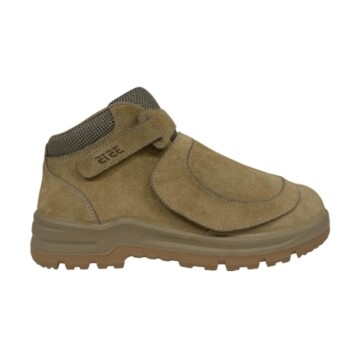
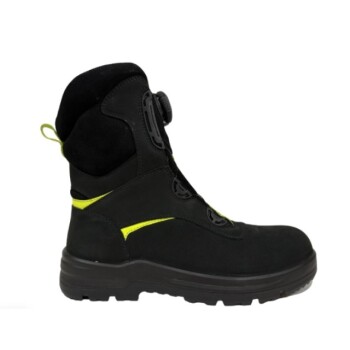
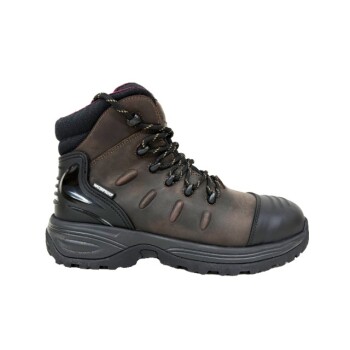
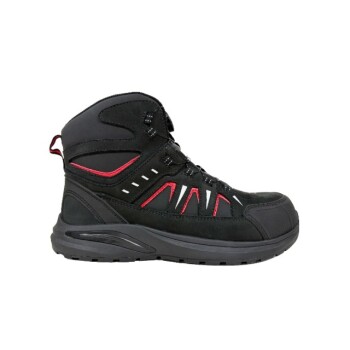
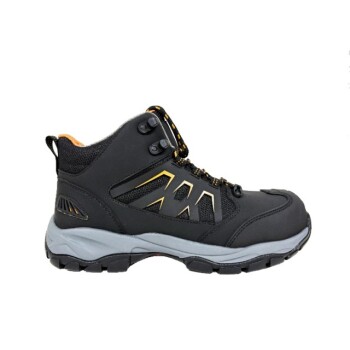
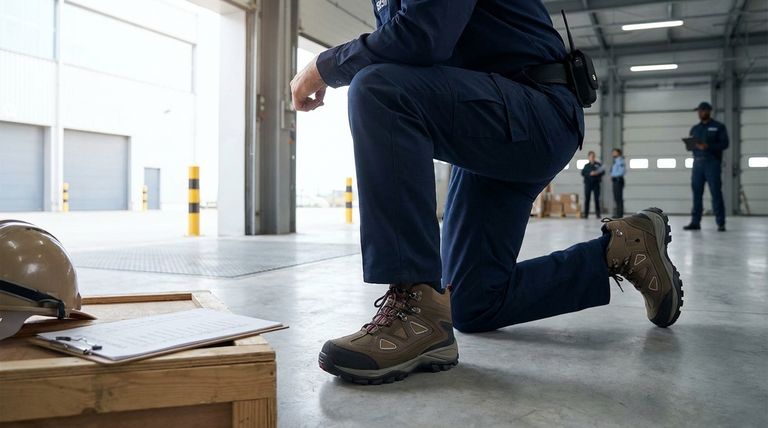
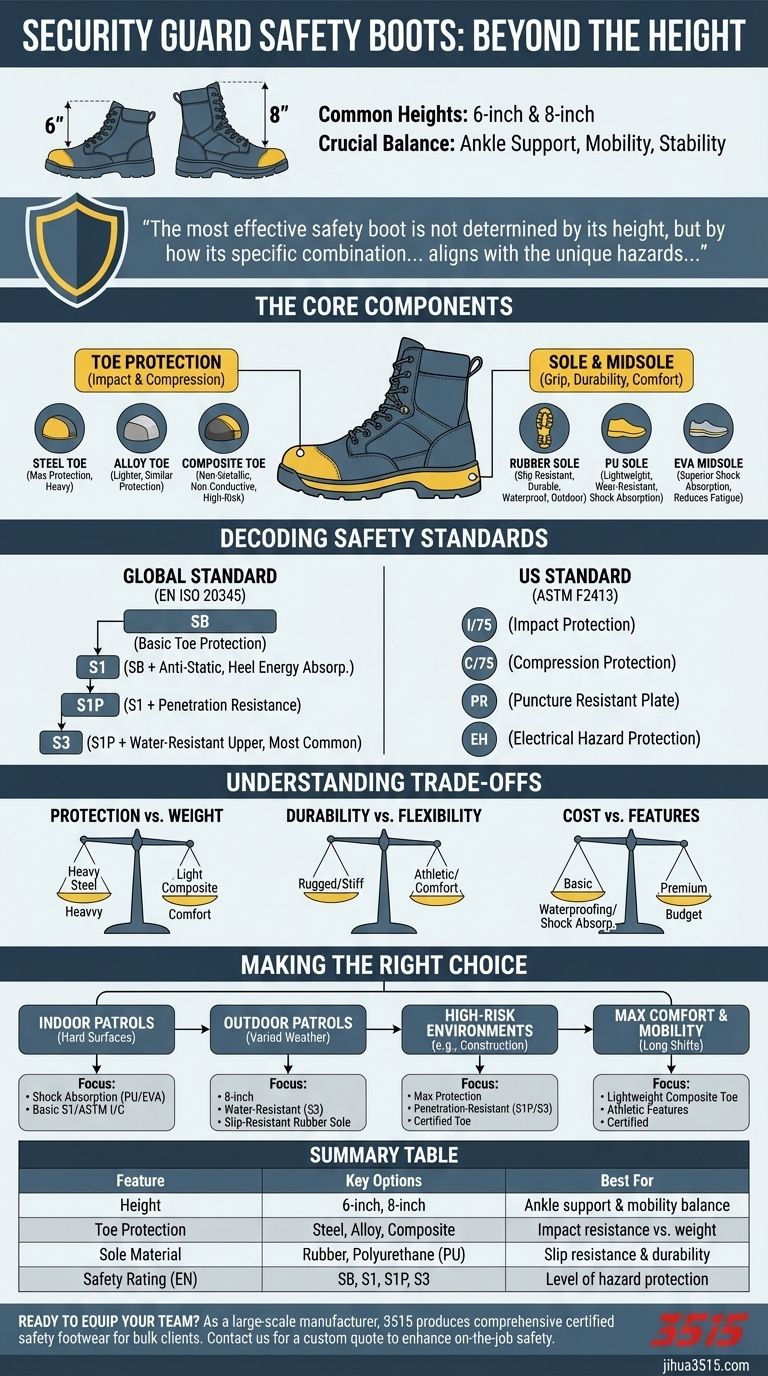
While security guard safety boots are most commonly available in 6-inch and 8-inch heights, the height is only one piece of a much larger puzzle. These two standard heights provide a crucial balance of ankle support and mobility, with the 8-inch version offering enhanced stability for more demanding environments. However, selecting the right boot depends far more on its protective features and its suitability for your specific work conditions.
The most effective safety boot is not determined by its height, but by how its specific combination of toe protection, sole material, and safety rating aligns with the unique hazards of your daily environment.
Beyond Height: The Core Components of a Safety Boot
Understanding the anatomy of a safety boot is the first step toward making an informed decision. The materials and construction dictate its performance, comfort, and lifespan.
Understanding Toe Protection
The protective toe cap is the most recognized feature of a safety boot. Each type offers a different balance of weight and protection.
- Steel Toe: This is the traditional standard, offering maximum protection against impact and compression from falling objects.
- Alloy Toe: Made from lighter materials like aluminum or titanium, these offer similar protection to steel but with less weight.
- Composite Toe: These non-metallic caps (using materials like carbon fiber, plastic, or Kevlar) do not conduct heat, cold, or electricity, making them ideal for certain high-risk environments.
The Foundation: Sole and Midsole
The sole determines the boot's grip, durability, and comfort over long hours of standing or walking.
- Rubber Soles: Offer excellent slip resistance and are highly durable and waterproof, making them ideal for outdoor or wet conditions.
- Polyurethane (PU) Soles: Are lightweight and wear-resistant, providing good shock absorption and comfort.
- EVA Midsoles: Ethylene Vinyl Acetate is often used in the midsole for its superior shock-absorbing properties, reducing fatigue during long shifts.
Decoding Safety Standards and Ratings
Official ratings are the most reliable indicator of a boot's protective capabilities. These standards are not suggestions; they are certifications proving the boot has passed rigorous testing.
The Global Standard (EN ISO 20345)
This is the European standard, widely recognized globally. The "S" ratings provide a clear hierarchy of protection.
- SB (Safety Basic): Meets basic toe protection requirements (200-joule impact).
- S1: Includes SB features plus anti-static properties and energy absorption in the heel.
- S1P: Adds penetration resistance to the S1 standard, protecting against sharp objects underfoot.
- S3: Includes all S1P features plus a water-resistant upper, making it the most common standard for all-around security work.
The US Standard (ASTM F2413)
This is the primary standard in the United States, required by OSHA for many workplaces. It uses specific codes to identify protections.
- I/75 (Impact): Indicates the toe cap protects against a 75-pound impact.
- C/75 (Compression): Shows the toe cap protects against a 2,500-pound compressive load.
- PR (Puncture Resistant): Signifies a puncture-resistant plate is built into the sole.
- EH (Electrical Hazard): Protects against accidental contact with live electrical circuits.
Understanding the Trade-offs
Choosing the perfect boot always involves balancing competing factors. There is no single "best" boot, only the best boot for a specific job.
Protection vs. Weight
Heavier protection, like that from traditional steel toe boots, can lead to greater fatigue over a 12-hour shift. Lighter composite materials can significantly improve comfort without sacrificing certified safety.
Durability vs. Flexibility
Rugged, highly durable boots often require a break-in period and can feel stiff. More flexible, athletic-style safety boots offer immediate comfort but may not withstand the same level of abuse over time.
Cost vs. Features
Advanced features like premium waterproofing, composite materials, and superior shock absorption come at a higher price. You must balance your budget against the non-negotiable safety requirements of your role.
Making the Right Choice for Your Role
Use your daily work environment as the primary guide for selecting the right combination of features.
- If your primary focus is indoor patrols on hard surfaces: Prioritize a boot with excellent shock absorption (PU or EVA midsole) and a basic S1 or ASTM I/C rating.
- If your primary focus is outdoor patrols in varied weather: Select an 8-inch boot with a certified water-resistant upper (S3 rating) and a slip-resistant rubber sole.
- If your primary focus is working in high-risk environments (e.g., construction sites): Demand maximum protection, including a penetration-resistant midsole (S1P or S3) and a certified protective toe.
- If your primary focus is maximum comfort and mobility for long shifts: Consider a lightweight composite toe boot built with athletic features and certified to the necessary safety standard.
Ultimately, choosing the right safety boot is an investment in your personal safety and daily well-being.
Summary Table:
| Feature | Key Options | Best For |
|---|---|---|
| Height | 6-inch, 8-inch | Ankle support & mobility balance |
| Toe Protection | Steel, Alloy, Composite | Impact resistance vs. weight |
| Sole Material | Rubber, Polyurethane (PU) | Slip resistance & durability |
| Safety Rating (EN) | SB, S1, S1P, S3 | Level of hazard protection |
Ready to equip your team with the right safety boots?
As a large-scale manufacturer, 3515 produces a comprehensive range of certified safety footwear for distributors, brand owners, and bulk clients. Our production capabilities encompass all types of shoes and boots, ensuring your security personnel have the perfect combination of protection, comfort, and durability for their specific work environment.
Contact us today for a custom quote and let us help you enhance on-the-job safety and performance!
Visual Guide
Related Products
- Premium Suede Metatarsal Guard Safety Boots Work Shoes
- Premium Grain Leather Safety Boots for Bulk Supply
- Premium High-Cut Waterproof Safety Boots Manufacturing & Wholesale Solutions
- Wholesale Leather Safety Boots with Customizable Protective Toe
- Wholesale Durable Mid-Cut Tactical Boots for Custom & Private Label Brands
People Also Ask
- How does metatarsal protection in safety footwear work? The Essential Guide to Foot Safety
- What is a metatarsal guard in safety boots? Essential Protection for Your Entire Foot
- How do metatarsal guards enhance work shoe safety? Prevent Crushing Foot Injuries on the Job
- What does the 'MT' in ASTM F2413-18 stand for? Essential Metatarsal Protection Explained
- What is metatarsal protection in safety boots? Essential Defense for Top-of-Foot Hazards