
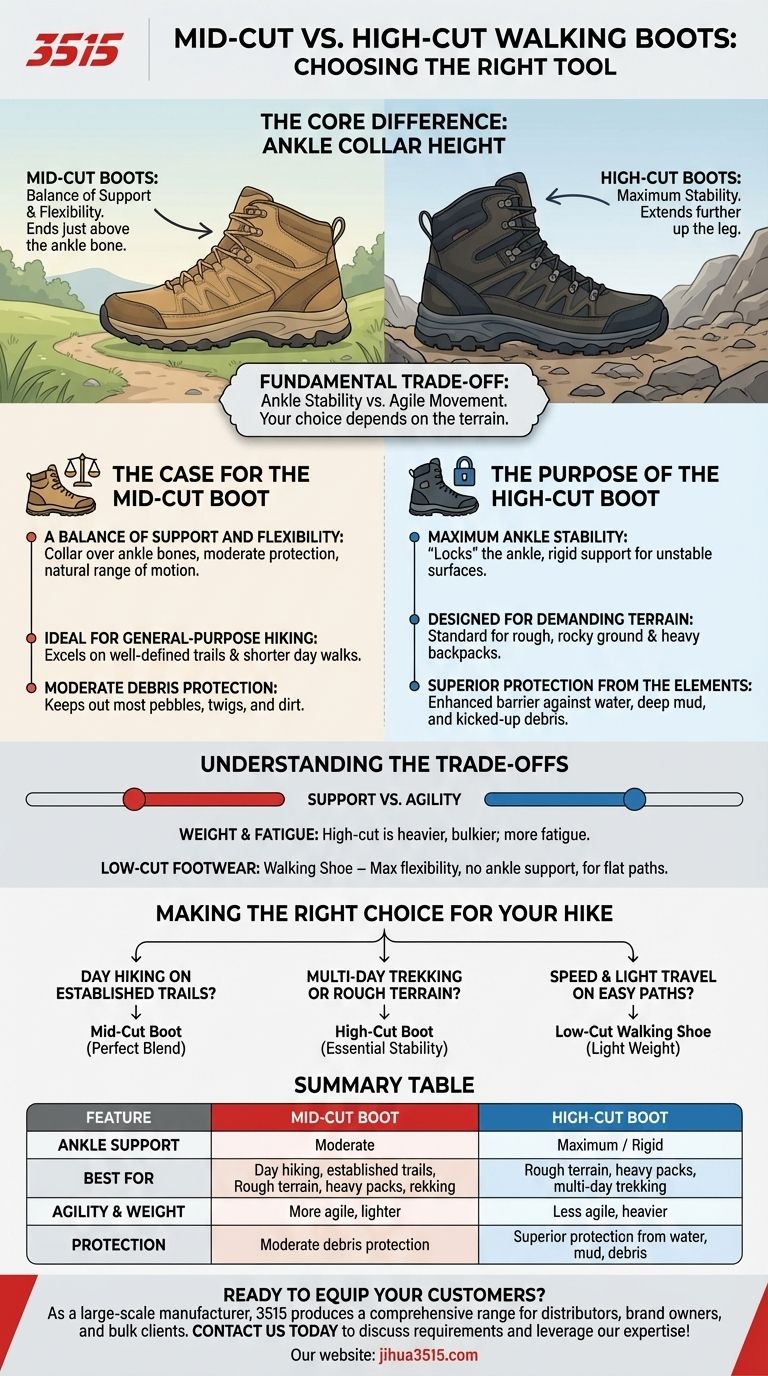
The core difference between mid-cut and high-cut walking boots is the height of the collar around your ankle. Mid-cut boots end just above the ankle bone to offer a balance of support and flexibility, while high-cut boots extend further up the leg to prioritize maximum stability for challenging conditions.
Your choice is not about which boot is inherently better, but which is the right tool for the job. The decision hinges on a fundamental trade-off: ankle stability versus agile movement, which is dictated entirely by the terrain you plan to hike.
The Case for the Mid-Cut Boot
A mid-cut boot is often seen as the versatile all-rounder in the hiking footwear world. Its design is a deliberate compromise between a low-cut shoe and a full-height boot.
A Balance of Support and Flexibility
The collar of a mid-cut boot sits just over the ankle bones. This provides moderate protection against ankle twists and impacts without severely restricting your natural range of motion.
Ideal for General-Purpose Hiking
This balanced design makes mid-cut boots ideal for the most common hiking scenarios. They excel on well-defined trails and for shorter day walks where agility is beneficial.
Moderate Debris Protection
The height is sufficient to keep most pebbles, twigs, and dirt from getting inside your boot on a typical trail, offering a clear advantage over low-cut walking shoes.
The Purpose of the High-Cut Boot
The high-cut boot is a specialized piece of equipment designed for stability and protection above all else. It is built for environments where a twisted ankle is a significant risk.
Maximum Ankle Stability
The primary function of a high-cut design is to "lock" the ankle in place. The collar extends well above the ankle, providing rigid support that is critical on unstable or unpredictable surfaces.
Designed for Demanding Terrain
These boots are the standard choice for navigating rough, rocky, or uneven ground. They are also highly recommended when carrying a heavy backpack, as the extra weight can compromise your stability.
Superior Protection from the Elements
The taller profile offers enhanced protection from water during stream crossings, deep mud, and kicked-up debris. This makes them a more robust barrier against the environment.
Understanding the Trade-offs
Choosing the right boot height requires acknowledging what you gain and what you give up with each design. This is the central decision you need to make.
Support vs. Agility
This is the most critical trade-off. High-cut boots offer superior support but feel more restrictive and can be slower. Mid-cut boots provide greater freedom of movement for faster walking but offer less defense against serious ankle rolls.
Weight and Fatigue
More material means more weight. High-cut boots are almost always heavier and bulkier than their mid-cut counterparts, which can lead to greater fatigue over a long day of hiking.
A Note on Low-Cut Footwear
Footwear that sits below the ankle is not considered a boot but a walking shoe. These offer maximum flexibility and minimum weight but provide virtually no ankle support, making them suitable only for flat, well-maintained paths.
Making the Right Choice for Your Hike
To select the correct boot, start by defining the environment you will be in most often.
- If your primary focus is day hiking on established trails: A mid-cut boot provides the perfect blend of support for uneven ground and the flexibility needed for comfort.
- If your primary focus is multi-day trekking or navigating rough terrain: A high-cut boot is essential for providing the ankle stability required to prevent injury, especially when carrying a pack.
- If your primary focus is speed and light travel on easy paths: A low-cut walking shoe is the superior choice, as it prioritizes light weight and flexibility over ankle protection.
Matching your boot's design to your intended environment is the single most important factor for a safe and comfortable journey.
Summary Table:
| Feature | Mid-Cut Boot | High-Cut Boot |
|---|---|---|
| Ankle Support | Moderate | Maximum / Rigid |
| Best For | Day hiking, established trails | Rough terrain, heavy packs, multi-day trekking |
| Agility & Weight | More agile, lighter | Less agile, heavier |
| Protection | Moderate debris protection | Superior protection from water, mud, and debris |
Ready to equip your customers with the perfect hiking boot?
As a large-scale manufacturer, 3515 produces a comprehensive range of mid-cut and high-cut walking boots for distributors, brand owners, and bulk clients. Our production capabilities ensure you get the right boots—balancing support, agility, and durability—for your target market's specific needs.
Contact us today to discuss your footwear requirements and leverage our manufacturing expertise!
Visual Guide
Related Products
- Heavy-Duty Waterproof Nubuck Safety Boots Safety Shoes for Bulk Supply
- Durable Goodyear Welt Leather Work Boots for Wholesale & Private Label
- Durable Rubber Sole Outdoor Shoes Wholesale & Custom Manufacturing
- Wholesale Safety Boots Manufacturer for Custom & Private Label Orders
- Wholesale High-Traction Camo Boots - Custom Manufacturer for Brands
People Also Ask
- What primary protective functions do professional safety boots provide in urban solid waste recovery and waste picking processes? Discover Dual-Layer Protection.
- How do safety boots reduce cutting hazards? Essential Protection for Your Workforce
- Which organizations develop safety standards for work boots? Ensure Compliance & Worker Safety
- What are the common types of safety boots and their primary uses? A Guide to Industrial Footwear
- Why is ankle and arch support important in safety footwear? Prevent Injury & Fatigue



















