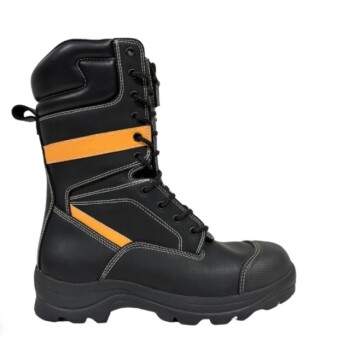
Modern professional safety and firefighting footwear manufacturing is currently defined by a shift toward lightweight material science, thermal regulation coatings, and the integration of digitalized production lines. These advancements allow manufacturers to produce boots that offer superior protection—such as NFPA-compliant flame resistance and enhanced slip-resistant soles—while significantly reducing wearer fatigue and improving thermal comfort through sun-reflective leather treatments.
To maintain a competitive edge, B2B stakeholders must prioritize manufacturers that bridge the gap between legacy expertise and digital innovation, ensuring products meet rigorous international certifications while benefiting from the efficiencies of intelligent, large-scale production.
Advanced Material Engineering and Ergonomics
Manufacturing today focuses on the "strength-to-weight" ratio, ensuring that heavy-duty protection does not hinder mobility.
Weight Reduction and Flexibility
Modern boots utilize advanced composites and lighter-weight materials to replace traditional, heavy components. This reduction in mass is critical for reducing physical strain during long shifts or high-intensity firefighting operations. Despite the lower weight, these materials maintain high levels of puncture resistance and impact absorption.
Thermal Management and Sun-Reflective Coatings
Specific leather treatments, such as sun-reflective coatings, are now being applied to improve the thermal performance of footwear. These coatings reduce heat absorption from direct sunlight, keeping the wearer’s feet cooler in outdoor or high-temperature environments. This technology is particularly vital for wildland firefighting, where external heat radiation is a constant threat.
Customizable Fit Systems
Manufacturers are moving away from "one-size-fits-all" internal structures toward customizable fit systems. Enhanced arch support and cushioning systems are integrated during the assembly process to provide better pressure distribution. A precise fit reduces the risk of blisters and long-term musculoskeletal issues for the end-user.
High-Performance Safety and Smart Integration
The evolution of footwear is moving beyond passive protection toward active safety and data-driven insights.
Enhanced Traction and Sole Technology
Development is focused on enhanced grip soles designed specifically for diverse and unstable surfaces. Through specialized rubber compounds and tread patterns, these soles provide maximum slip resistance on oily, wet, or uneven terrain. This is a critical requirement for meeting global safety compliance and reducing workplace injury rates.
Smart Connectivity and Kinetic Sensors
The industry is beginning to implement smart features, such as connectivity to monitor stress levels and impact forces. Future innovations include using kinetic energy generated by walking to power built-in sensors. These sensors can provide real-time data on the wearer's environment and physical state, which is invaluable for high-risk B2B sectors.
Digitalized Production and Global Supply Chains
Leading manufacturers are replacing legacy machinery with intelligent management systems and digital upgrades. This technological modernization improves raw material utilization and ensures consistent quality across massive production volumes. For distributors, this means high-volume delivery stability and a more seamless integration into global production networks.
Understanding the Trade-offs
While innovation drives the market forward, it introduces specific challenges that brands and distributors must navigate.
Durability vs. Weight
The push for lighter materials can sometimes lead to a reduction in long-term durability if lower-quality synthetics are used. Enterprise-level manufacturers must balance these factors by using premium materials that offer both lightness and longevity. Distributors should verify that lightweight models still meet the rigorous NFPA or ISO standards required for their specific industry.
The Complexity of Smart Tech Maintenance
Integrating electronics into footwear introduces new failure points, such as battery life or sensor calibration. These "smart" features may increase the cost per unit and require specialized knowledge for post-sale support. Resellers must weigh the marketing appeal of smart tech against the practical needs of their core client base.
Strategic Selection for Large-Scale Procurement
Choosing a manufacturing partner requires balancing modern technological trends with proven production reliability.
How to Apply This to Your Business
- If your primary focus is OEM/ODM brand growth: Prioritize partners with a rich heritage (dating back to 1951 or earlier) that offer state-of-the-art equipment to ensure your brand is backed by both history and innovation.
- If your primary focus is supply chain stability: Seek manufacturers who have transitioned to digitalized production lines, as they can offer more consistent quality and better raw material management for large-volume orders.
- If your primary focus is high-risk safety compliance: Ensure the boots utilize the latest traction technologies and sun-reflective treatments to meet the most stringent NFPA and international safety requirements.
The future of professional footwear lies in the synergy of 70 years of manufacturing heritage and the precision of digital-age engineering.
Summary Table:
| Technology Trend | Key Benefit | Target Application |
|---|---|---|
| Lightweight Composites | Reduces wearer fatigue & boosts mobility | Firefighting & Tactical Ops |
| Sun-Reflective Coatings | Minimizes heat absorption from sunlight | Wildland Firefighting & Outdoor |
| Digitalized Production | Ensures quality consistency & high volume | Large-scale OEM/ODM Supply |
| Advanced Traction Soles | Maximum slip resistance on unstable terrain | Industrial & High-risk Safety |
Elevate Your Brand with an Enterprise-Level Manufacturing Partner
As a large-scale manufacturer with a legacy dating back to 1951, 3515 provides the manufacturing strength required by distributors and brand owners to dominate the market. We combine decades of expertise with state-of-the-art digitalized production to deliver high-performance footwear at a massive scale.
Why Partner with 3515?
- Robust Supply Chain: Consistent, large-volume delivery for Safety Shoes, tactical boots, and sneakers.
- Premium OEM/ODM Support: Tailored footwear engineering to meet your brand’s specific technical requirements.
- Certified Excellence: Comprehensive international certifications ensuring compliance with global safety standards.
- Technological Leadership: From sun-reflective leather to precision-molded soles, we lead the industry in innovation.
Ensure your business benefits from heritage-backed quality and modern production efficiency.
Contact 3515 to Discuss Your Bulk Requirements
Related Products
- Premium Flame-Retardant Waterproof Safety Boots and Shoes
- High Performance Fire-Retardant Waterproof Safety Boots
- Safety Footwear Wholesale Manufacturer for Custom OEM/ODM Production
- Premium Safety Shoes with Rotating Buckle Safety Sneakers
- Wholesale Customizable Safety Boots Durable & Protective Footwear Manufacturing
People Also Ask
- Why are waterproof safety boots recommended for certain work environments? Essential Protection for Wet & Hazardous Jobs
- What materials are commonly used in waterproof boots? The Complete Guide to Durable, Breathable Protection
- How does boot construction affect waterproofing? The Science Behind Truly Dry Feet
- What should you look for to ensure boots are fully waterproof? The Essential 2-Part System
- What is the advantage of one-piece construction in waterproof boots? Unbeatable Seamless Protection