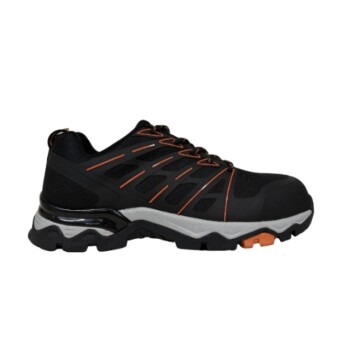
The fundamental biomechanical difference lies in structural intent: professional safety shoes prioritize stable support and rigidity to enforce load uniformity, whereas high-performance training shoes emphasize energy feedback. This distinction dictates how vertical ground reaction forces are transmitted through the foot, directly impacting the restoration of load-bearing symmetry during gait recovery.
Effective gait recovery relies on the uniform distribution of plantar loads. While training shoes focus on returning energy to the wearer, professional safety shoes utilize specific hardness and slip-resistant properties to stabilize ground reaction forces and ensure load-bearing symmetry.
Structural Rigidity and Load Symmetry
The Role of Stable Support
Professional safety shoes are engineered with stable support structures. These structures are designed to maintain foot alignment under pressure.
This rigidity helps enforce uniform plantar load distribution, which is a prerequisite for effective gait recovery. Without this support, the foot may distribute weight unevenly, hindering the restoration of natural movement patterns.
Achieving Load-Bearing Symmetry
Restoring symmetry in how weight is borne across the foot is a primary goal of rehabilitation.
The structural rigidity of a shoe acts as a critical external factor in this process. By limiting excessive flex, the footwear ensures that the load remains balanced during dynamic activities.
Force Transmission and Sole Properties
Sole Hardness and Ground Reaction
The shoe sole acts as the primary interface between the human body and the ground.
Consequently, the hardness of the sole directly influences the transmission efficiency of vertical ground reaction forces. A sole that is too soft may dampen these forces unpredictably, while a harder sole provides more direct feedback and stability.
The Importance of Slip Resistance
Slip-resistant properties contribute to more than just accident prevention.
By ensuring a secure friction coefficient with the ground, these properties allow for consistent force application. This consistency is vital for maintaining the structural integrity of the gait cycle during recovery.
Understanding the Trade-offs
Energy Feedback vs. Stability
High-performance training shoes are typically designed to maximize energy feedback.
While this can aid in propulsion and reduce fatigue in healthy individuals, it often comes at the expense of stability. The lack of rigid support in training shoes may allow for asymmetrical loading, which is detrimental during the recovery phase.
The Implications of Structural Choices
Choosing the wrong footwear rigidity can impede progress.
A shoe that lacks the necessary hardness may fail to correct load imbalances. Conversely, footwear that prioritizes stability over all else may reduce the dynamic responsiveness required for advanced athletic movements.
Making the Right Choice for Your Goal
Selecting the appropriate footwear is a strategic decision that depends on where the individual is in their recovery timeline.
- If your primary focus is restoring balance and symmetry: Prioritize professional safety shoes with high structural rigidity to enforce uniform load distribution.
- If your primary focus is dynamic propulsion and speed: Consider high-performance training shoes that offer superior energy feedback, provided your load-bearing symmetry is already established.
Ultimately, the correct shoe acts not just as protection, but as a calibrated tool to guide the body back to biomechanical efficiency.
Summary Table:
| Feature | Professional Safety Shoes | High-Performance Training Shoes |
|---|---|---|
| Primary Goal | Load-bearing symmetry & stable support | Energy feedback & dynamic propulsion |
| Structural Intent | High rigidity to enforce uniform load | Flexibility for maximum energy return |
| Sole Properties | Harder sole for direct force transmission | Softer materials for cushioning |
| Key Benefit | Prevents asymmetrical loading | Reduces fatigue & aids propulsion |
| Ideal Use Case | Gait rehabilitation & injury recovery | Advanced athletic training |
| Safety Focus | High slip resistance & foot alignment | Surface grip & lightweight mobility |
Partner with 3515 for Biomechanically Optimized Footwear
As a large-scale manufacturer serving distributors and brand owners, 3515 offers comprehensive production capabilities for all footwear types, anchored by our flagship Safety Shoes series. Whether you require professional safety boots designed for load-bearing symmetry or high-performance training shoes, our extensive portfolio—including tactical boots, outdoor gear, and sneakers—is engineered for durability and biomechanical efficiency.
Enhance your product line with our bulk manufacturing expertise: Contact us today to discuss how our footwear solutions can meet your diverse market requirements!
References
- Sónia A. Alves, Alison N. Agres. The Recovery of Weight-Bearing Symmetry After Total Hip Arthroplasty Is Activity-Dependent. DOI: 10.3389/fbioe.2022.813345
This article is also based on technical information from 3515 Knowledge Base .
Related Products
- Premium Suede Sport Safety Shoes for Wholesale & Bulk Orders
- Premium Lightweight Safety Shoes for Wholesale & Bulk Orders
- Wholesale Anti-Smash & Puncture-Proof Safety Shoes Custom Manufacturing for Brands
- Premium KPU Injection Athletic Style Safety Shoes
- Premium Safety Shoes with Rotating Buckle Safety Sneakers
People Also Ask
- What are the primary functions of professional safety shoes? Maximize Safety in Water Supply Confined Spaces
- What industries have specific OSHA footwear requirements? Ensure Compliance & Protect Your Workforce
- What role do specialized safety shoes play in preventing falls? Engineering Stability in Industrial Environments
- Why is barefoot walking used as a baseline in gait safety research? Unlocking Natural Biomechanics for Shoe Design
- How do complex outsole tread designs in safety shoes work with coated floors? Master Slip Resistance Engineering