For professionals who stand all day, proper footwear is not a luxury but a critical tool for health and safety. The immediate benefits include preventing blisters and circulation issues, while the long-term advantages involve supporting correct posture, distributing body weight optimally, and averting chronic musculoskeletal damage to your feet, back, and joints.
Your choice of footwear is a foundational decision that directly impacts your daily performance and long-term physical well-being. It's less about temporary comfort and more about providing a stable, protective base for your entire body throughout the workday.
Beyond Comfort: How Footwear Impacts Your Entire Body
Choosing the right work shoe goes far beyond simply avoiding sore feet at the end of a shift. The construction of your footwear has a cascading effect on your entire musculoskeletal system.
The Foundation of Your Posture
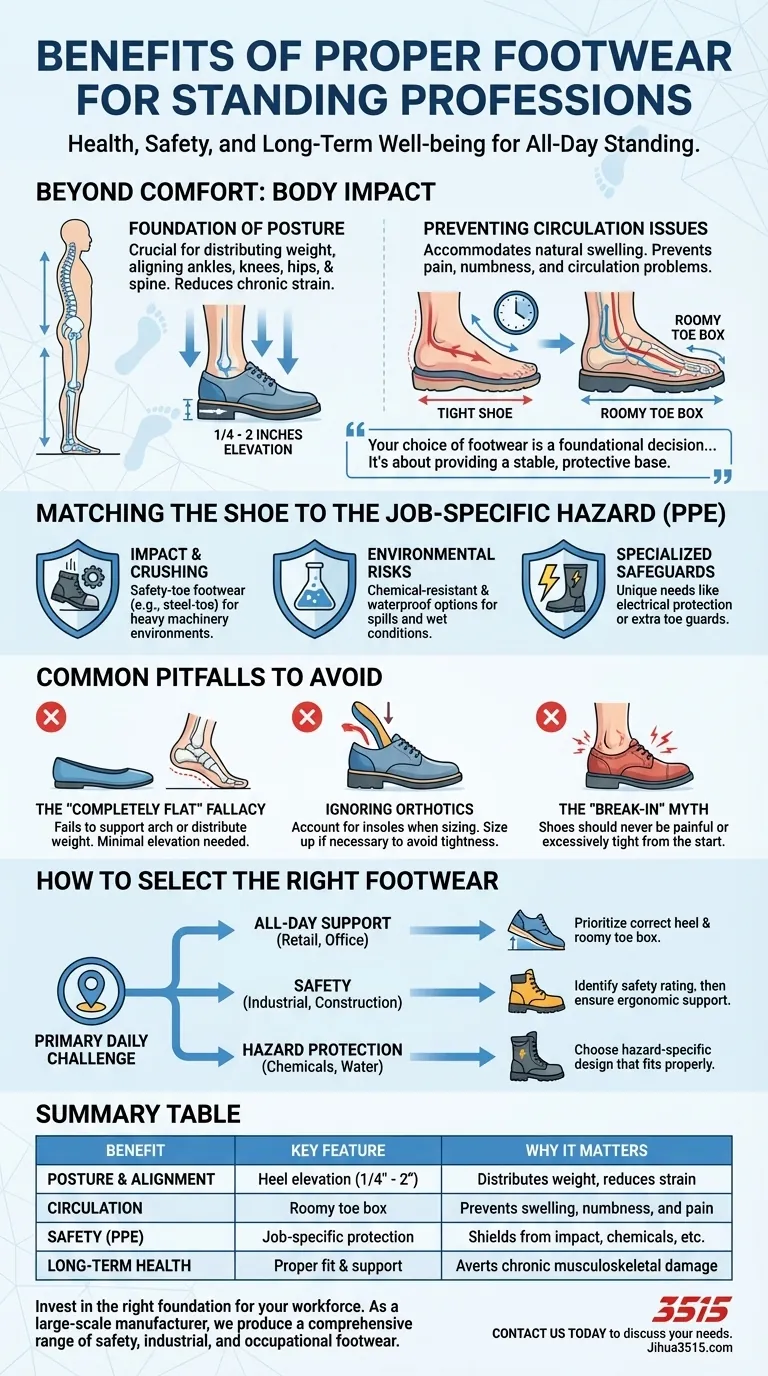
Proper shoes act as the base for your body's alignment. A modest heel elevation, between 1/4 and 2 inches, is crucial for distributing your weight correctly across the foot.
This optimal distribution helps align your ankles, knees, hips, and spine, reducing the strain that can lead to chronic back and joint pain.
Preventing Circulation and Swelling
Your feet naturally swell throughout the day, especially when you are standing for long periods. Footwear must have adequate room to accommodate this change.
Shoes that are too tight can restrict blood flow, leading to pain, numbness, and other circulation problems. It is wise to shop for work shoes later in the day when your feet are at their largest.
Averting Immediate and Long-Term Damage
Ill-fitting shoes are a primary cause of immediate issues like blisters. Over time, however, they contribute to more serious conditions.
Consistent pressure from improper footwear can lead to long-term damage, requiring more significant intervention down the line.
Matching the Shoe to the Job-Specific Hazard
For many professions, footwear is a key piece of personal protective equipment (PPE). The right shoe must not only provide support but also shield you from workplace-specific dangers.
Protection from Impact and Crushing
In environments with heavy machinery or falling objects, safety-toe footwear (such as steel-toe boots) is non-negotiable. These shoes are designed to protect the toes from severe crushing incidents.
Shielding from Environmental Risks
Professionals in laboratories or industrial cleaning may require chemical-resistant boots to prevent hazardous spills from contacting the skin.
Similarly, waterproof footwear is essential for many, including electrical workers, to protect against environmental conditions and potential electrical hazards.
Specialized Safeguards
Certain roles have unique needs. For example, those who work with large animals may require shoes with extra toe protection to guard against being stepped on.
Common Pitfalls to Avoid
Making an informed choice means recognizing common mistakes that can negate the benefits of otherwise good footwear.
The "Completely Flat" Fallacy
Many assume that a perfectly flat shoe is the most "natural" or comfortable option for standing. However, a complete lack of elevation fails to properly support the arch and distribute weight.
A minimal elevation of at least 1/4 inch is necessary to provide the structural support needed for long hours on your feet.
Ignoring the Need for Orthotics
If you use custom or over-the-counter orthotic insoles, you must account for them when sizing your shoes.
Failing to do so can make the shoe too tight, restricting circulation and creating painful pressure points. Consider buying a half-size larger to ensure a proper fit.
The "Break-In" Myth
While high-quality shoes may conform to your feet over time, they should never be painful or excessively tight from the start.
A shoe that causes immediate discomfort or restricts circulation is the wrong size or shape for your foot, and no amount of "breaking in" will correct its fundamental fit.
How to Select the Right Footwear for Your Profession
Use your primary daily challenge as the starting point for selecting the right shoe.
- If your primary focus is all-day support in a retail, service, or office setting: Prioritize a shoe with the correct heel elevation (1/4 to 2 inches) and a roomy toe box to accommodate natural swelling.
- If your primary focus is safety in an industrial or construction environment: Begin by identifying the required safety rating (e.g., safety-toe, puncture-resistant), then select a model that also offers proper ergonomic support.
- If your primary focus is protection from specific hazards like chemicals or water: Choose footwear explicitly designed for that risk, ensuring it still meets the core principles of a supportive and proper fit.
Investing in the right footwear is a direct investment in your own health and career longevity.
Summary Table:
| Benefit | Key Feature | Why It Matters |
|---|---|---|
| Posture & Alignment | Heel elevation (1/4" - 2") | Distributes weight, reduces strain on back & joints |
| Circulation | Roomy toe box | Prevents swelling, numbness, and pain |
| Safety (PPE) | Job-specific protection (e.g., steel-toe) | Shields from impact, chemicals, and other hazards |
| Long-Term Health | Proper fit & support | Averts chronic musculoskeletal damage |
Invest in the right foundation for your workforce. As a large-scale manufacturer, 3515 produces a comprehensive range of safety, industrial, and occupational footwear for distributors, brand owners, and bulk clients. Our production capabilities encompass all types of supportive shoes and boots designed for long hours on the job, ensuring the health and safety of your team.
Contact us today to discuss your specific needs and discover how our footwear solutions can enhance performance and protect your most valuable asset—your people.
Visual Guide
Related Products
- Durable Canvas Work Shoes with Rubber Lug Sole | Wholesale Manufacturer
- Durable Leather Work Boots for Wholesale & Custom OEM Manufacturing
- Durable Leather Work Boots for Wholesale & Custom Manufacturing
- Durable Goodyear Welt Leather Work Boots for Wholesale & Private Label
- Durable Leather Moc Toe Work Boots for Wholesale & Custom Manufacturing
People Also Ask
- What are the properties of canvas as a shoe material? A Guide to Lightweight Comfort & Style
- Why is the selection of high-strength fabric materials necessary in the production of canvas shoes and training shoes?
- What types of jobs are canvas work boots suitable for? Ideal for Light-Duty, High-Mobility Roles
- Can canvas shoes be worn in rainy conditions? The Truth About Water Resistance
- What are the functional advantages of choosing rubber soles over leather soles for work boots? Superior Safety & Durability