
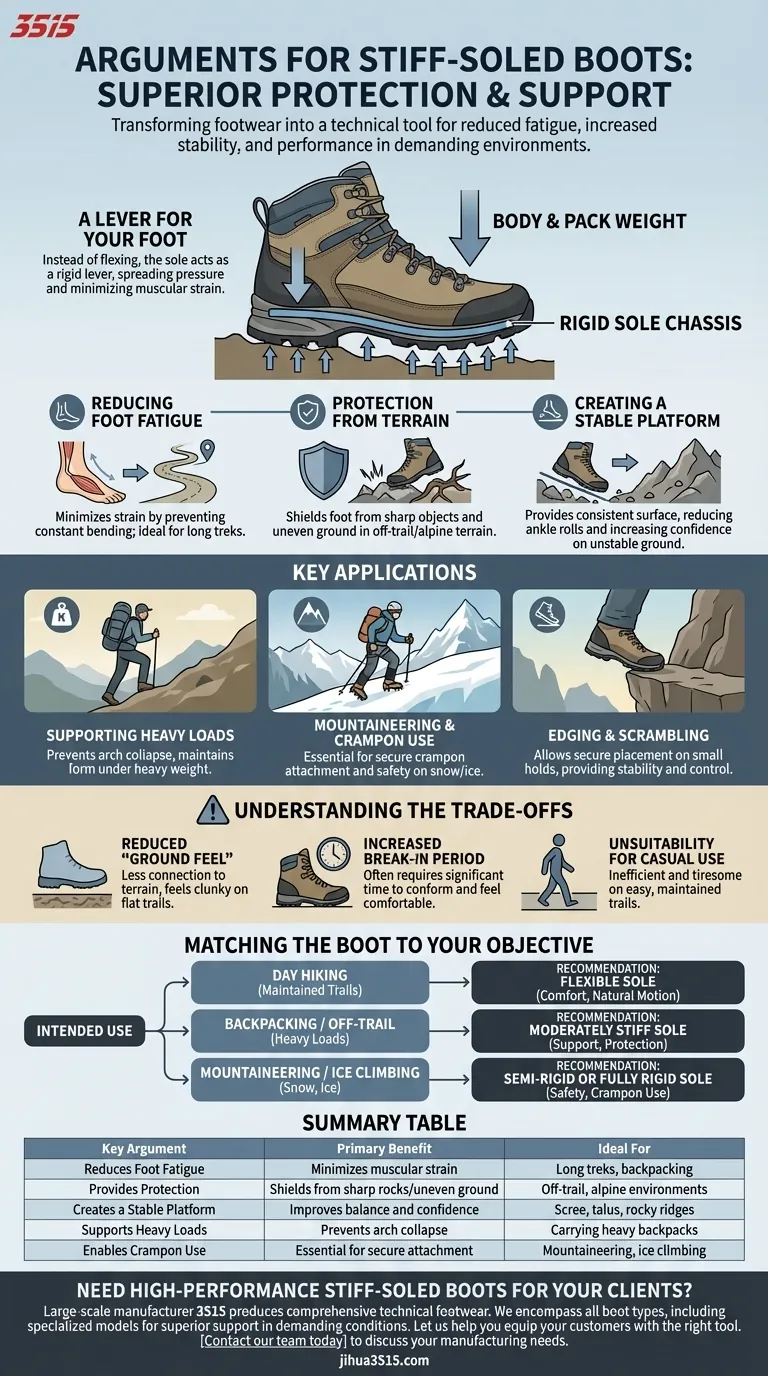
The primary arguments for stiff-soled boots are that they provide superior protection from rough terrain and offer crucial support when carrying heavy loads. This design transforms the boot from simple footwear into a technical tool, reducing foot fatigue and increasing stability on challenging ground.
A stiff sole functions as a chassis for your foot. Its purpose is not traditional comfort, but performance—to transfer energy efficiently, shield you from the ground, and create a stable platform in demanding environments.
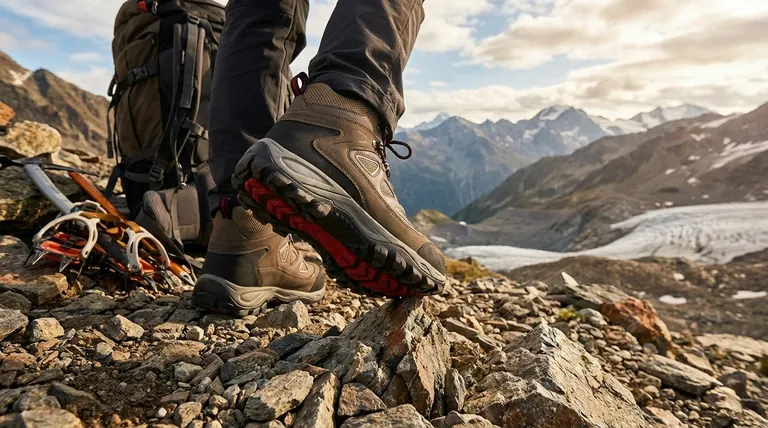
The Core Function: A Lever for Your Foot
A boot's stiffness fundamentally changes how your foot interacts with the ground. Instead of flexing with every irregularity, your foot remains relatively flat, letting the boot's structure do the work.
Reducing Foot Fatigue
A flexible sole forces the muscles and ligaments in your foot to constantly bend and adapt to the terrain. A stiff sole acts as a rigid lever, spreading the pressure of each step across the entire platform and minimizing this muscular strain. This significantly reduces fatigue on long treks.
Protection from Terrain
The most intuitive benefit is protection. A stiff sole acts as a shield, preventing sharp rocks, gnarled roots, and uneven ground from bruising or injuring the bottom of your foot. This is especially critical in off-trail or alpine environments.
Creating a Stable Platform
On unstable surfaces like scree, talus, or rocky ridges, a stiff sole provides a consistent and predictable platform. This reduces the likelihood of ankle rolls and allows you to place your feet with more confidence.
Key Applications for Stiff Boots
The benefits of stiffness are most apparent in specific, demanding situations where flexible footwear would be a significant liability.
Supporting Heavy Loads
When you carry a heavy backpack, your body weight and the pack's weight are driven through your feet. A stiff boot prevents your foot's arch from collapsing under this load, maintaining proper form and improving your overall balance and efficiency.
Mountaineering and Crampon Use
For travel on snow and ice, stiffness is a non-negotiable safety feature. Semi-rigid and fully rigid boots have welts designed for securely attaching crampons. A flexible boot cannot do this, as it would cause the crampon to pop off, creating a severe fall hazard.
Edging and Scrambling
On steep terrain or when scrambling on rock, a stiff edge allows you to stand securely on very small ledges or holds. The boot's structure supports your weight, not just the small muscles in your foot, giving you far more stability and control.
Understanding the Trade-offs
Stiffness is a feature for specific applications, not a universal benefit. Choosing a boot that is too stiff for your needs can create its own set of problems.
Reduced "Ground Feel"
The same rigidity that protects you also isolates you from the terrain. Stiff boots can feel clunky and unnatural on flat, well-maintained trails where flexibility would provide a more comfortable and natural stride.
Increased Break-in Period
While modern designs have improved, highly stiff boots—especially those made of leather—often require a significant break-in period to conform to your foot and feel comfortable.
Unsuitability for Casual Use
Using a stiff mountaineering or heavy backpacking boot for a simple day hike is overkill. The lack of flex can make your walking motion inefficient and tiresome on easy terrain.
Matching the Boot to Your Objective
The right choice depends entirely on your intended use. Analyze your goal, not just the boot's features, to make an informed decision.
- If your primary focus is day hiking on maintained trails: A flexible sole will provide more comfort and a natural walking motion.
- If your primary focus is backpacking with heavy loads or off-trail travel: A moderately stiff sole is crucial for support, protection, and fatigue reduction.
- If your primary focus is mountaineering or ice climbing: A semi-rigid or fully rigid sole is an essential requirement for safety and performance.
Choosing the right sole stiffness is about selecting the correct tool for the terrain you intend to conquer.
Summary Table:
| Key Argument | Primary Benefit | Ideal For |
|---|---|---|
| Reduces Foot Fatigue | Acts as a rigid lever, minimizing muscular strain | Long treks, backpacking |
| Provides Protection | Shields foot from sharp rocks and uneven ground | Off-trail, alpine environments |
| Creates a Stable Platform | Improves balance and confidence on unstable surfaces | Scree, talus, rocky ridges |
| Supports Heavy Loads | Prevents arch collapse, maintains proper form | Carrying heavy backpacks |
| Enables Crampon Use | Essential for secure attachment on snow and ice | Mountaineering, ice climbing |
Need High-Performance Stiff-Soled Boots for Your Clients?
As a large-scale manufacturer, 3515 produces a comprehensive range of technical footwear for distributors, brand owners, and bulk clients. Our production capabilities encompass all types of boots, including specialized stiff-soled models designed for superior support, protection, and durability in the most demanding conditions.
Let us help you equip your customers with the right tool for the terrain. Contact our team today to discuss your manufacturing needs and get a quote.
Visual Guide
Related Products
- Wholesale Leather Work Boots with Customizable Wedge Sole for Brands
- Wholesale Leather Ankle Boots with Lug Soles for Custom Brand Manufacturing
- Premium Wholesale Waterproof Safety Boots High Performance Protection for Industrial Markets
- Wholesale Waterproof Tactical Boots Custom Suede & High-Traction Soles
- Durable Steel Toe Safety Boots Wholesale & Custom Manufacturing
People Also Ask
- What is the difference between full-grain and top-grain leather? Premium Material Guide for Boot Manufacturers
- What are the advantages of leather as an upper material for work boots? Unmatched Durability & Custom Comfort
- How can leather work boots be protected from environmental elements? A 3-Step Guide to Lasting Durability
- What is the complete process for deep cleaning leather work boots? A Step-by-Step Guide to Preserve Your Investment
- What are the key qualities of leather for work boots? Superior Durability, Breathability & Custom Fit















