
To put it simply, the primary advantages of short riding boots are their exceptional comfort, versatility, and affordability. They are easier to put on, cooler in warm weather, and provide greater flexibility for both riding and groundwork, making them an ideal choice for a wide range of riders.
The core advantage of short riding boots lies in their practicality. They are not just a budget-friendly option, but a versatile tool that excels in everyday training and stable management, offering a unique combination of comfort and function that formal long boots cannot match.

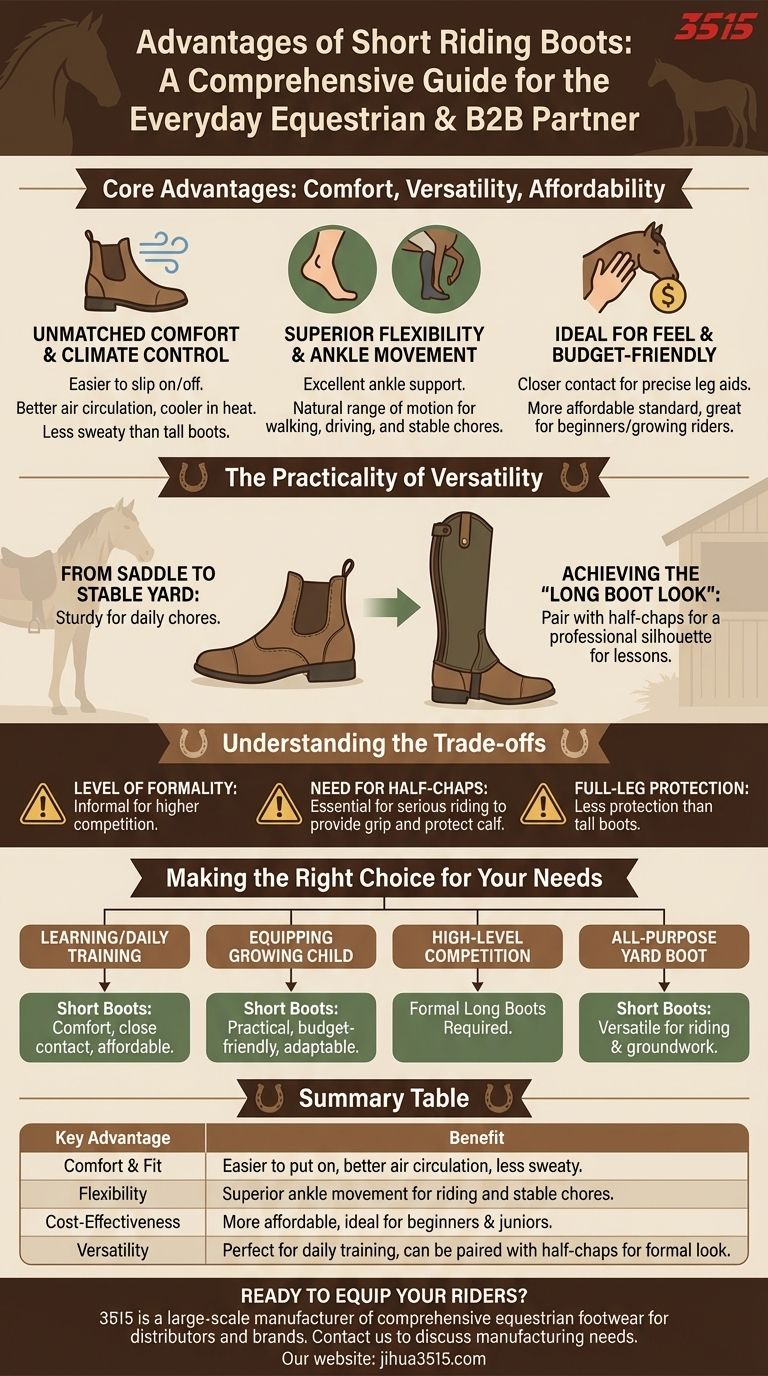
Core Advantages for the Everyday Rider
Short boots, often called paddock or jodhpur boots, are the workhorse of the equestrian world. Their design prioritizes function and comfort for the daily demands of horse ownership and training.
Unmatched Comfort and Climate Control
Short boots are significantly easier to slip on and off than tall boots. Their lower cut allows for better air circulation, making them far less sweaty and more comfortable during hot weather.
Superior Flexibility and Ankle Movement
The design provides excellent ankle support while still allowing for a natural range of motion. This flexibility is invaluable when walking around the stable yard, driving, or performing other groundwork tasks.
Ideal for Developing Feel
For beginners and junior riders, short boots allow for a closer contact between the leg and the horse's side. This enhanced connection makes it easier to develop a feel for giving precise leg aids without the barrier of a stiff, tall boot.
The Practicality of Versatility and Cost
Beyond comfort, the true value of short boots emerges in their adaptability and accessibility, making them the default choice for many equestrians.
The Budget-Friendly Standard
Short boots are generally more affordable than their tall counterparts. This makes them the perfect starting point for new riders or a sensible choice for children who are still growing.
From the Saddle to the Stable Yard
These boots are built to be sturdy and handle the rigors of daily barn chores. Unlike many formal long boots that are reserved for riding, short boots can comfortably transition from the saddle to mucking out a stall.
Achieving the "Long Boot Look"
When paired with a set of matching half-chaps, short boots create the sleek, professional silhouette of a tall boot. This combination offers the best of both worlds: the formal appearance for lessons or shows and the comfort of a short boot.
Understanding the Trade-offs
While highly advantageous, short boots are not the universal solution for every equestrian discipline or situation. Understanding their limitations is key to making an informed choice.
Level of Formality
Short boots are inherently more informal than traditional long boots. For higher levels of competition, particularly in disciplines like dressage, a pair of formal dress boots is often required to achieve the correct professional appearance.
The Need for Half-Chaps
For serious riding, short boots must be worn with half-chaps or gaiters. This is essential to provide grip against the saddle and protect the rider's calf from rubbing and pinching by the stirrup leathers. This adds another piece of equipment to your gear list.
Full-Leg Protection
By design, a short boot does not offer the same level of protection or structural support to the full lower leg as a tall boot. This may be a consideration for riders in disciplines that require more leg stability or protection.
Making the Right Choice for Your Needs
Selecting the right boot depends entirely on your personal goals, discipline, and daily routine.
- If your primary focus is learning to ride or daily training: Short boots offer the ideal blend of comfort, close contact, and affordability to help you develop your skills.
- If your primary focus is equipping a growing child: Short boots are the most practical and budget-friendly option, easily adapting as they grow.
- If your primary focus is high-level competition: While short boots are excellent for everyday training, you will likely need a pair of formal long boots to meet discipline standards.
- If your primary focus is a comfortable, all-purpose yard boot: Short boots provide the versatility to move from riding to groundwork without needing to change footwear.
Ultimately, choosing the right boot is about empowering your performance and comfort in and out of the saddle.
Summary Table:
| Key Advantage | Benefit |
|---|---|
| Comfort & Fit | Easier to put on, better air circulation, less sweaty. |
| Flexibility | Superior ankle movement for riding and stable chores. |
| Cost-Effectiveness | More affordable than tall boots, ideal for beginners and juniors. |
| Versatility | Perfect for daily training and can be paired with half-chaps for a formal look. |
Ready to equip your riders with the perfect blend of comfort and performance?
As a large-scale manufacturer, 3515 produces a comprehensive range of equestrian footwear for distributors, brand owners, and bulk clients. Our production capabilities encompass all types of riding boots, including durable and comfortable short boots perfect for everyday use.
We can help you stock the ideal footwear that meets the demands of your customers. Contact our team today to discuss your manufacturing needs and discover how we can support your business.
Visual Guide
Related Products
- Wholesale Durable Mid-Cut Tactical Boots for Custom & Private Label Brands
- Premium Wholesale Tactical Style Safety Shoes Boots with Quick Lacing
- Wholesale Lightweight Tactical Boots with Dial Closure OEM & Bulk Orders
- Wholesale Lightweight Tactical Boots Custom Manufacturer for Desert & Combat Use
- Durable Leather Tactical Boots Wholesale & Custom Manufacturing for Brands
People Also Ask
- What are the main construction similarities between tactical boots and tactical sneakers? Built for Performance & Durability
- What are the weight and mobility differences between combat and tactical boots? Choose the Right Boot for Your Mission
- Can tactical boots be stylish for everyday wear? Yes, with the right styling and features.
- How should tactical boots be stored to maintain their condition? Protect Your Gear Investment
- What are some tips for breaking in new tactical boots? Achieve a Perfect, Pain-Free Fit



















