
Beyond their classic appearance, riding boots are an essential piece of equestrian equipment designed to provide critical safety, enhance rider performance, and ensure comfort. Their core advantages lie in protecting the rider's leg, offering stability in the stirrup, and improving communication with the horse.
The primary advantage of riding boots is not style, but function. They are specifically engineered to protect the rider from chafing and impact while creating a stable lower leg, which is essential for clear communication and effective control of the horse.

The Core Functions of a Riding Boot
To understand the advantages, it's crucial to look beyond the boot as simple footwear and see it as a technical tool.
Rider Safety and Protection
The most important function of a riding boot is safety. The sturdy construction shields the lower leg from getting pinched or chafed by the stirrup leathers.
In the event of a fall or an accidental kick, a robust boot provides a significant layer of protection against impact.
Improved Riding Performance
Proper riding boots help the rider maintain a correct and stable lower-leg position. This stability is fundamental to a balanced seat and effective riding.
A well-fitting boot creates a smooth, close-contact surface against the saddle, allowing for more precise and subtle leg aids, which enhances communication with the horse.
Durability and Environmental Shielding
Riding boots are built to be robust. Whether made from leather, rubber, or synthetic materials, they are designed to withstand the rigors of the stable and the arena.
Many styles, particularly long boots and dedicated winter boots, offer excellent protection from the elements, keeping the rider warm and dry.
Choosing Your Style: Long vs. Short Boots
The specific advantages you gain depend heavily on whether you choose a traditional long boot or a more versatile short boot.
The Case for Long Boots
Long boots, which cover the entire calf up to the knee, offer the maximum level of protection and support. They present the most traditional and polished appearance, making them standard for competitions.
They come in specific styles like high-cut dress boots for dressage and laced-front field boots for jumping, each tailored to the needs of the discipline.
The Appeal of Short Boots
Short boots, often called paddock boots, are budget-friendly, comfortable, and flexible, making them ideal for beginners, growing children, and everyday use.
They offer excellent ankle support and are easier for new riders to develop a "feel" for leg aids. When paired with half-chaps (leggings that go over the boot), they can mimic the function and appearance of a long boot.
Understanding the Trade-offs
No single boot is perfect for every situation. Objectively weighing the pros and cons is key to making the right choice.
The Demands of Long Boots
High-quality leather long boots require a significant investment and a "break-in" period to become comfortable. Proper fitting is critical; an ill-fitting boot can be painful and counterproductive.
They also demand consistent care and maintenance to preserve the leather and maintain their appearance.
The Limitations of Short Boots
While highly practical, short boots alone do not protect the calf from chafing by stirrup leathers. They rely on the addition of half-chaps for full protection and a formal look.
For competitive riders in certain disciplines, short boots and half-chaps may not be considered formal enough for the show ring.
The Impact of Material Choice
The material of your boot directly influences its performance, maintenance, and cost.
Traditional Leather
Leather is the classic choice, prized for its durability, breathability, and ability to mold to the rider's leg for a custom fit. It offers a professional appearance that is hard to replicate.
Modern Synthetics and Rubber
Plastic and rubber boots are exceptionally resistant, waterproof, and easy to clean, making them perfect for stable work, beginners, and children. They are the most affordable option.
Synthetic "leather" materials offer a similar look to the real thing at a lower cost and with easier maintenance, providing a great middle-ground option.
Making the Right Choice for Your Needs
Your ideal boot depends entirely on your riding goals, environment, and budget.
- If your primary focus is competition and formal discipline: A pair of well-fitted, long leather boots is the standard for both performance and appearance.
- If your primary focus is versatility and everyday riding: Short paddock boots paired with quality half-chaps offer the best balance of comfort, value, and function.
- If your primary focus is budget and ease of care (especially for children or beginners): Rubber or synthetic boots provide all the essential safety features without a significant investment.
Ultimately, choosing the right riding boot is a foundational step in ensuring your safety and effectiveness as a rider.
Summary Table:
| Advantage | Key Benefit | Best For |
|---|---|---|
| Safety & Protection | Shields leg from chafing and impact | All riders, especially beginners |
| Riding Performance | Stable lower leg position for better control | Competitive and performance-focused riders |
| Durability & Weatherproofing | Robust materials withstand stable and arena use | Riders in varied weather conditions |
| Style & Discipline Suitability | Long boots for competition; short boots for versatility | Riders needing formal or everyday options |
Ready to find the perfect riding boot for your needs?
As a large-scale manufacturer, 3515 produces a comprehensive range of equestrian footwear for distributors, brand owners, and bulk clients. Our production capabilities encompass all types of riding boots—from high-performance leather dress boots to durable rubber paddock boots—ensuring you get the right combination of safety, comfort, and style.
Contact us today to discuss your specific requirements and discover how our expertise can enhance your riding experience or product line!
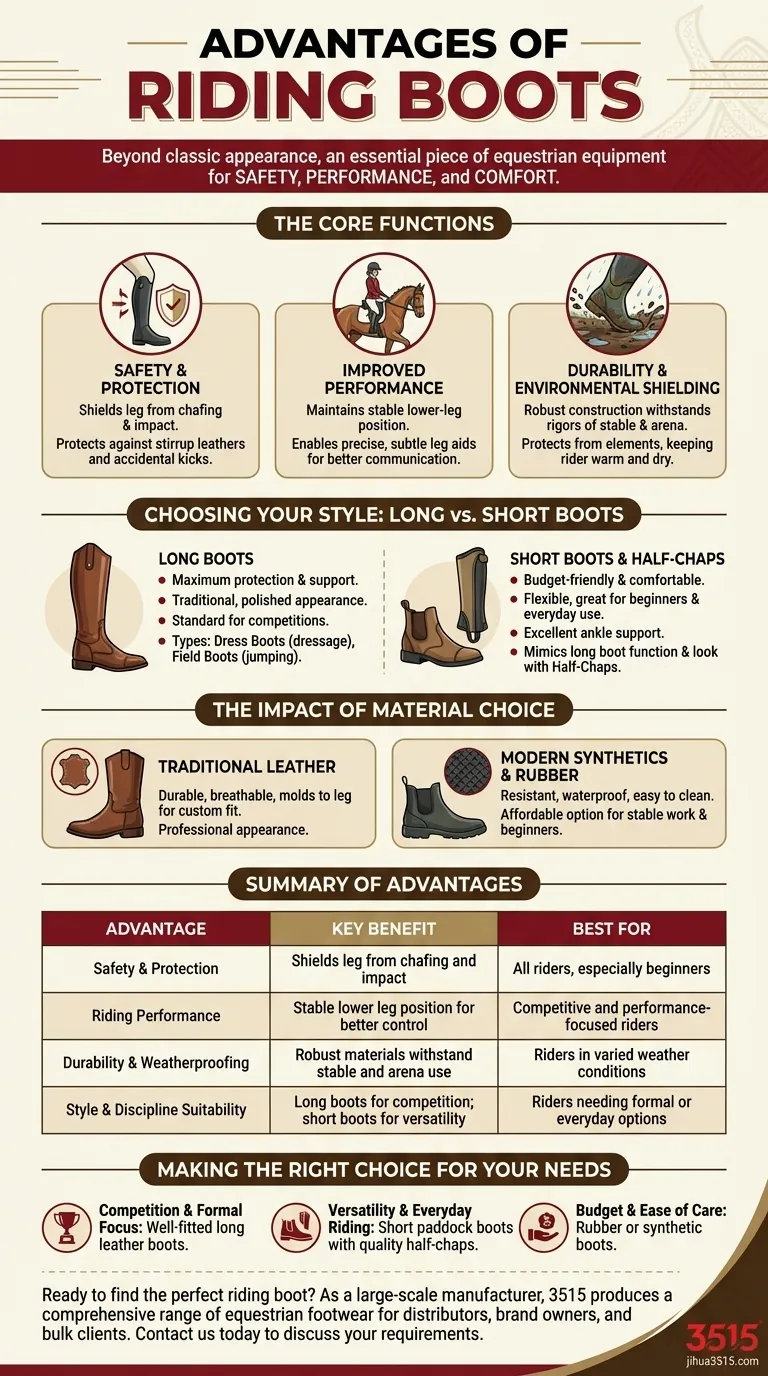
Visual Guide
Related Products
- Heavy-Duty Waterproof Nubuck Safety Boots Safety Shoes for Bulk Supply
- Premium Wholesale Tactical Style Safety Shoes Boots with Quick Lacing
- Wholesale High-Traction Camo Boots - Custom Manufacturer for Brands
- Wholesale Tactical Boots High-Traction & Reflective for Bulk & Brand Orders
- High-Traction Suede Tactical Boots Wholesale & Custom Manufacturing
People Also Ask
- What primary protective functions do professional safety boots provide in urban solid waste recovery and waste picking processes? Discover Dual-Layer Protection.
- How do safety boots reduce cutting hazards? Essential Protection for Your Workforce
- Which organizations develop safety standards for work boots? Ensure Compliance & Worker Safety
- What are the common types of safety boots and their primary uses? A Guide to Industrial Footwear
- Why is ankle and arch support important in safety footwear? Prevent Injury & Fatigue



















