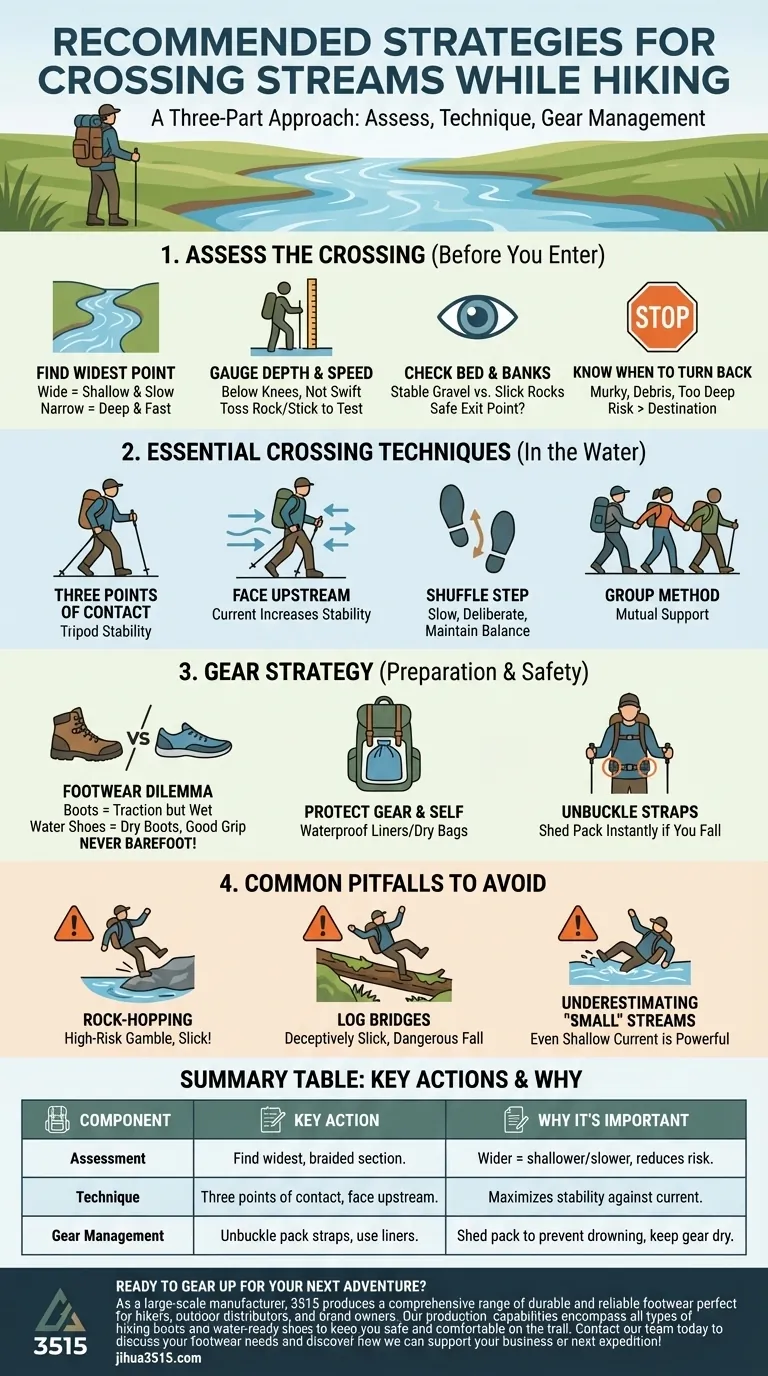
The most effective strategy for crossing a stream involves a three-part approach: first, carefully assessing the water to find the safest crossing point; second, using a specific, stable technique to wade through the current; and third, managing your gear to keep essential items dry and ensure your safety if you fall. Simply changing your shoes is only a small part of a much larger safety system.
The safest path across a stream is almost never a straight line. A successful crossing prioritizes a methodical assessment of the water's depth and speed over the desire to stay dry or cross quickly.
The First Step: Assess the Crossing
Before you even touch the water, your most critical task is to stop and analyze the situation. Rushing this step is the most common mistake hikers make.
Find the Widest Point
Look for the widest, most braided section of the stream. This may seem counterintuitive, but a wider channel forces the water to spread out, making it shallower and slower. A narrow, constricted channel will always be deeper and more powerful.
Gauge Water Depth and Speed
Never enter water without knowing its depth. Toss a rock in to gauge how deep it might be. To check the speed, throw a stick or leaf in and see how fast it moves. A general rule of thumb for safety is to avoid crossing if the water is moving swiftly and is above your knees.
Check the Stream Bed and Banks
Look into the water to see what you'll be walking on. Are the rocks large and slick with algae, or is it a more stable gravel bed? Equally important is the exit point—a steep, muddy bank can be impossible to climb out of even after a successful crossing.
Know When to Turn Back
If the water is murky and you can't see the bottom, if it's carrying large debris like logs, or if it is simply too deep or fast, the correct decision is to turn back. No destination is worth the risk of being swept away.
Essential Crossing Techniques
Once you've chosen the safest possible location, your physical technique determines your stability in the current.
Maintain Three Points of Contact
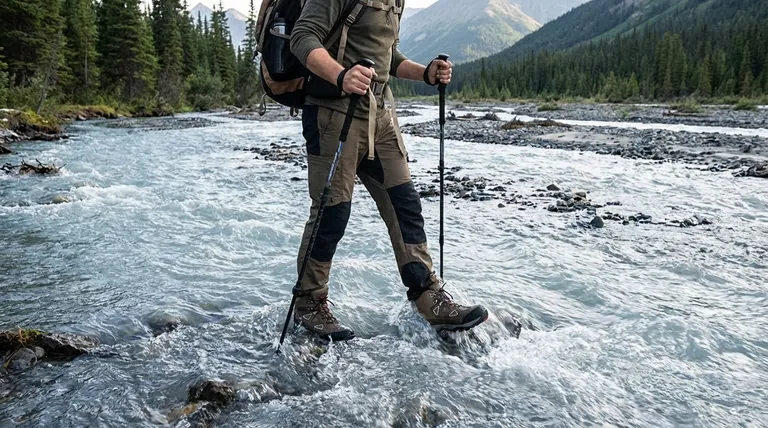
This is the fundamental principle of stability. Use two trekking poles and one foot, or two feet and one pole, to create a stable tripod at all times. Plant your poles firmly before you move your feet.
Face Upstream
Always face into the current. The water pressure will help push your legs and poles into the stream bed, increasing your stability. If you turn sideways, the current will push you off balance.
Use the Shuffle Step
Never cross your feet. Instead, use a slow, deliberate shuffle step. Plant your poles, move one foot, plant it firmly, then move the other. This ensures you are always balanced and can feel the stream bed before committing your full weight.
The Group Method
If crossing with others, the strongest person can go first to fix a line, or the group can link arms or hold onto each other's pack straps to form a stable line or triangle, providing mutual support.
Gear Strategy: What to Wear and How to Pack
Properly managing your gear prevents discomfort and, more importantly, can save your life in a fall.
The Footwear Dilemma
Crossing in your hiking boots provides the best traction and ankle support but leaves you with wet boots for the rest of your trip, risking blisters and discomfort. However, for a short, simple crossing, it can be the fastest option.
The Case for Dedicated Water Shoes
The best practice is to carry a pair of lightweight sandals with a heel strap, water shoes, or even Crocs. This keeps your primary hiking boots dry. Some hikers wear socks inside their water shoes to help prevent chafing from grit. Never cross barefoot; the risk of a severe foot injury on a sharp rock is extremely high.
Protect Your Gear
Use a waterproof pack liner or dry bags for critical gear like your sleeping bag, electronics, and spare clothes. Before you enter the water, unbuckle your pack's hip belt and sternum strap. If you fall, you must be able to shed your pack instantly so it doesn't drag you under the water.
Common Pitfalls to Avoid
Seemingly easy shortcuts are often the most dangerous traps. A controlled wade is almost always safer than attempting to stay perfectly dry.
The Lure of Rock-Hopping
Jumping from rock to rock is a high-risk gamble. A single wet, mossy rock can lead to a serious fall, causing fractures or a head injury far from help.
The Deceptive Log Bridge
A fallen log looks like a perfect bridge, but they are often incredibly slick, especially when wet or mossy. A fall from a log can be much more dangerous than wading through knee-deep water.
Underestimating "Small" Streams
Even shallow water can have a surprisingly powerful current. A swift six inches of water is enough to knock you off your feet if you aren't using poles and proper technique. Treat every crossing with respect.
Making the Right Choice for Your Goal
Your approach should be dictated by the conditions and your primary objective.
- If your primary focus is maximum safety: Always find the widest, shallowest point, use trekking poles for three points of contact, and face upstream with a shuffle step.
- If your primary focus is comfort and efficiency: Carry dedicated water shoes and a small towel, allowing you to keep your main boots dry without sacrificing grip and foot protection.
- If you encounter high, fast, or murky water: Your only goal is to find a much safer crossing upstream or downstream, or to turn back and try another day.
Ultimately, crossing a stream safely is a skill built on careful judgment, not on luck or brute force.
Summary Table:
| Strategy Component | Key Action | Why It's Important |
|---|---|---|
| Assessment | Find the widest, braided section of the stream. | Wider sections are shallower and slower, reducing risk. |
| Technique | Use three points of contact (poles/feet) and face upstream. | Maximizes stability against the current. |
| Gear Management | Unbuckle pack straps and use waterproof liners. | Allows you to shed your pack if you fall, preventing drowning. |
Ready to Gear Up for Your Next Adventure? As a large-scale manufacturer, 3515 produces a comprehensive range of durable and reliable footwear perfect for hikers, outdoor distributors, and brand owners. Our production capabilities encompass all types of hiking boots and water-ready shoes to keep you safe and comfortable on the trail.
Contact our team today to discuss your footwear needs and discover how we can support your business or next expedition!
Visual Guide