
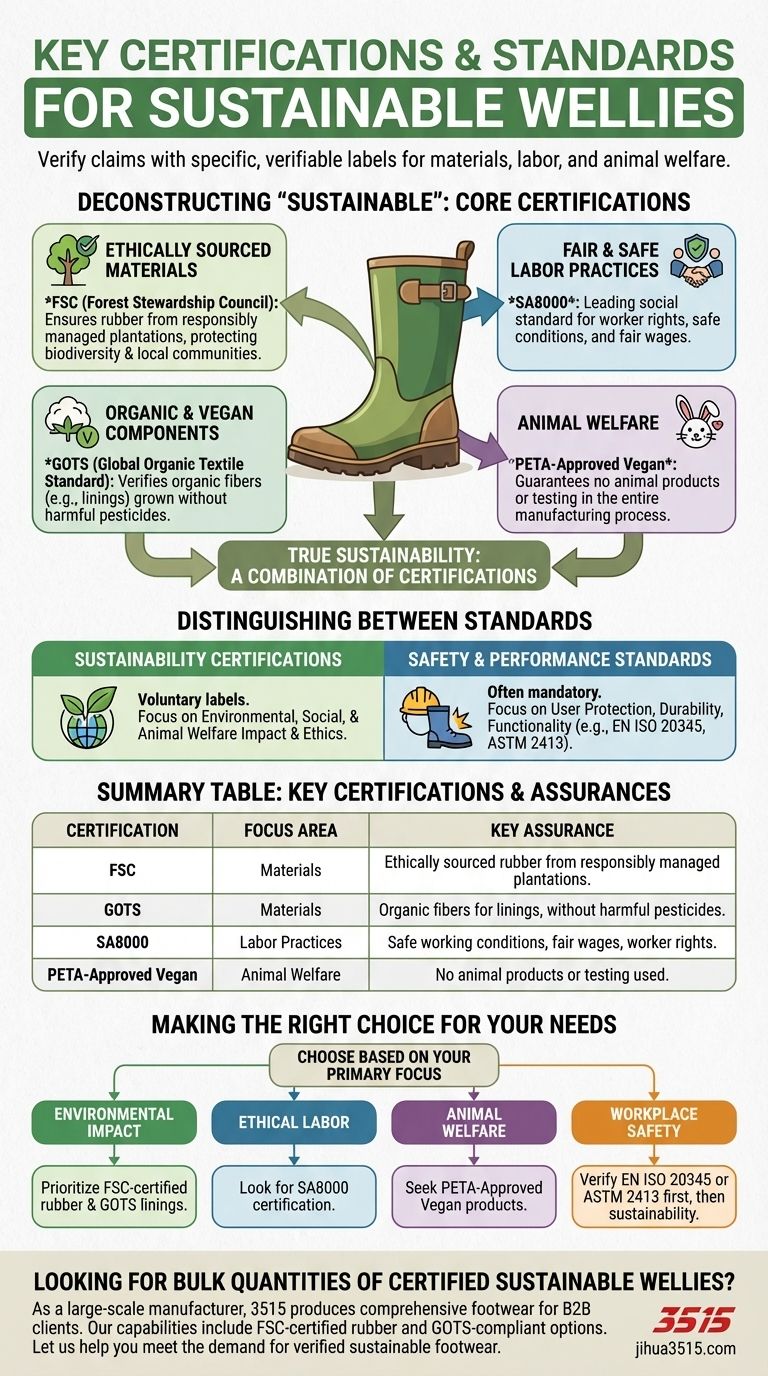
To verify a welly's sustainability claims, you must look beyond general marketing and focus on specific, verifiable certifications. Key labels to seek out include the Forest Stewardship Council (FSC) for rubber, the Global Organic Textile Standard (GOTS) for linings, SA8000 for social accountability, and PETA-Approved Vegan for animal welfare.
True sustainability in wellies isn't defined by a single label, but by a combination of certifications covering material sourcing, ethical labor, and animal welfare. It's crucial to distinguish these from performance or safety standards, which address durability and protection, not environmental or social impact.
Deconstructing "Sustainable": What to Look For
A truly sustainable brand integrates ethical and environmental principles throughout its entire manufacturing process. These certifications are your proof.
Ethically Sourced Materials
The primary material in a welly is often natural rubber. How this rubber is farmed has a significant environmental impact.
The Forest Stewardship Council (FSC) certification ensures the rubber comes from a plantation that is managed to preserve biological diversity and benefit the lives of local people and workers.
Fair and Safe Labor Practices
Sustainability extends to the people involved in production. Verifying a brand's claims about fair labor requires a dedicated social standard.
The SA8000 standard is a leading social certification that holds companies accountable for worker's rights, ensuring safe working conditions and fair wages.
Organic and Vegan Components
Many wellies include textile linings for comfort. Additionally, the glues and materials used can sometimes involve animal by-products.
The Global Organic Textile Standard (GOTS) is the top certification for organic fibers, verifying that materials like cotton linings are grown without harmful pesticides.
A PETA-Approved Vegan certification guarantees that no animal products were used and no animal testing occurred at any point in the manufacturing process.
Distinguishing Between Standards
A common point of confusion is the difference between sustainability certifications and mandatory safety standards. They serve entirely different purposes.
The Role of Sustainability Certifications
These are voluntary labels a brand earns to prove its commitment to environmental, social, or animal welfare goals. They answer questions about impact and ethics.
The Role of Safety Standards
These are often legally required for footwear used in professional or hazardous environments. They focus exclusively on user protection.
Standards like EN ISO 20345 and ASTM 2413 specify requirements for features like protective toe caps that can withstand 200 joules of impact. A welly can be a certified safety boot, but this says nothing about its sustainability.
The Role of Performance Standards
This broad category covers the general quality and functionality of footwear. These standards ensure a boot fits correctly, provides comfort, and is durable enough for its intended use, such as hiking or running.
Making the Right Choice for Your Needs
Use these certifications to filter brands based on what matters most to you.
- If your primary focus is environmental impact: Prioritize wellies made from FSC-certified natural rubber and featuring GOTS-certified linings.
- If your primary focus is ethical labor: Look specifically for the SA8000 certification to ensure the fair treatment of workers.
- If your primary focus is animal welfare: Seek out products that are explicitly marked as PETA-Approved Vegan.
- If your primary focus is workplace safety: Verify compliance with EN ISO 20345 or ASTM 2413 first, then look for sustainability labels as a secondary benefit.
Armed with this understanding, you can now look past marketing claims and choose footwear that truly aligns with your values.
Summary Table:
| Certification | Focus Area | Key Assurance |
|---|---|---|
| FSC | Materials | Ethically sourced rubber from responsibly managed plantations. |
| GOTS | Materials | Organic fibers for linings, grown without harmful pesticides. |
| SA8000 | Labor Practices | Safe working conditions, fair wages, and worker rights. |
| PETA-Approved Vegan | Animal Welfare | No animal products or testing used in manufacturing. |
Looking for bulk quantities of certified sustainable wellies? As a large-scale manufacturer, 3515 produces a comprehensive range of footwear for distributors, brand owners, and bulk clients. Our production capabilities encompass all types of shoes and boots, including FSC-certified rubber and GOTS-compliant options. Let us help you meet the growing demand for verified sustainable footwear. Contact us today to discuss your production needs!
Visual Guide
Related Products
- Durable Waterproof Rain Boots | Custom Manufacturer for Wholesale & Brands
- Durable Goodyear Welt Leather Work Boots for Wholesale & Private Label
- Durable Leather Moc Toe Work Boots for Wholesale & Custom Manufacturing
- Durable Leather High-Ankle Tactical Boots for Wholesale & Custom Manufacturing
- Durable Rubber Sole Outdoor Shoes Wholesale & Custom Manufacturing
People Also Ask
- What are the main materials for waterproof rain boots? Choose the Right Material for Durability & Comfort
- What is the overall recommendation for choosing rain boot materials? A Guide to Rubber vs. PVC
- How does boot height affect waterproofing? Choose the Right Height for Ultimate Protection
- Why are rain boots more flexible and comfortable than snow boots? The Key Differences Explained
- What are the best types of shoes for different gardening conditions? Find Your Perfect Match.










