
At their core, motorcycle boots are specialized safety equipment. They are engineered footwear designed to provide motorcyclists with critical protection from impact and abrasion, structural support against crushing and twisting forces, and a secure connection to the motorcycle's controls. They are built with durable materials, like reinforced leather and advanced textiles, to withstand the unique hazards of riding.
The single most important concept to understand is that motorcycle boots are not fashion; they are a purpose-built system to protect your feet and ankles in a crash. Unlike standard shoes, they are specifically designed to resist the violent twisting, crushing, and sliding forces that are common in motorcycle accidents.
The Anatomy of Protection: What Sets Them Apart
Thinking a sturdy pair of work boots is "good enough" is a common and dangerous misconception. Motorcycle boots incorporate specific, engineered features that are entirely absent in other types of footwear.
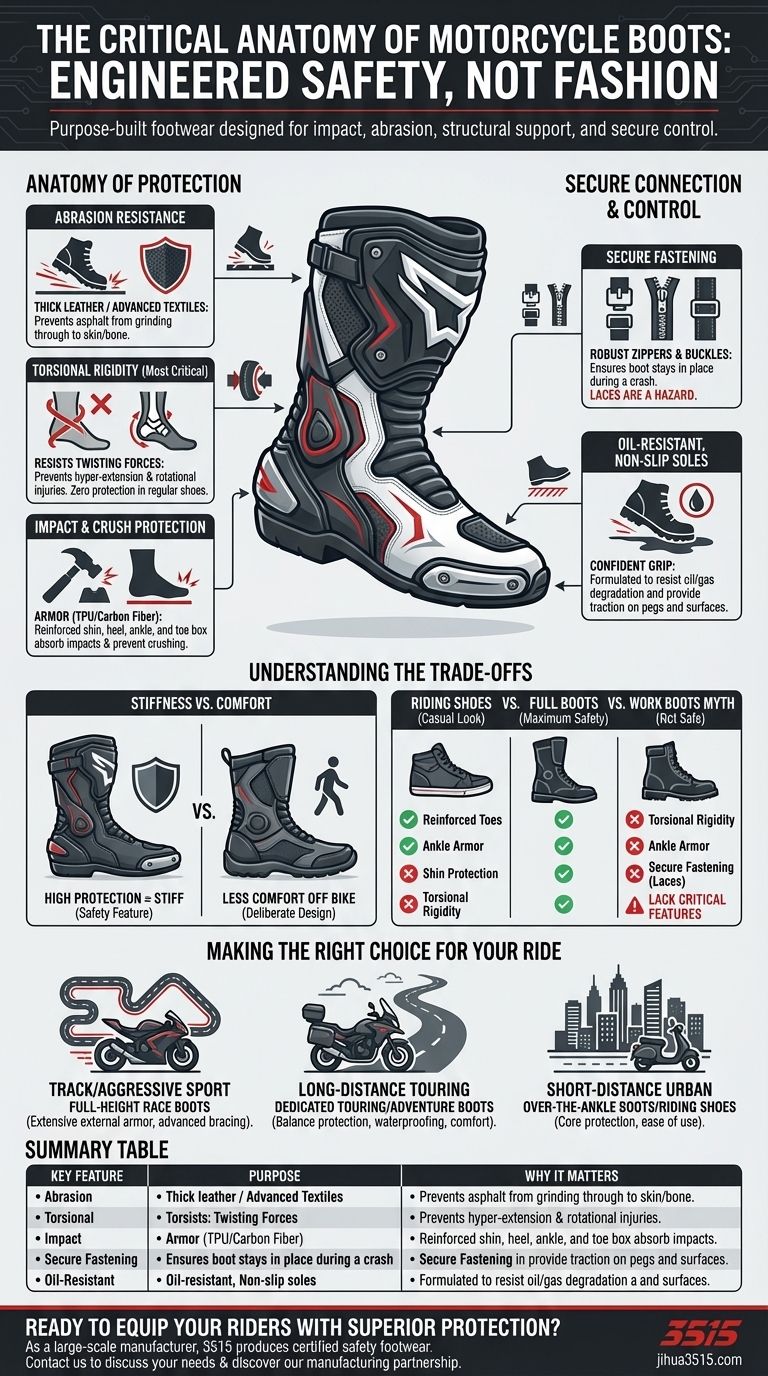
Abrasion Resistance
Your feet are highly vulnerable to sliding across the pavement in a crash. Motorcycle boots use thick leather or advanced abrasion-resistant textiles to keep the asphalt from grinding through to your skin and bone.
Torsional Rigidity
This is arguably the most critical protective feature. Torsional rigidity is the boot's resistance to twisting. It prevents your ankle from hyper-extending, rotating, or breaking in a tumbling crash—an injury that regular shoes offer zero protection against.
Impact and Crush Protection
Boots are reinforced with armor, often made of thermoplastic polyurethane (TPU) or carbon fiber. This armor is placed in key areas like the shin, heel, ankle, and toe box to absorb direct impacts and prevent your foot from being crushed under the weight of the bike.
Secure Fastening
Motorcycle boots use robust zippers, buckles, and hook-and-loop closures. This ensures the boot stays firmly in place during a crash. Standard laces are a significant hazard, as they can loosen or get caught on the bike's footpegs or controls.
Oil-Resistant, Non-Slip Soles
The sole of a riding boot provides a confident grip on the footpegs and on the ground when you stop. They are specifically formulated to resist degrading from exposure to oil and gasoline, preventing slips on uncertain road surfaces.
Understanding the Trade-offs
Choosing motorcycle footwear involves balancing absolute protection with practical usability. This is a decision every rider must make based on their needs.
The Stiffness Dilemma
A high-protection boot is, by design, very stiff. This torsional rigidity is what saves your ankle, but it also makes the boot less comfortable for walking around off the bike. This is not a design flaw; it is a deliberate safety feature.
"Riding Shoes" vs. Full Boots
Many companies offer more casual-looking "riding shoes" that resemble sneakers or high-tops. While they are a significant improvement over standard shoes—typically including reinforced toes and ankle armor—they often sacrifice shin protection and the critical torsional rigidity found in a proper boot.
The Myth of Work Boots
Heavy work boots, even those with steel toes, are not a safe substitute. They lack torsional rigidity, have no dedicated ankle armor, and often rely on laces that can become a hazard. A steel toe is designed for drop protection, not the crushing and sliding forces of a motorcycle crash.
Making the Right Choice for Your Ride
Your choice of boot should directly reflect the type of riding you do most often.
- If your primary focus is maximum track or aggressive sport riding: Choose full-height race boots with extensive external armor and advanced ankle-bracing systems.
- If your primary focus is long-distance touring: Look for dedicated touring or adventure boots that balance robust protection with waterproofing and a bit more walking comfort.
- If your primary focus is short-distance urban commuting: Consider over-the-ankle boots or certified riding shoes that offer core protection like ankle armor and a reinforced sole, prioritizing ease of use.
Ultimately, proper motorcycle boots are an essential investment in your ability to control your motorcycle and walk away from an accident.
Summary Table:
| Key Feature | Purpose | Why It Matters |
|---|---|---|
| Abrasion Resistance | To prevent pavement from grinding through to skin/bone during a slide. | Uses thick leather or advanced textiles. |
| Torsional Rigidity | To resist twisting forces and prevent ankle/leg injuries. | The most critical feature; prevents hyper-extension. |
| Impact & Crush Protection | To absorb direct impacts from the bike or road. | Armor (TPU/carbon) on shin, heel, ankle, and toe. |
| Secure Fastening | To ensure the boot stays on during a crash. | Uses buckles/zippers; avoids hazardous laces. |
| Oil-Resistant Sole | To provide a secure grip on footpegs and slippery surfaces. | Prevents slips from oil/gasoline exposure. |
Ready to Equip Your Riders with Superior Protection?
As a large-scale manufacturer, 3515 produces a comprehensive range of certified safety footwear for distributors, brand owners, and bulk clients. Our production capabilities encompass all types of protective motorcycle boots and riding shoes, engineered with the critical features outlined above to ensure rider safety without compromising on quality or durability.
Contact us today to discuss your footwear needs and discover how we can become your trusted manufacturing partner.
Visual Guide
Related Products
- Wholesale Tactical Boots High-Traction & Reflective for Bulk & Brand Orders
- High Performance Fire-Retardant Waterproof Safety Boots
- Durable Goodyear Welt Leather Work Boots for Wholesale & Private Label
- Wholesale High-Traction Camo Boots - Custom Manufacturer for Brands
- Heavy-Duty Waterproof Nubuck Safety Boots Safety Shoes for Bulk Supply
People Also Ask
- How do tactical boots protect against injuries? Discover the Integrated Safety System
- What are the advantages and disadvantages of tactical boots? Lightweight Comfort vs. Rugged Durability
- How is the compatibility of polymer materials demonstrated in smart footwear? Enhancing Tactical & Training Performance
- What are the consequences of wearing ill-fitting tactical boots? Avoid Injury and Boost Performance
- Why is the footwear standardization essential in ambient temperature studies? Ensure Scientific Data Accuracy



















