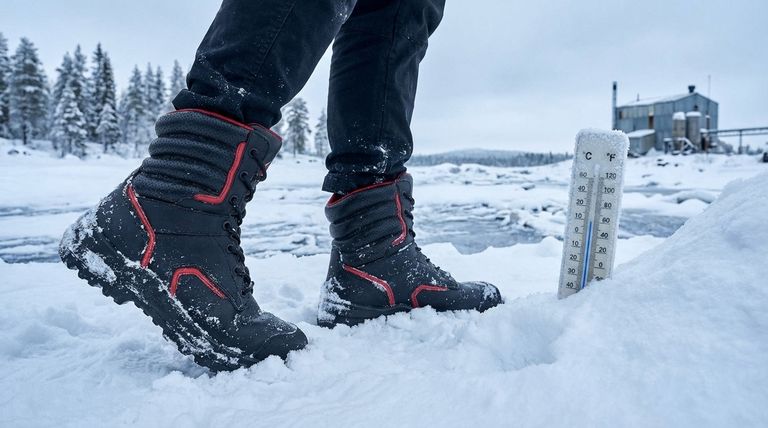
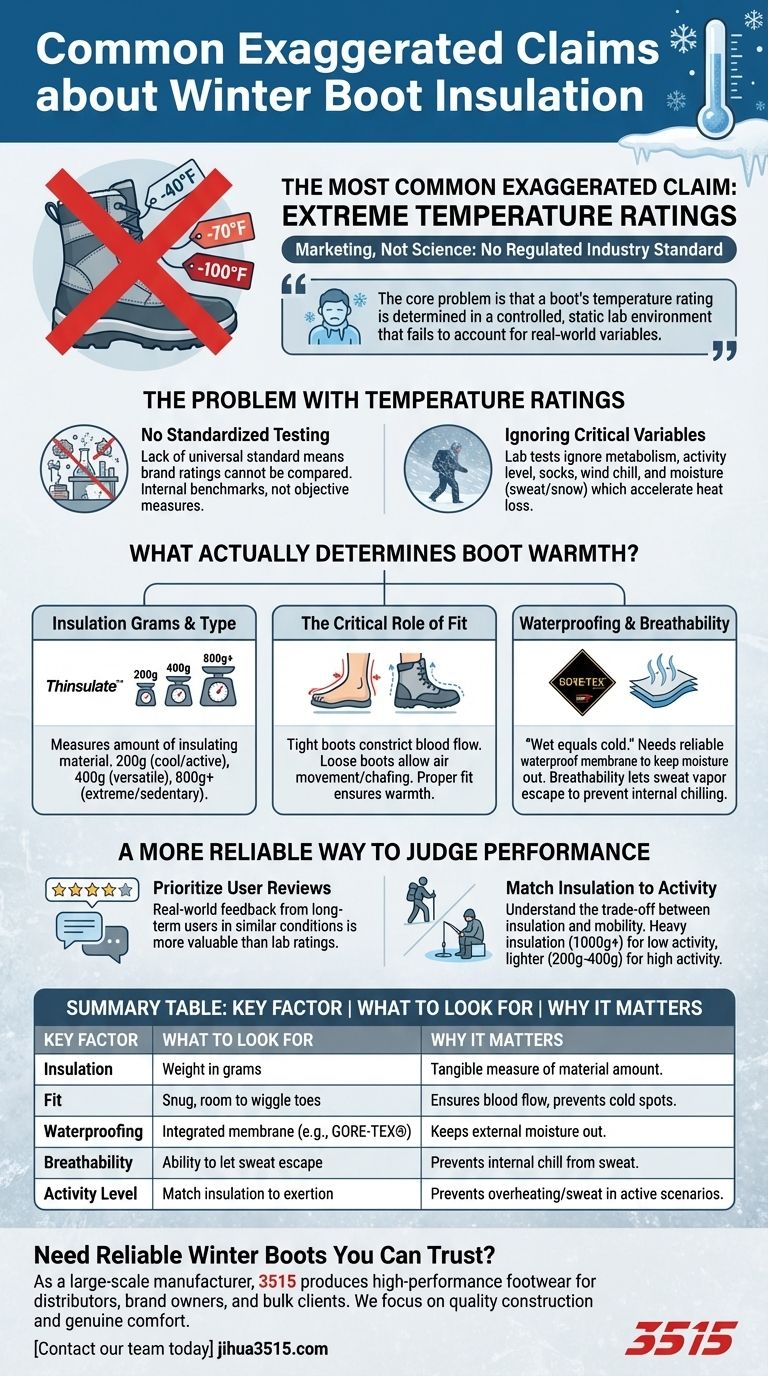
The most common exaggerated claim about winter boot insulation is the extreme temperature rating, such as a boot being rated for -40°F, -70°F, or even -100°F. These numbers are often presented as a scientific guarantee of performance but are primarily a marketing tool. Because there is no regulated industry standard for testing, these ratings are not a reliable way to compare the actual warmth of different boots.
The core problem is that a boot's temperature rating is determined in a controlled, static lab environment that fails to account for real-world variables. True warmth is a result of insulation material, activity level, fit, and moisture management, not a single, often misleading number.
The Problem with Temperature Ratings
To make an informed choice, you must first understand why a simple temperature rating on a box is fundamentally unreliable. It promises a simplicity that doesn't exist when battling the cold.
No Standardized Testing
The central issue is the lack of a universal, government-regulated, or industry-wide standard for how these temperature ratings are determined. One brand's "-40°F" test might involve a stationary mannequin, while another's might be purely theoretical.
This means you cannot compare the ratings between different manufacturers with any degree of confidence. It's an internal benchmark, not an objective measure.
Ignoring Critical Variables
A static lab test completely ignores the dynamic factors that determine if your feet stay warm. These include your personal metabolism, your activity level (hiking vs. standing still), and the type of socks you are wearing.
Furthermore, a rating doesn't account for wind chill or moisture from sweat or snow, both of which dramatically accelerate heat loss and can make even a highly-rated boot feel cold.
What Actually Determines Boot Warmth?
Instead of focusing on a single number, a more effective approach is to evaluate the components and construction of the boot itself. These factors provide a much clearer picture of its potential performance.
Insulation Grams and Type
A more useful metric is the weight of the insulation, measured in grams (e.g., 200g, 400g, 800g of Thinsulate™ or a similar synthetic). While not perfect, this gives you a tangible way to compare the amount of insulating material.
Generally, 200g is for cool conditions or high activity, 400g is a versatile all-around choice, and 800g or more is intended for extreme cold and sedentary activities like ice fishing.
The Critical Role of Fit
No amount of insulation will work if the boot fits poorly. A boot that is too tight will constrict blood flow to your toes, causing them to get cold regardless of the boot's rating.
Conversely, a boot that is too loose allows for too much air movement and can cause chafing, making it inefficient and uncomfortable.
Waterproofing and Breathability
The phrase "wet equals cold" is a law in winter conditions. A boot must have a reliable waterproof membrane (like GORE-TEX®) to keep external moisture from snow and slush out.
Equally important is breathability. Your feet sweat, and if that moisture is trapped, it will cool and chill your feet from the inside out. A good winter boot lets this water vapor escape.
A More Reliable Way to Judge Performance
Since marketing claims are unreliable, you must shift your evaluation criteria toward more practical and objective measures.
Prioritize User Reviews
The most valuable information comes from long-term users who have worn the boots in conditions similar to yours. Look for detailed reviews that discuss the specific activities performed and the temperatures encountered.
This real-world feedback is infinitely more valuable than a number printed on a box. It tells you how the boot actually performs when faced with real weather and human factors.
Match Insulation to Activity
Understand the trade-off between insulation and mobility. A heavily insulated boot with 1000g of insulation will be incredibly warm for sitting in a deer stand but will be bulky, heavy, and likely cause your feet to sweat excessively during a winter hike.
Always choose the boot that is appropriate for your intended level of physical exertion.
Making the Right Choice for Your Goal
Ignore the extreme temperature claims and focus on matching the boot's construction to your specific needs.
- If your primary focus is high-activity use (like snowshoeing): Opt for a waterproof and breathable boot with moderate insulation (200g-400g) to prevent overheating and sweat buildup.
- If your primary focus is low-activity use (like ice fishing or winter spectating): Prioritize higher insulation grams (800g+) and a thick sole to insulate your feet from the cold ground.
- If your primary focus is versatile daily wear: A waterproof boot with around 200g of insulation offers a great balance of warmth and comfort for commuting and general use without being too bulky.
Ultimately, your warmth and comfort depend on understanding the system of insulation, fit, and activity, not on trusting a single marketing number.
Summary Table:
| Key Factor | What to Look For | Why It Matters |
|---|---|---|
| Insulation | Weight in grams (e.g., 200g, 400g, 800g) | A tangible measure of the amount of insulating material. |
| Fit | Snug but not tight, with room to wiggle toes. | Proper fit ensures blood flow and prevents cold spots. |
| Waterproofing | Integrated membrane (e.g., GORE-TEX®). | Keeps external moisture from snow and slush out. |
| Breathability | Ability to let sweat vapor escape. | Prevents internal moisture buildup that causes chilling. |
| Activity Level | Match insulation to your exertion (e.g., hiking vs. standing). | Prevents overheating and sweat in active scenarios. |
Need Reliable Winter Boots You Can Trust?
As a large-scale manufacturer, 3515 produces a comprehensive range of high-performance footwear for distributors, brand owners, and bulk clients. We understand that true warmth comes from quality construction, not exaggerated claims.
Our production capabilities encompass all types of insulated boots, engineered with the right balance of insulation, waterproofing, and breathability for any climate or activity. Let us help you provide your customers with boots that deliver genuine comfort and performance.
Contact our team today to discuss your winter footwear needs and explore our manufacturing solutions.
Visual Guide
Related Products
- Premium Insulated Safety Boots and Shoes for Wholesale & Bulk Orders
- Premium Wholesale Waterproof Safety Boots High Performance Protection for Industrial Markets
- Factory Direct Wholesale Rain Boots Durable Waterproof & Fully Customizable
- Durable Waterproof Rain Boots | Custom Manufacturer for Wholesale & Brands
- High Performance Fire-Retardant Waterproof Safety Boots
People Also Ask
- What are the recommended insulation ratings for mild winter conditions? A Guide for Active & Stationary Workers
- How does insulation thickness correlate with temperature ranges? A Guide to Choosing the Right Warmth
- What insulation level is needed for severe cold and stationary work? 1200g or Higher is Essential
- What safety advantages do insulated boots offer beyond warmth? Dielectric Protection & Superior Grip
- How does fleece lining contribute to the warmth of insulated boots? Trapping Air for Superior Cold Protection