
Gore-Tex breathes most effectively in cold, dry conditions. Its performance is driven by a difference in temperature and humidity between the warm, moist air inside your jacket and the colder, drier air outside. When this gradient is strong, moisture vapor from your sweat is actively pushed through the membrane.
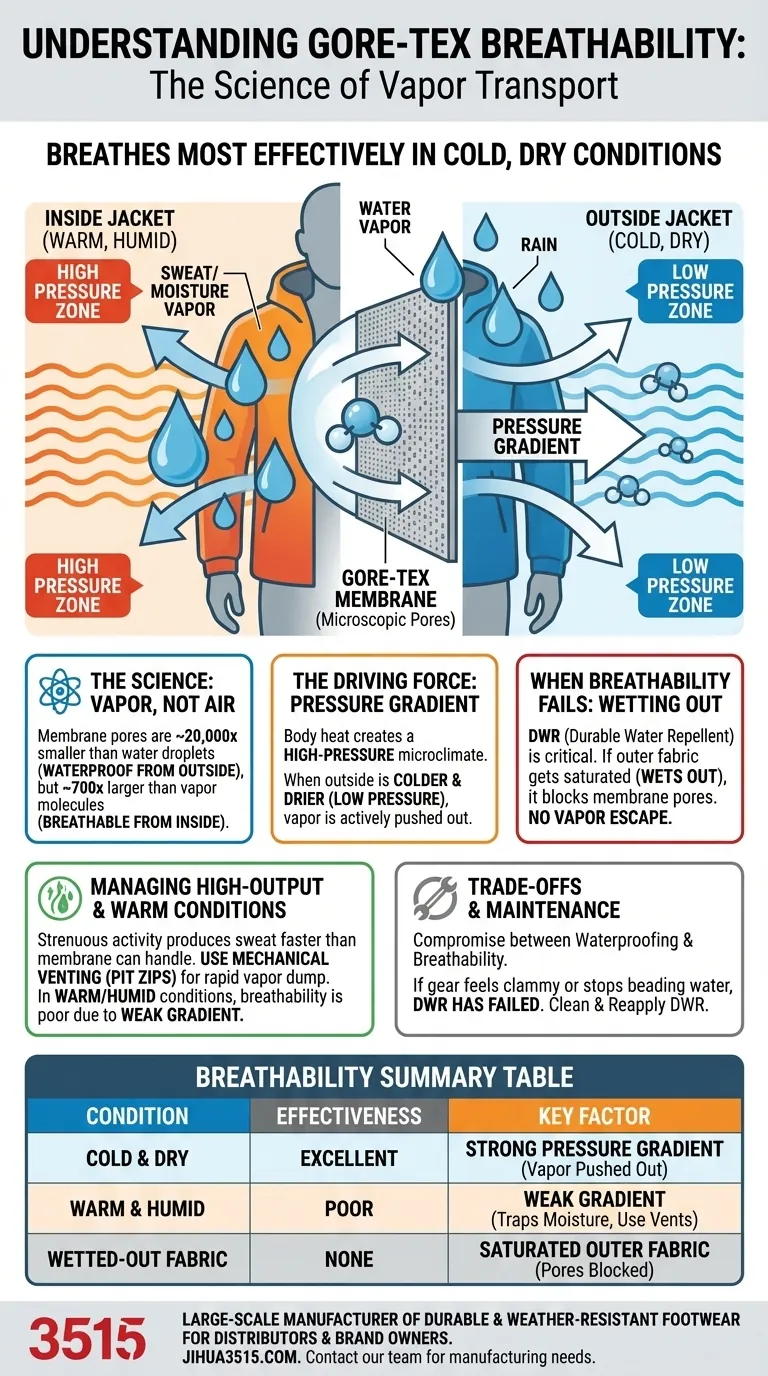
Gore-Tex doesn't "breathe" air; it transports moisture vapor. This process relies entirely on a pressure gradient, moving moisture from a high-pressure (warm, damp) zone to a low-pressure (cold, dry) one. When that gradient disappears, so does the "breathability."
The Science of Breathability
It’s About Vapor, Not Air
The core of Gore-Tex is a membrane with billions of microscopic pores per square inch. These pores are about 20,000 times smaller than a water droplet, making it waterproof from the outside.
Crucially, these same pores are about 700 times larger than a water vapor molecule. This allows sweat, in its gaseous state, to escape from the inside.
The Driving Force: A Pressure Gradient
Effective breathability depends on creating a difference in vapor pressure. Your body heat warms the air and moisture inside your jacket, creating a high-pressure microclimate.
When the air outside is colder and less humid (low pressure), this gradient actively pushes the warm, moist air out through the membrane's pores. The greater the difference, the more efficiently the fabric "breathes."
When Breathability Fails
The Warm, Humid Environment Problem
In warm, humid, or rainy conditions, the outside air is already saturated with moisture. The vapor pressure outside the jacket is nearly equal to or even higher than the pressure inside.
With no significant gradient, there is no force to push your sweat vapor out. The moisture gets trapped, and you feel clammy, even though the jacket isn't leaking.
The Critical Role of DWR
The outer fabric of a Gore-Tex garment is not the waterproof layer; it's a protective face fabric treated with a Durable Water Repellent (DWR) finish. This coating makes water bead up and roll off.
DWR is essential for breathability. It keeps the face fabric from becoming saturated with water, ensuring the microscopic pores of the Gore-Tex membrane underneath remain clear and able to transport vapor.
Fabric "Wetting Out": The Breathability Killer
When the DWR wears off from dirt, abrasion, or washing, the outer fabric absorbs water and becomes saturated. This phenomenon is called "wetting out."
A wet outer fabric creates a continuous film of water that physically blocks the pores of the Gore-Tex membrane. It's like covering a screen door with plastic wrap—nothing can pass through. This is the most common reason a high-quality jacket suddenly feels like a cheap plastic bag.
Understanding the Trade-offs
Waterproofing vs. Breathability
There is an inherent engineering compromise between being fully waterproof and fully breathable. Gore-Tex is designed to be, first and foremost, a barrier against liquid water.
While it is a leader in breathable performance, no waterproof fabric can transport moisture as fast as your body can produce it during intense physical exertion.
Managing High-Output Activity
During strenuous activity like running or climbing, you will likely generate sweat faster than any waterproof-breathable membrane can handle.
This is why features like pit zips are essential. They provide mechanical venting to dump heat and moisture vapor far more rapidly than the fabric alone ever could, helping the Gore-Tex membrane keep up.
Making the Right Choice for Your Goal
To get the most from your gear, you must match its capabilities to the environmental conditions and your activity level.
- If your primary focus is activity in cold, dry climates (e.g., skiing, winter hiking): Gore-Tex will perform exceptionally well, efficiently moving moisture away from your body.
- If your primary focus is activity in warm, humid climates (e.g., tropical trekking, summer rain): Gore-Tex will keep you dry from rain but will feel significantly less breathable; prioritize jackets with large vents like pit zips.
- If your jacket stops beading water and feels clammy: Your gear's breathability is compromised because the DWR has failed. You must clean the garment and reapply a DWR treatment to restore its performance.
Understanding these principles allows you to use your gear as an effective environmental management system, not just a single piece of clothing.
Summary Table:
| Condition | Breathability Effectiveness | Key Factor |
|---|---|---|
| Cold & Dry | Excellent | Strong temperature/humidity gradient pushes vapor out. |
| Warm & Humid | Poor | Weak gradient traps moisture; mechanical venting is key. |
| Wetted-Out Fabric | None | Saturated outer fabric blocks the membrane's pores. |
Need high-performance footwear for demanding environments? As a large-scale manufacturer, 3515 produces a comprehensive range of durable and weather-resistant footwear and boots for distributors, brand owners, and bulk clients. Our expertise ensures your gear meets the highest standards of protection and performance. Contact our team today to discuss your manufacturing needs.
Visual Guide
Related Products
- Wholesale Waterproof Tactical Boots Custom Suede & High-Traction Soles
- High-Traction Suede Tactical Boots Wholesale & Custom Manufacturing
- Durable Leather Work Boots for Wholesale & Custom Manufacturing
- Custom Manufactured Air Cushion Leather Business Shoes for Wholesale
- Durable Leather Moc Toe Work Boots for Wholesale & Custom Manufacturing
People Also Ask
- What waterproof technology is used in tactical boots? Unlock All-Weather Performance & Protection
- What are the advantages and disadvantages of waterproof tactical boots? A Guide to the Key Trade-Offs
- What is the significance of waterproof functionality in tactical boots? Essential for Health & Performance
- What is the role of professional 3D medical imaging software in optimizing tactical boot design and performance?
- What features enhance breathability and comfort in tactical boots? A Guide to Superior Footwear Performance





