
Okay, here's what I'm thinking. The user needs clear, direct guidance on sleeping with a walking boot. Let's get right to it: Yes, you should wear your walking boot while sleeping, particularly during the critical initial recovery phase. This is standard practice for several reasons, and I need to lay them out clearly.
Wearing a walking boot to bed is a non-negotiable part of the healing process for many lower leg and foot injuries. Its purpose is to immobilize the joint and protect it from accidental movements during sleep, which could otherwise delay or compromise your recovery.
My thinking is that it's crucial to break this down. First, there's the why. Then, we'll talk how to make it manageable. And finally, some practical advice to wrap it all up.
The Critical Role of Nighttime Immobilization
It's natural to toss and turn at night, and we often forget about an injury during sleep. The walking boot acts as a crucial barrier.
- Preventing Unintentional Movement: We move unconsciously in our sleep, and that can lead to kicks or other movements that are detrimental to healing. The boot acts as a physical shield.
- Maintaining Proper Ankle Position: Leaving your ankle pointed (plantarflexed) for extended periods while sleeping can delay healing, and even contribute to scar tissue formation. The boot keeps the ankle neutral, in the optimal position for recovery.
- Avoiding Accidental Pressure: We might accidentally roll over or place weight on the injured foot, even briefly, without realizing it. This can lead to setbacks.
Managing Discomfort and Practical Concerns
Let's address the elephant in the room: sleeping in a boot isn't comfortable. But there are ways to manage it:
- Adjusting for Comfort: It's acceptable to loosen the straps slightly for sleeping, but only enough to maintain a secure fit. The boot still needs to provide support.
- When Can It Be Removed? Generally, the boot should only be removed for specific activities like showering, as instructed by your doctor.
- Addressing Pressure Points: Doctor-recommended gels or extra padding can provide relief for pressure points. It's about finding a balance between immobilization and comfort.
Key Principles for a Successful Recovery
Okay, let's make this actionable. It's about following protocol.
- If your primary focus is protecting the injury: Always wear the boot to bed to prevent accidental kicks or pressure that could cause a serious setback.
- If your primary focus is ensuring proper healing: Keeping the boot on maintains the optimal, neutral position for your foot and ankle, which is crucial for ligaments and bones to mend correctly.
- If your primary focus is managing discomfort: You can slightly loosen the straps for sleeping, but never remove the boot entirely without your doctor's explicit instruction.
Consistently wearing your boot as advised is the most direct way to protect your investment in your own healing. We're in this together. As a general rule, yes. You should wear your walking boot while sleeping, especially during the initial and most critical weeks of your recovery. This practice is a key component of the healing process, designed to protect the injured area and ensure it mends in the correct anatomical position.
Wearing a walking boot to bed is not about comfort; it is a critical medical instruction for proper healing. It serves to completely immobilize the foot and ankle, protecting them from the unintentional movements, pressures, and positions that occur during sleep and could otherwise compromise your recovery.
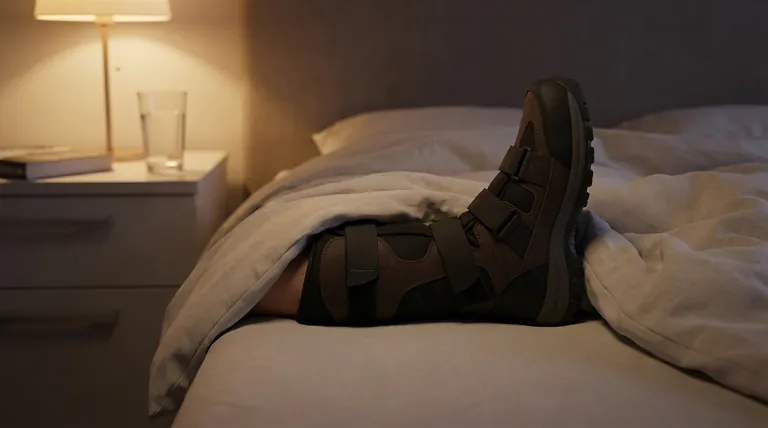
The Critical Role of Nighttime Immobilization
While sleeping with a bulky boot is certainly an adjustment, understanding its protective function is key. During sleep, you lack conscious control over your body, creating risks for an unprotected injury.
Preventing Unintentional Movement
We all shift, turn, and sometimes even kick in our sleep. A walking boot acts as a rigid shield, protecting your injured foot or ankle from accidental impacts against a wall, bedframe, or even your other leg.
Such an impact on an un-booted injury could easily exacerbate the damage and significantly delay your healing time.
Maintaining Proper Ankle Position
When you sleep without a boot, your foot naturally tends to fall into a pointed, downward position (plantar flexion). This extended position is often not ideal for healing, as it can strain recovering ligaments and tendons.
The boot locks your ankle in a neutral, stable position, ensuring the bones and soft tissues mend correctly without being subjected to prolonged stress.
Avoiding Accidental Pressure
In a state of deep sleep, it's possible to forget your injury for a moment and roll over, placing intense pressure on your foot.
This is one of the most significant risks of sleeping without the boot. The rigid shell prevents you from applying weight, even accidentally, which could be catastrophic for a healing fracture.
Managing Discomfort and Common Concerns
The primary drawback of wearing a boot to bed is discomfort. However, the goal is protection, not perfect comfort, and there are ways to make it more manageable.
Adjusting the Straps
While the boot should be snug, it does not necessarily need to be as tight as it is when you are walking. You can often loosen the straps slightly for sleeping to improve comfort and circulation.
Ensure it is still secure enough that your foot does not move around inside the boot.
Addressing Pressure Points
If specific areas are causing pain, consult your doctor. They may recommend using specific gels or padding to alleviate pressure points and make sleeping more tolerable.
When to Remove the Boot
Follow your doctor's instructions precisely. For most acute injuries, the boot should only be removed for bathing or showering. Removing it for sleep, especially in the early weeks, goes against standard medical protocol.
Key Principles for a Successful Recovery
Following your prescribed protocol is the fastest and most reliable path back to full mobility. Your approach should be guided by the nature of your recovery goal.
- If your primary focus is protecting the injury: Always wear the boot to bed to prevent accidental kicks or pressure that could cause a serious setback.
- If your primary focus is ensuring proper healing: Keep the boot on to maintain the optimal, neutral position for your foot and ankle, which is crucial for tissues to mend correctly.
- If your primary focus is managing discomfort: You may slightly loosen the straps for sleeping, but never remove the boot entirely without your doctor's explicit instruction.
Consistently following the prescribed use of your walking boot is the most direct way to protect your investment in your own healing.
Summary Table:
| Aspect | Key Takeaway |
|---|---|
| General Rule | Yes, wear the boot while sleeping, especially during initial recovery. |
| Primary Purpose | Immobilizes the foot/ankle to prevent unconscious movement and pressure. |
| Discomfort Management | Straps can be slightly loosened for sleep, but the boot must remain on. |
| When to Remove | Typically only for bathing, as per your doctor's specific instructions. |
Ready to Find the Right Support for Your Recovery?
As a large-scale manufacturer, 3515 produces a comprehensive range of high-quality orthopedic and protective footwear, including walking boots, for distributors, brand owners, and bulk clients. Our production capabilities ensure durable, comfortable, and medically sound solutions for every stage of recovery.
Let us help you provide the best support for your customers. Contact our team today to discuss your specific needs and explore our product catalog.
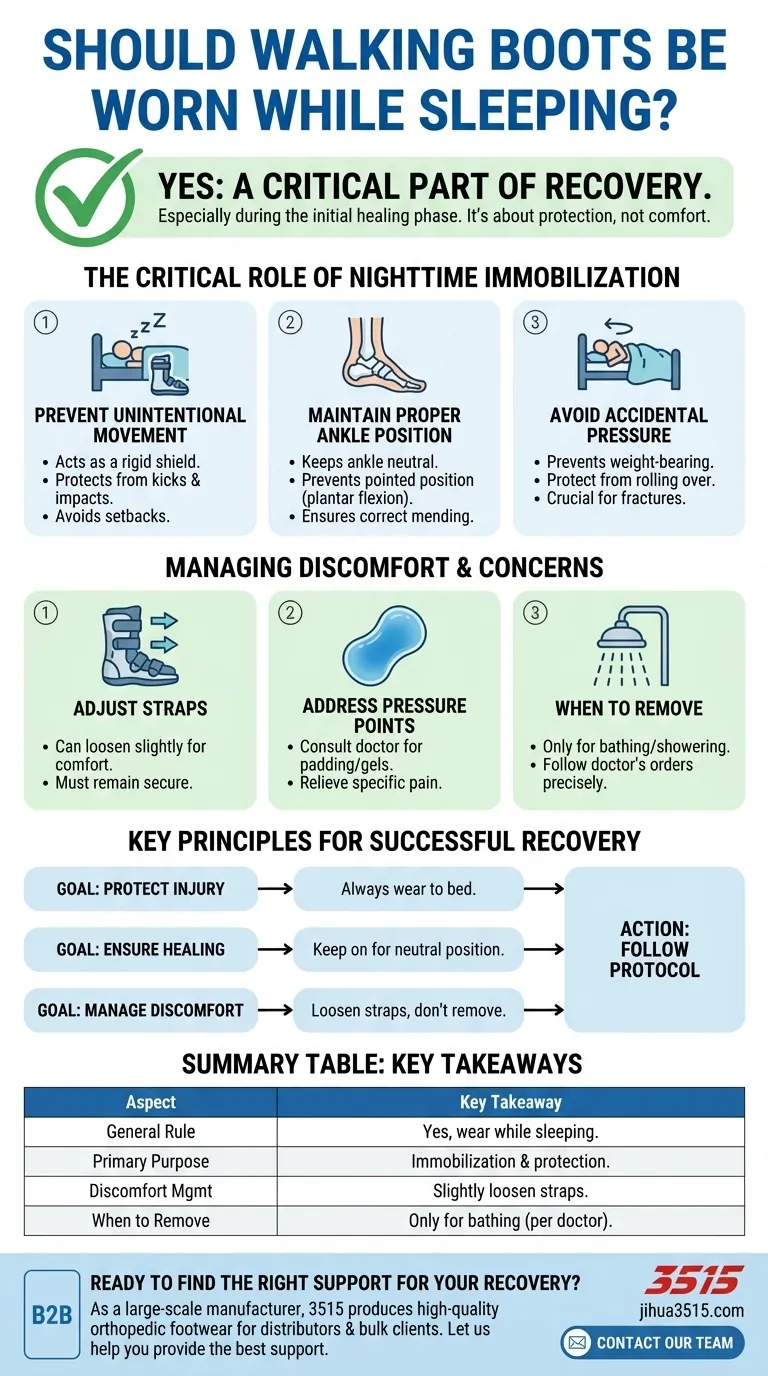
Visual Guide
Related Products
- Durable Rubber Sole Outdoor Shoes Wholesale & Custom Manufacturing
- Durable Goodyear Welt Leather Work Boots for Wholesale & Private Label
- Wholesale Customizable Safety Boots Durable & Protective Footwear Manufacturing
- Heavy-Duty Waterproof Nubuck Safety Boots Safety Shoes for Bulk Supply
- Wholesale Durable Camouflage Canvas Shoes with High-Traction Cleated Rubber Sole
People Also Ask
- What is the function of the sole in outdoor shoes? Find the Perfect Grip and Support
- What role do outdoor shoes and sneakers play in navigating external terrains? Engineered Stability for Every Surface
- How is AI utilized in the design of outdoor and safety footwear? Harnessing Big Data for Market-Driven Shoe Innovation
- Why is durability important when selecting outdoor shoes? A Guide to Safety & Long-Term Value
- What are the key components of outdoor shoes that affect comfort and sturdiness? A Guide to Durable, High-Performance Footwear

















