
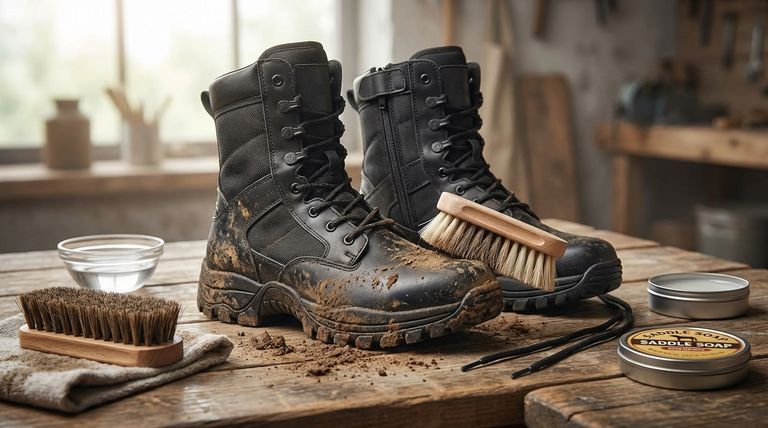
To remove excess dirt from military boots, your primary tool is a soft-bristled brush. This allows you to effectively dislodge caked-on mud and dust from all surfaces, paying special attention to the grooves in the sole and the seams where different materials meet. This initial dry brushing is the most critical first step.
The goal is not just to clean your boots, but to do so in a way that preserves their material integrity. Proper dirt removal is the first step in a maintenance routine that protects your investment and ensures your gear remains mission-ready.
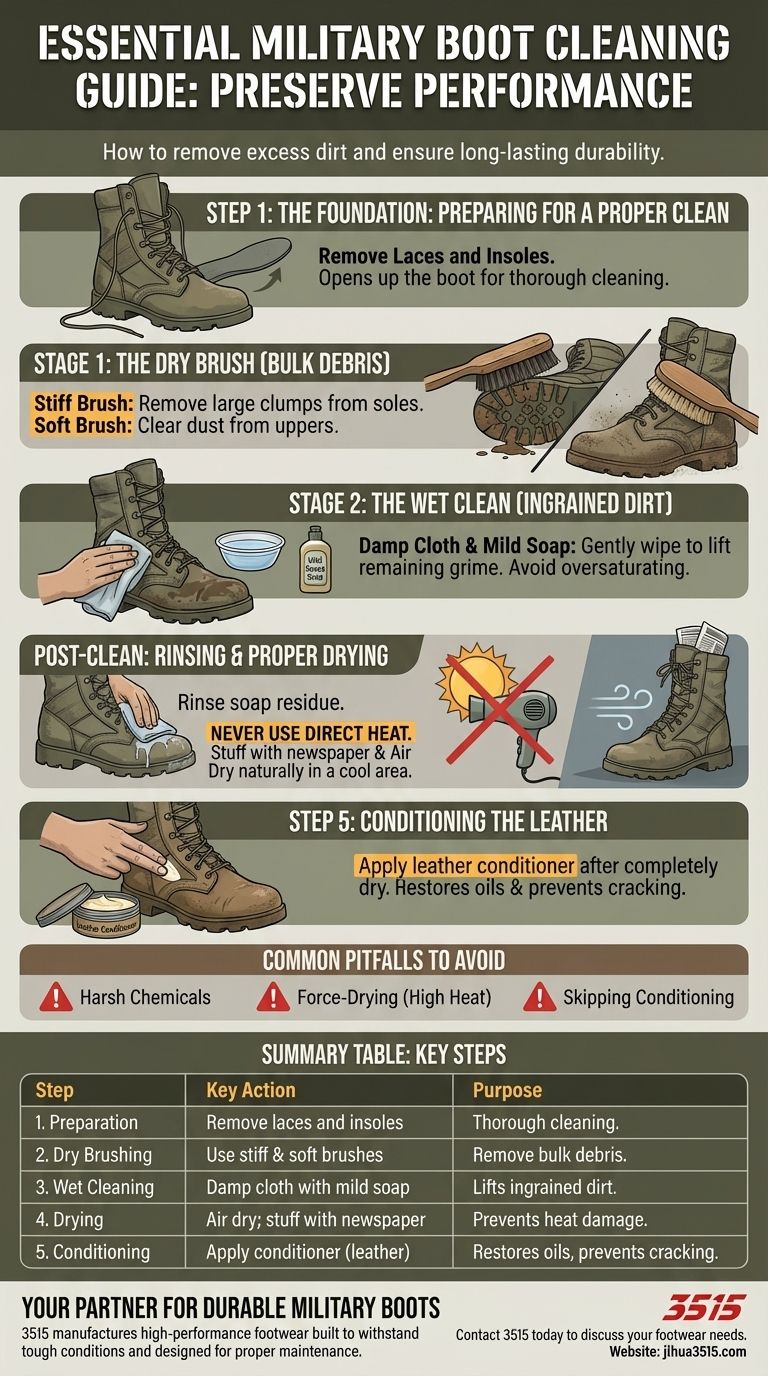
The Foundation: Preparing for a Proper Clean
Before you begin scrubbing, a moment of preparation ensures a more thorough and effective cleaning process. This prevents dirt from being trapped in hard-to-reach areas.
Remove Laces and Insoles
First, unlace your boots completely and remove the insoles. This opens up the boot, allowing you to clean the tongue and interior more easily and preventing grime from getting trapped under the hardware. Laces and insoles can be washed separately.
A Two-Stage Process for Dirt Removal
Effective cleaning involves two distinct stages: a dry pass to remove the bulk of the debris, followed by a wet pass to address ingrained dirt and stains.
Stage 1: The Dry Brush (Bulk Debris)
Use a stiff-bristled brush on the soles and thick rubber portions of the boot to knock off large, dried clumps of mud and dirt.
For the uppers, especially leather or synthetic fabric, switch to a soft-bristled brush. Work methodically across the entire surface to remove the remaining layer of dust and smaller particles.
Stage 2: The Wet Clean (Ingrained Dirt)
For stubborn dirt, dampen a clean cloth with lukewarm water and a mild soap. Saddle soap is ideal for leather, but a small amount of mild dish detergent mixed with water can also be effective.
Wipe the boot's exterior from top to bottom. Avoid oversaturating the material, especially leather. This step is for lifting remaining grime, not for soaking the boot.
Understanding the Critical Post-Clean Steps
How you treat your boots after washing is just as important as the cleaning itself. Improper drying or a failure to recondition the material can cause permanent damage.
Rinsing and Proper Drying
Use a separate damp cloth with only water to wipe away any soap residue.
Never use direct heat (like a hairdryer, radiator, or direct sunlight) to dry your boots. This can cause leather to crack and synthetic materials to become brittle. Stuff the boots with newspaper and let them air dry naturally in a cool, shaded, well-ventilated area.
Conditioning the Leather
Once the boots are completely dry, apply a leather conditioner if your boots have leather components. This restores essential oils, keeping the leather supple and preventing it from drying out and cracking over time.
Common Pitfalls to Avoid
Aggressive or improper cleaning techniques will shorten the lifespan of your boots far more than field use.
The Mistake of Harsh Chemicals
Avoid using hard detergents, bleaches, or other harsh cleaning agents. These chemicals can strip protective coatings, discolor fabrics, and permanently damage leather fibers. Always opt for mild, material-specific cleaners.
The Danger of Force-Drying
The single fastest way to ruin a pair of quality boots is to dry them with high heat. Patience is essential; let them air dry completely, even if it takes a day or two.
Skipping the Conditioning Step
Clean leather that isn't conditioned is vulnerable. It will dry out, lose its flexibility, and eventually crack under stress. Conditioning is not an optional step for leather boot maintenance.
Making the Right Choice for Your Goal
Your cleaning routine should match the boot's condition and your immediate need.
- If your primary focus is a quick, daily clean: A thorough dry brushing with a soft and stiff brush to remove surface dust and mud is all you need.
- If your primary focus is a deep clean after heavy field use: Follow the full two-stage process, including removing laces, wet cleaning with mild soap, proper air drying, and conditioning.
Properly caring for your boots ensures they will continue to support you when you need them most.
Summary Table:
| Step | Key Action | Purpose |
|---|---|---|
| 1. Preparation | Remove laces and insoles. | Allows for thorough cleaning of all areas. |
| 2. Dry Brushing | Use stiff & soft brushes on soles/uppers. | Removes bulk, dry debris. |
| 3. Wet Cleaning | Damp cloth with mild soap (e.g., saddle soap). | Lifts ingrained dirt and stains. |
| 4. Drying | Air dry naturally; stuff with newspaper. | Prevents material damage from heat. |
| 5. Conditioning | Apply leather conditioner after drying. | Restores oils, prevents cracking. |
Need a reliable source for durable military boots?
As a large-scale manufacturer, 3515 produces a comprehensive range of high-performance footwear built to withstand tough conditions. Our boots are designed with proper maintenance in mind, using quality materials that respond well to correct cleaning routines.
We supply distributors, brand owners, and bulk clients with all types of military, tactical, and safety boots. Let us provide you with gear that is mission-ready from day one.
Contact 3515 today to discuss your footwear needs and discover how our manufacturing expertise can be your supply chain advantage.
Visual Guide
Related Products
- Durable Military Combat Boots with Water Drainage for Wholesale & OEM
- High-Traction Suede Tactical Boots Wholesale & Custom Manufacturing
- Durable High-Ankle Tactical Boots for Wholesale & Custom Manufacturing
- Durable Mid-Cut Tactical Boots for Wholesale & Private Label
- Wholesale Waterproof Tactical Boots Custom Suede & High-Traction Soles
People Also Ask
- Why must gait validation for military applications be conducted in combat boots? Ensure Data Accuracy for Soldiers
- What are the common types of combat boots? Find the Right Boot for Your Mission
- What factors should be considered when choosing military boots for hiking? Durability vs. Weight for Your Terrain
- What are the key considerations when choosing military boots? Prioritize Compliance, Environment & Fit
- How should the midfoot and heel fit in military boots? Achieve a Snug, Secure Fit for Blister Prevention



















