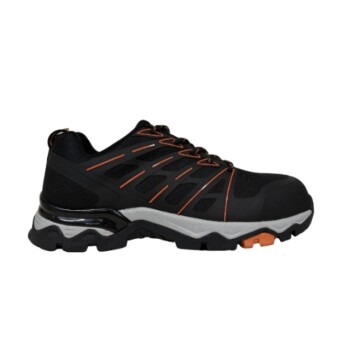
Manufacturing precision is the non-negotiable bedrock of reliable safety footwear. In large-scale production, the difference between a protective tool and a liability lies in millimeter-level accuracy during assembly. This exactness ensures that every pair produced adheres to strict safety standards, maintaining the specific structural integrity required to withstand industrial hazards.
High-precision equipment provides the consistent measurement plane necessary to eliminate dangerous deviations. By ensuring accuracy in toe cap alignment, sole attachment, and material cutting, manufacturers prevent structural weaknesses that could compromise safety or cause wearer discomfort.
The Critical Role of Accuracy in Assembly
Millimeter-Level Toe Cap Alignment
The protective capability of a safety shoe relies heavily on how the steel or composite toe is seated. Millimeter-level accuracy ensures the toe cap is aligned perfectly with the sole and upper. If this alignment deviates even slightly, the cap may not distribute impact forces correctly, putting the wearer at risk of injury.
Secure Sole Attachment
Precision is equally vital when attaching the sole to the upper. High-precision equipment maintains a consistent measurement plane, ensuring the bond is uniform across the entire surface. This prevents weak spots that could lead to sole separation or reduced slip resistance in active industrial environments.
Reducing Safety Risks
In mass production, consistency is the primary challenge. Precision machinery ensures that deviations are kept to an absolute minimum. By strictly controlling these variables, manufacturers prevent the "growth" of safety risks that occur when minor manufacturing errors compound into structural failures.
Precision in Material Cutting
Achieving Dimensional Consistency
Before assembly begins, industrial-grade cutting machines utilize precision molds to shape leather or synthetic materials. This process guarantees that every component of the shoe's upper maintains identical dimensions. Without this consistency, the components would vary from shoe to shoe, making standardized safety impossible to guarantee.
Ensuring Seamless Sewing Alignment
High-precision cutting is the prerequisite for effective sewing. When components are cut with exact accuracy, they align seamlessly during the sewing process. This prevents the operator from having to force materials together, which preserves the integrity of the join.
Preventing Structural Weak Points
Inaccurate cutting often leads to wrinkles or bunched material during assembly. These imperfections create uneven structural strength, resulting in hidden weak points that can tear or fail under stress. Precision cutting eliminates these defects, significantly lowering the overall defect rate of the final product.
Understanding the Consequences of Deviation
Comfort as a Safety Factor
Precision impacts more than just durability; it directly dictates wearer comfort. Deviations in assembly often create internal pressure points or poor fits. Discomfort causes fatigue and distraction for the worker, which indirectly increases the likelihood of workplace accidents.
The Cost of Inconsistency
A lack of precision in the cutting or assembly phase introduces variables that inevitably lead to a higher defect rate. While high-precision machinery requires investment, the cost of manufacturing "safe" shoes that fail in the field due to uneven structural strength is far higher in terms of liability and reputation.
Ensuring Quality Across the Production Line
To achieve reliable safety footwear, you must look at precision as a holistic requirement, not just a finishing step.
- If your primary focus is Impact Protection: Prioritize millimeter-level accuracy in toe cap alignment to ensure force is distributed correctly during accidents.
- If your primary focus is Durability: Ensure your cutting process utilizes precision molds to guarantee dimensional consistency and prevent structural weak points.
- If your primary focus is Compliance: Utilize high-precision equipment to maintain a consistent measurement plane, ensuring every unit meets strict regulatory standards.
True safety in industrial footwear is not defined by the materials alone, but by the disciplined precision of their assembly.
Summary Table:
| Precision Factor | Impact on Quality & Safety | Core Benefit |
|---|---|---|
| Toe Cap Alignment | Ensures exact force distribution during impact | Maximum foot protection |
| Sole Attachment | Prevents separation and maintains slip resistance | Enhanced durability |
| Material Cutting | Eliminates wrinkles and structural weak points | Reduced defect rates |
| Dimensional Consistency | Ensures uniform fit and seamless sewing | Improved worker comfort |
Partner with a Manufacturer Dedicated to Precision
At 3515, we understand that in the safety footwear industry, precision is the difference between protection and liability. As a large-scale manufacturer serving global distributors and brand owners, we utilize high-precision equipment and rigorous assembly standards to ensure every pair meets the highest industrial safety benchmarks.
Our comprehensive production capabilities allow us to deliver consistent, high-quality footwear across our entire portfolio, including:
- Flagship Safety Shoes & Tactical Boots
- Outdoor & Training Footwear
- Industrial Sneakers & Dress Shoes
Experience the value of millimeter-level accuracy for your brand. Contact us today to discuss your bulk requirements and see how our manufacturing excellence can strengthen your product line.
References
- Joanna Baj–Korpak, Marek Wochna. Sports activity and changes in physical fitness of Polish children and adolescents: OSF study. DOI: 10.3389/fped.2022.976943
This article is also based on technical information from 3515 Knowledge Base .
Related Products
- Premium Suede Sport Safety Shoes for Wholesale & Bulk Orders
- Premium Lightweight Safety Shoes for Wholesale & Bulk Orders
- Wholesale Anti-Smash & Puncture-Proof Safety Shoes Custom Manufacturing for Brands
- Premium KPU Injection Athletic Style Safety Shoes
- Premium Safety Shoes with Rotating Buckle Safety Sneakers
People Also Ask
- What are the primary functions of professional safety shoes? Maximize Safety in Water Supply Confined Spaces
- What industries have specific OSHA footwear requirements? Ensure Compliance & Protect Your Workforce
- What role do specialized safety shoes play in preventing falls? Engineering Stability in Industrial Environments
- How do I choose the best safety shoes? Match Certified Features to Your Hazards
- What are the main safety features of S1-S5 shoes? The 3 Essential Protections Explained