First, I need to get to the core of the problem. The user isn't just asking "how" - they want the why. So, I need to understand that the cold toes are a symptom, and the root cause is something bigger: the body's natural response to cold. This means I'll need to explain the physiology behind it - the "surface need" is cold toes, the "deep need" is to understand the root cause and avoid cold toes in the future.
The most important part? I need to keep the focus on solving the problem, and not just throwing out some products. I have to synthesize the information, not just copy it. No making up facts, but I can use my understanding of the references to synthesize them, and come up with an explanation that will make sense to the user. I'll make sure to provide a logical structure that starts from the basic science, and leads to actionable advice.
To deliver a useful piece, I'm thinking of this format: A bold opening that directly answers the surface question ("The solution to cold toes often starts at your chest"), a clear "Core Takeaway" box summarizing the key insight, and a main body that addresses the "why" with H2/H3 headings. I need to include a critical "Pitfalls" section to address common misconceptions and highlight trade-offs, making the user aware of any potential issues with applying the advice. Finally, the conclusion will be a bulleted list of actionable steps for them to take to manage the core-extremity temperature balance and solve their cold toes issue. I will keep the writing simple, but authoritative.
So, what do the references tell me? Core temperature drops? Blood flows to vital organs, away from extremities. Insulating the torso helps. Warming pulse points might help. That's the raw data. I need to convert that into a compelling story that makes sense.
Here's the plan:
- Start by explaining that cold toes are a consequence of the body's survival mechanism - the body prioritizes core warmth, and sacrifices extremities. This vasoconstriction is the main driver here.
- Dig into the physiology: Explain vasoconstriction in simple terms, using an analogy like a "hot water" system.
- Emphasize that "spot treating" (thick socks) doesn't always work if the "hot water" (blood) isn't even getting to the feet.
- Highlight the importance of core insulation - layers, windproof shells.
- Briefly mention pulse points, but as a secondary tactic.
- In the "Pitfalls" section, I'll address common mistakes: over-insulating your feet in tight shoes, neglecting wind chill, and forgetting about other extremities.
- End with actionable steps: If they want to prevent it, prioritize the core; if they're already layering, check the shoes and socks; if they are trying to optimize, protect the head and hands, too.
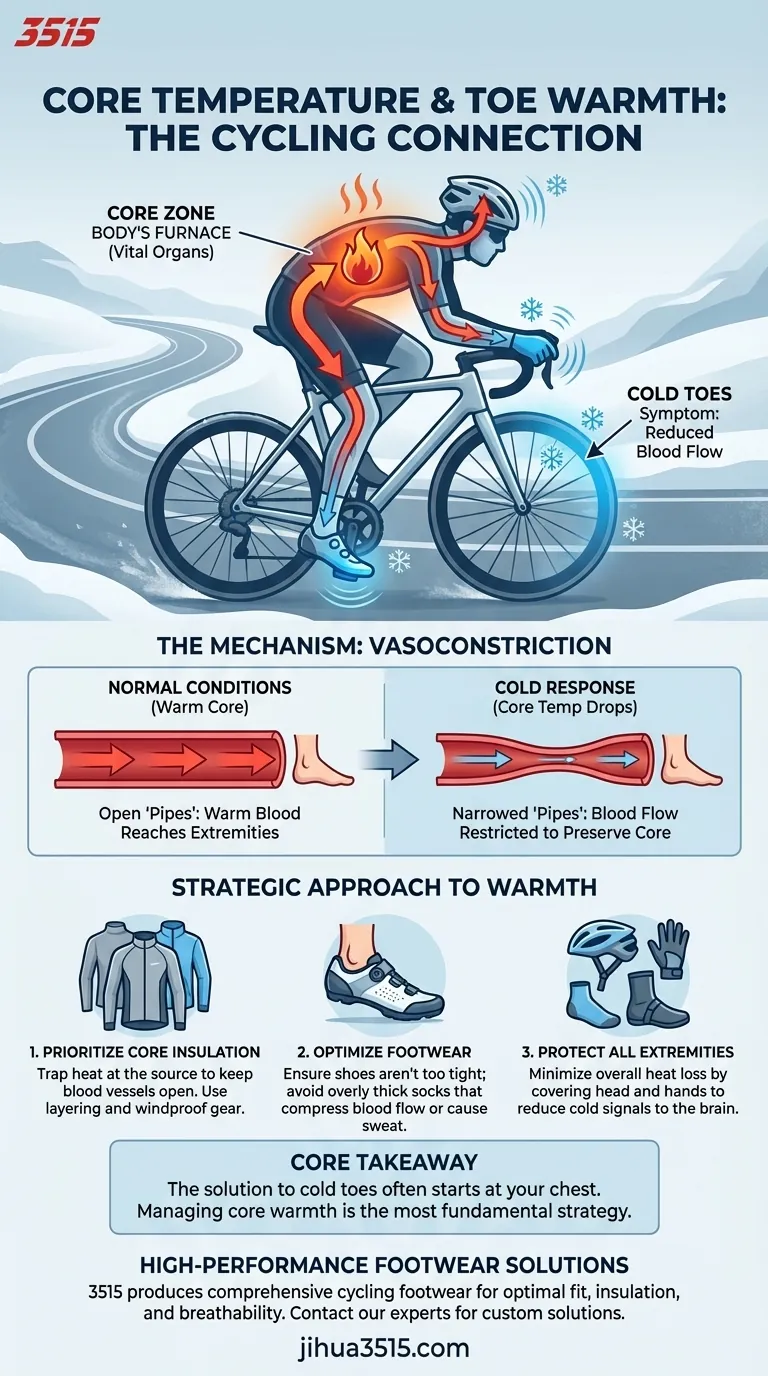
Ultimately, I want to empower the user to think strategically about their body's temperature regulation. Keeping the language simple, the structure clear, and the advice actionable is the name of the game. Now, let's get writing! The solution to cold toes on a bike often starts at your chest, not your feet. When your core body temperature begins to drop, your body initiates a survival response. It prioritizes keeping your vital organs warm by constricting blood vessels in your extremities, dramatically reducing the flow of warm blood to your hands and, most notably, your toes.
Your body treats its core temperature as a top survival priority. To protect vital organs in the torso, it will sacrifice warmth in your feet and hands by restricting blood flow, a process called vasoconstriction. Therefore, managing core warmth is the most fundamental and effective strategy for keeping your toes warm.
The Body's Survival Mechanism: Centralization
Your circulatory system acts as your body's central heating. When everything is functioning normally, warm blood is distributed evenly. However, in cold conditions, this system is strategically re-routed to protect what matters most.
Understanding Vasoconstriction
Vasoconstriction is the technical term for the narrowing of blood vessels. When your brain senses that your core is losing heat, it sends signals to the smooth muscles in the walls of the arteries in your limbs, causing them to tighten.
This process effectively reduces the "pipe size" leading to your extremities. The result is a significant decrease in the volume of warm blood reaching your feet.
Why Your Toes Get Cold First
Your feet and hands are the farthest points from your body's core. This distance, combined with their high surface-area-to-volume ratio, makes them highly susceptible to heat loss. From a survival standpoint, they are less critical than your heart, lungs, and brain.
Your body's internal logic is simple: it is better to risk frostbite in a toe than to allow the core temperature to drop to a life-threatening level.
Blood Flow as Your Heating System
Think of your circulatory system like the radiant heating in a house. Your core is the furnace, and your blood is the hot water flowing through the pipes.
To keep the vital rooms (your organs) warm during a power outage, you would shut the valves to the outlying rooms (your feet and hands). This is precisely what your body does to conserve its limited heat energy.
The Core is Your Furnace, Not Your Feet
This biological reality means that focusing solely on insulating your feet is often an incomplete and ineffective strategy. If the supply of warm blood has been cut off at the source, even the thickest socks will only delay the inevitable cooling.
The Limits of "Spot Treating" the Cold
Adding more insulation to your feet without addressing your core is like trying to keep a room warm after the radiator has been turned off. While a thick sock or overshoe helps, it's merely slowing the rate of heat loss from tissue that is no longer being actively warmed by blood flow.
How to Properly Insulate Your Torso
The most effective strategy is to prevent your core temperature from dropping in the first place. Use a layering system for your torso: a moisture-wicking base layer, an insulating mid-layer, and a windproof outer shell.
By trapping heat around your core, you signal to your brain that there is no thermal emergency. In response, it keeps the "valves" open, allowing warm blood to continue flowing freely to your toes.
Common Pitfalls and Misconceptions
Understanding the core-to-extremity principle helps you avoid common mistakes that can paradoxically make your feet colder.
Over-Insulating Your Feet
Wearing socks that are too thick inside snug cycling shoes can be counterproductive. The added bulk can compress the very blood vessels you need to stay open, physically choking off what little blood flow is available.
Causing Sweat with Thick Socks
Another issue with overly thick socks is sweat. If your feet begin to perspire, the moisture will dramatically accelerate heat loss through evaporation, leaving your feet colder and damper than before.
Neglecting Wind Chill
Cycling generates significant wind chill, which can strip heat from your torso much faster than the ambient temperature would suggest. A simple windproof vest or jacket is one of the most critical pieces of gear for maintaining your core temperature and, by extension, keeping your toes warm.
A Strategic Approach to Staying Warm
Based on this understanding, your strategy for warmth should be prioritized from the inside out, focusing on your core before your extremities.
- If your primary focus is preventing cold toes on any ride: Prioritize insulating your torso with a quality base layer and a windproof outer layer before adding thicker socks.
- If you are already layering your core but still have cold feet: Ensure your shoes are not too tight and your socks are not so thick they restrict circulation or cause your feet to sweat.
- If you are trying to optimize your entire system for cold weather: Treat your body as a whole by also protecting your head and hands to minimize the overall heat loss signals being sent to your brain.
By managing your body's core temperature first, you directly control the flow of warmth to every part of your body.
Summary Table:
| Key Factor | Effect on Toe Warmth | Actionable Insight |
|---|---|---|
| Core Temperature Drops | Body restricts blood flow to extremities (vasoconstriction) | Insulate your torso first with layers |
| Tight Shoes/Thick Socks | Can compress blood vessels, reducing flow | Ensure proper shoe fit; avoid overly bulky socks |
| Wind Chill on Torso | Accelerates core heat loss, triggering vasoconstriction | Use a windproof jacket or vest |
Need high-performance footwear that complements your cold-weather strategy?
As a large-scale manufacturer, 3515 produces a comprehensive range of cycling and outdoor footwear for distributors, brand owners, and bulk clients. Our production capabilities encompass all types of performance shoes and boots designed with optimal fit, insulation, and breathability in mind.
Contact our experts today to discuss how our footwear solutions can help keep your customers comfortable and performing at their best, no matter the conditions.
Visual Guide