
The fundamental difference between Blake stitch and Goodyear welt construction lies in how the sole is attached to the upper part of the shoe. A Blake stitch uses a single stitch to directly connect the upper, insole, and outsole, creating a simpler, more flexible shoe. In contrast, a Goodyear welt uses a strip of leather (the "welt") as a middleman, with two independent stitches securing the components, resulting in a more durable and water-resistant shoe.
The choice between Blake stitch and Goodyear welt is not about which is "better," but which set of trade-offs you are willing to accept. Blake stitch prioritizes flexibility and a sleek profile, while Goodyear welt prioritizes durability, water resistance, and ease of repair.
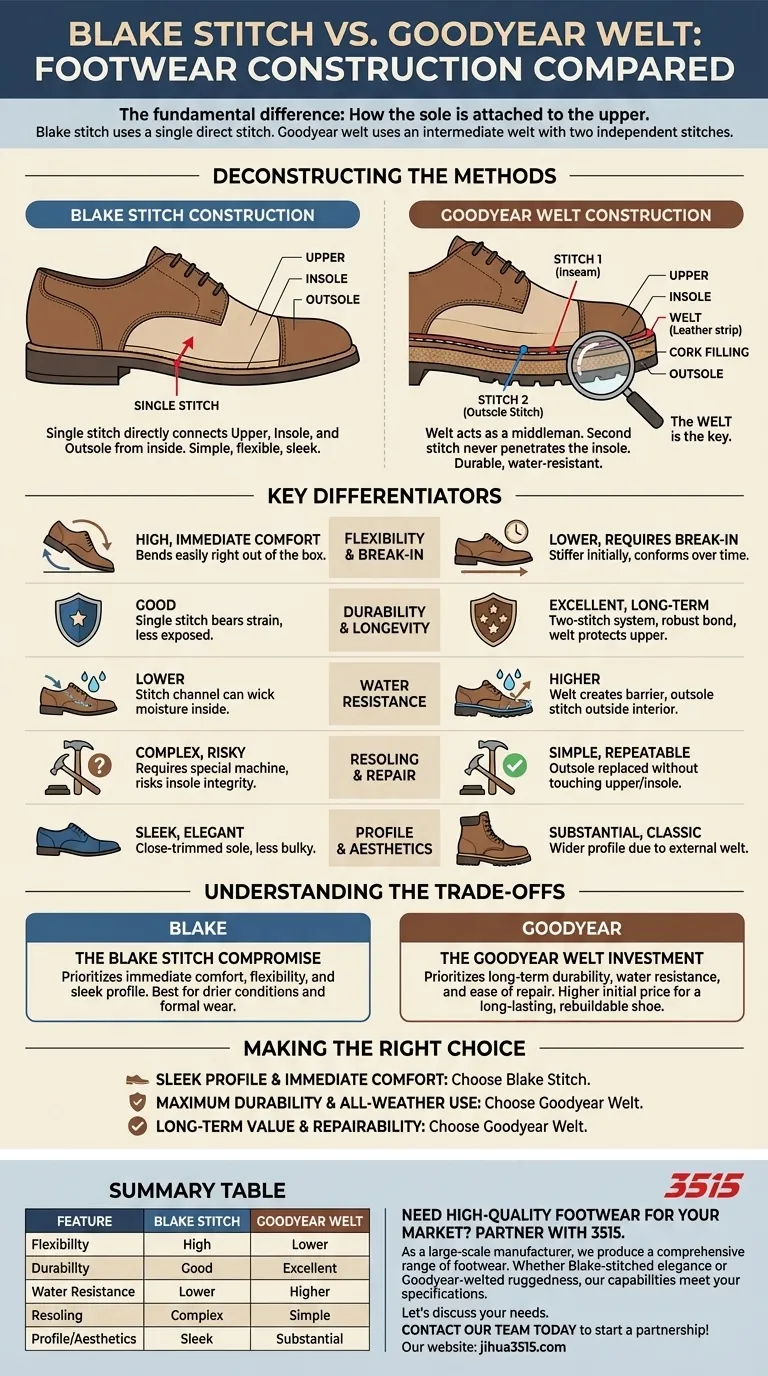
Deconstructing the Methods
To understand the practical differences, you first need to visualize how each shoe is built. The construction method dictates nearly every performance characteristic, from comfort to longevity.
How Blake Stitch Works
In a Blake-stitched shoe, a single line of stitching runs from the inside of the shoe, through the insole, through the upper, and finally through the outsole.
This direct, single-stitch connection pulls the sole very tightly to the upper. It requires a specialized machine to perform the stitch from inside the shoe.
How Goodyear Welt Works
The Goodyear welt method is more complex and involves two separate stitches. First, a strip of leather called a welt is stitched to the upper and the insole.
Then, in a completely separate stitch, the outsole is sewn directly to that welt. The key is that this second stitch never penetrates the insole, keeping the interior of the shoe sealed.
The Key Differentiators Explained
The mechanical differences in construction lead to distinct advantages and disadvantages in the final product. Understanding these is crucial to choosing the right shoe for your needs.
Flexibility and Break-in
A Blake-stitched shoe is significantly more flexible right out of the box. With fewer layers and a direct connection, the sole can bend and move with your foot almost immediately.
Goodyear-welted shoes are notoriously stiffer at first. The additional layers of the welt and cork filling require a break-in period before they conform to your foot and become comfortable.
Durability and Longevity
The Goodyear welt is the gold standard for durability. The two-stitch system creates an incredibly robust bond, and the welt itself acts as a buffer, protecting the upper from wear.
While not fragile, a Blake-stitched shoe is generally less durable because the single stitch bears all the strain and is more exposed to the elements from the inside.
Water Resistance
The Goodyear welt offers superior water resistance. The welt creates a protective barrier around the edge of the shoe, and because the outsole stitch doesn't go inside the shoe, it's much harder for water to seep in.
Some manufacturers use a Storm Welt, which is a wider welt bent upwards to create an even more effective seal against moisture.
Blake-stitched shoes are more susceptible to water. The stitch channel that passes directly into the shoe's interior can act as a wick, drawing moisture inside.
Resoling and Repair
Ease of resoling is the signature advantage of a Goodyear welt. A cobbler can simply cut the stitch holding the outsole to the welt and attach a new sole without ever touching the upper or insole. This can be done many times over the shoe's life.
Resoling a Blake-stitched shoe is more difficult and riskier. It requires the same specialized machine to restitch the sole, and each time it's done, new holes are punched through the original insole, potentially compromising its integrity.
Profile and Aesthetics
The direct attachment of a Blake stitch allows for a very close-trimmed, sleek sole. This results in a more elegant and less bulky silhouette, often favored for formal dress shoes.
A Goodyear-welted shoe has a more substantial and wider profile due to the external welt. This is often seen as a mark of sturdy, high-quality construction.
Understanding the Trade-offs
Neither method is perfect; each represents a conscious engineering choice that prioritizes certain qualities over others.
The Blake Stitch Compromise
You choose Blake stitch for its immediate comfort, flexibility, and elegant profile. The trade-off is reduced water resistance and a shorter, more complicated repair life. These shoes excel in drier conditions and for occasions where a sleek look is paramount.
The Goodyear Welt Investment
You choose Goodyear welt as a long-term investment in durability. You accept a higher initial price and a stiffer break-in period in exchange for a shoe that can withstand harsh conditions and be rebuilt multiple times, potentially lasting for decades.
Making the Right Choice for Your Goal
Your decision should be guided by your primary use case and personal priorities.
- If your primary focus is a sleek profile and immediate comfort: A Blake-stitched shoe is the ideal choice for formal wear or office use in fair weather.
- If your primary focus is maximum durability and all-weather use: A Goodyear-welted shoe is the superior option, providing robust construction and better protection from the elements.
- If your primary focus is long-term value and repairability: Goodyear welting is unmatched, as the ability to easily resole the shoe dramatically extends its usable lifespan.
Ultimately, understanding the construction of your footwear empowers you to invest in quality that is perfectly aligned with your needs.
Summary Table:
| Feature | Blake Stitch | Goodyear Welt |
|---|---|---|
| Flexibility | High, immediate comfort | Lower, requires break-in |
| Durability | Good | Excellent, long-term investment |
| Water Resistance | Lower | Higher, especially with a storm welt |
| Resoling | Complex, requires special machine | Simple, can be done multiple times |
| Profile/Aesthetics | Sleek, elegant, less bulky | Substantial, wider, classic mark of quality |
Need High-Quality Footwear for Your Market? Partner with 3515.
As a large-scale manufacturer, 3515 produces a comprehensive range of footwear for distributors, brand owners, and bulk clients. Whether your customers demand the sleek elegance of Blake-stitched shoes or the rugged durability of Goodyear-welted boots, our production capabilities encompass all types of shoes and boots to meet your exact specifications.
Let's discuss your footwear needs and how we can deliver quality and value. Contact our team today to start a partnership!
Visual Guide
Related Products
People Also Ask
- What is the difference between full-grain and top-grain leather? Premium Material Guide for Boot Manufacturers
- What are the advantages of leather as an upper material for work boots? Unmatched Durability & Custom Comfort
- Why is it important to waterproof leather work boots? Protect Your Investment and Performance
- How should new leather work boots be broken in? A Guide to Comfort and Durability
- What are the advantages of leather uppers in work boots? Unmatched Durability & Protection
