
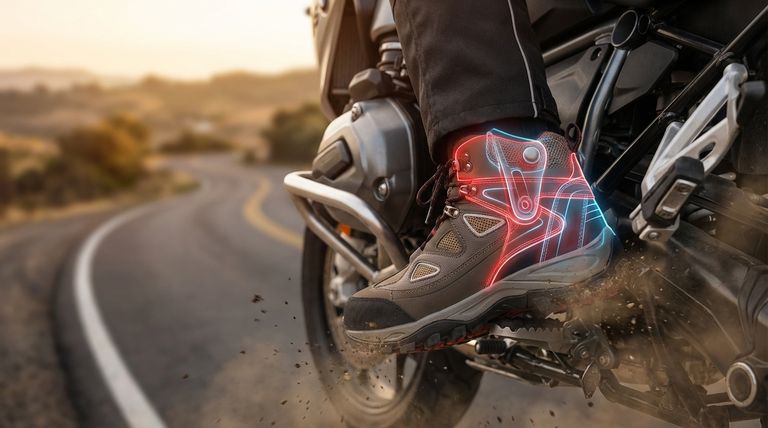
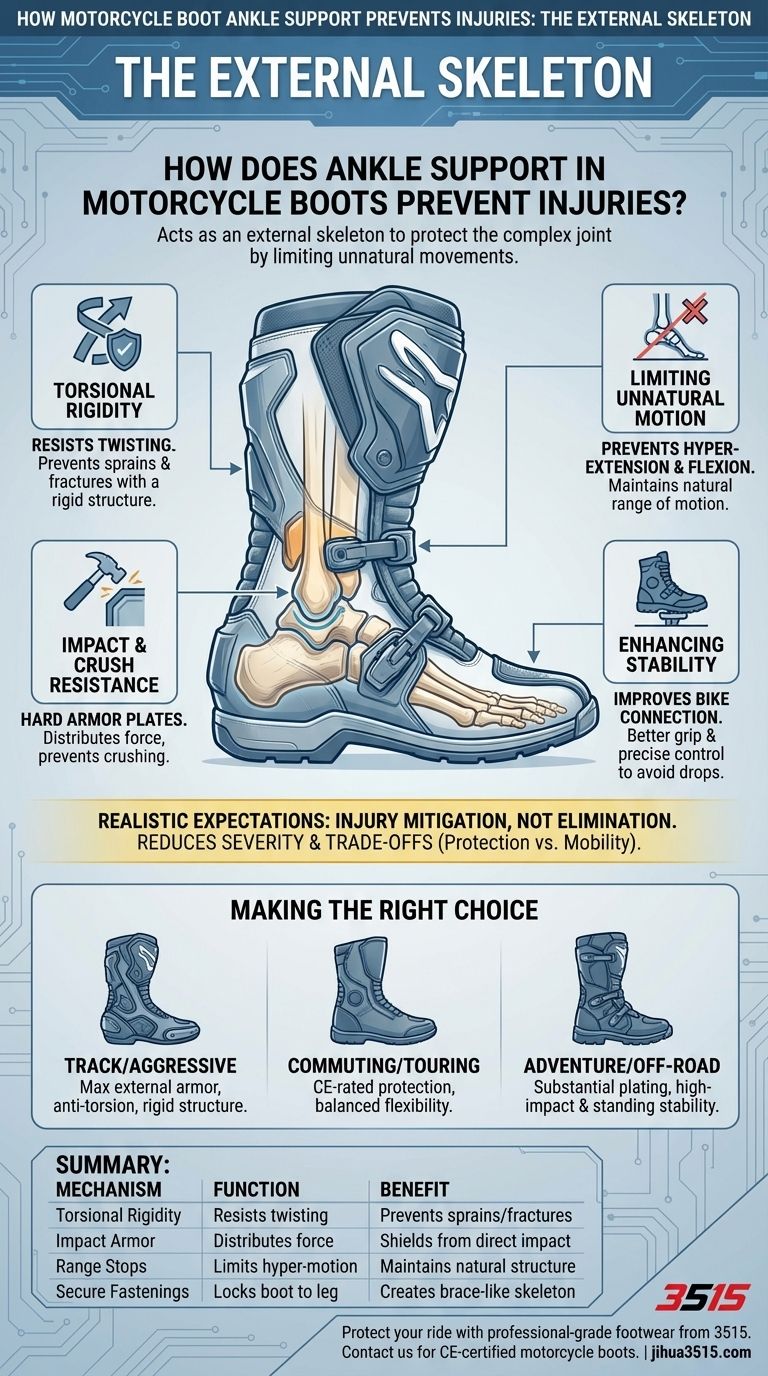
Ankle support in motorcycle boots acts as an external skeleton, designed to protect one of the most complex and vulnerable joints in your body. It works by combining a rigid structure, hard armor, and secure fastenings to severely limit the unnatural movements—like twisting, over-extending, and crushing—that cause fractures and ligament damage during an impact or crash.
The core purpose of ankle support is not to guarantee you walk away uninjured, but to manage catastrophic forces. It functions like a pre-emptive cast, locking the joint within its safe range of motion to reduce the severity of an otherwise debilitating injury.
The Core Mechanisms of Ankle Protection
A well-designed motorcycle boot provides protection through several engineered features that work in unison. Understanding these mechanisms clarifies why a simple work boot is insufficient for riding.
Torsional Rigidity to Prevent Twisting
The primary danger in many motorcycle accidents is torsional force, or twisting. A proper boot incorporates a rigid chassis, often reinforced with plastic or carbon fiber, that resists this rotation.
Secure buckles or lacing systems cinch the boot tightly, making it an extension of your lower leg. This effectively creates a brace that prevents the ankle from rotating beyond its natural limits, a common cause of sprains and fractures.
Impact and Crush Resistance
In a crash, your ankle can be struck by another vehicle, the road surface, or even crushed under the weight of your own motorcycle.
Protective boots feature hard armor plates made of thermoplastic polyurethane (TPU) or similar materials over the delicate ankle bones. This armor distributes the force of a direct impact and provides a rigid barrier to prevent crushing injuries.
Limiting Unnatural Range of Motion
The boot is engineered to allow the necessary forward and backward flex for operating the shifter and rear brake.
However, it is built with intentional "stops" that prevent hyper-extension (bending too far back) and hyper-flexion (bending too far forward). This maintains the leg's natural structure during the violent tumbling of an accident.
Enhancing Stability and Control
Ankle support provides a secondary, proactive benefit by improving your connection to the bike.
The firm footing and stabilized joint give you better grip on the pegs and more precise control. This can help prevent the low-speed drops or unexpected wobbles that can lead to injury in the first place.
Understanding the Limitations and Trade-offs
It is crucial to have a realistic understanding of what motorcycle boots can and cannot do. Their role is to mitigate, not eliminate, risk.
Protection is Not Infallible
Even the most advanced, race-spec boots cannot prevent all injuries. The forces in a high-speed crash can exceed what any wearable protection can withstand.
Riders have sustained broken bones, such as a fractured fibula, and torn ligaments even while wearing high-quality protective boots.
Injury Mitigation, Not Elimination
The true value of a good boot is in reducing the severity of an injury. A crash that might have caused a complex, open fracture could result in a simpler, clean break thanks to the boot's support.
This distinction is critical—it can mean the difference between a standard recovery and a life-altering injury with multiple surgeries.
The Balance of Protection and Mobility
There is a direct trade-off between the level of protection and off-the-bike comfort.
The most protective race boots are extremely stiff and awkward to walk in. Conversely, more casual-looking riding shoes offer more flexibility but sacrifice the rigid, cast-like support needed to prevent serious torsional injuries.
Making the Right Choice for Your Riding Style
Your choice of boot should align directly with the risks associated with your type of riding.
- If your primary focus is track riding or aggressive street riding: Prioritize boots with maximum external armor, dedicated anti-torsion systems, and a rigid, cast-like structure.
- If your primary focus is daily commuting or touring: Look for a CE-rated boot that balances certified ankle protection with enough flexibility for comfortable walking.
- If your primary focus is adventure or off-road riding: Seek out tall, rugged boots with substantial shin and ankle plating designed for both high-impact events and standing stability on uneven terrain.
Investing in a boot with appropriate, certified ankle support is one of the most critical safety decisions a rider can make.
Summary Table:
| Mechanism | Function | Benefit |
|---|---|---|
| Torsional Rigidity | Resists twisting forces | Prevents sprains and fractures |
| Impact Armor Plates | Distributes crash force | Shields ankle bones from direct impact |
| Range of Motion Stops | Limits hyper-extension/flexion | Maintains joint's natural structure |
| Secure Fastenings | Locks boot to lower leg | Creates a brace-like external skeleton |
Protect your ride with professional-grade footwear from 3515. As a large-scale manufacturer, we produce a comprehensive range of CE-certified motorcycle boots designed for maximum ankle support, impact resistance, and rider safety. Whether you are a distributor, brand owner, or bulk client, our production capabilities ensure top-tier protection for all riding styles. Contact our team today to discuss your footwear needs and enhance your product line with boots built for safety.
Visual Guide
Related Products
- Wholesale Tactical Boots High-Traction & Reflective for Bulk & Brand Orders
- High Performance Fire-Retardant Waterproof Safety Boots
- Durable Goodyear Welt Leather Work Boots for Wholesale & Private Label
- Wholesale High-Traction Camo Boots - Custom Manufacturer for Brands
- Heavy-Duty Waterproof Nubuck Safety Boots Safety Shoes for Bulk Supply
People Also Ask
- How do tactical boots protect against injuries? Discover the Integrated Safety System
- Are tactical boots suitable for urban environments? Discover Superior Comfort for City Life
- How is the compatibility of polymer materials demonstrated in smart footwear? Enhancing Tactical & Training Performance
- What factors should be considered when choosing tactical boots for different terrains? Match Your Boot to the Mission.
- Importance of Professional Tactical Boots in Loess Gully Regions: Ensure Safety and Precision for Field Monitoring



















