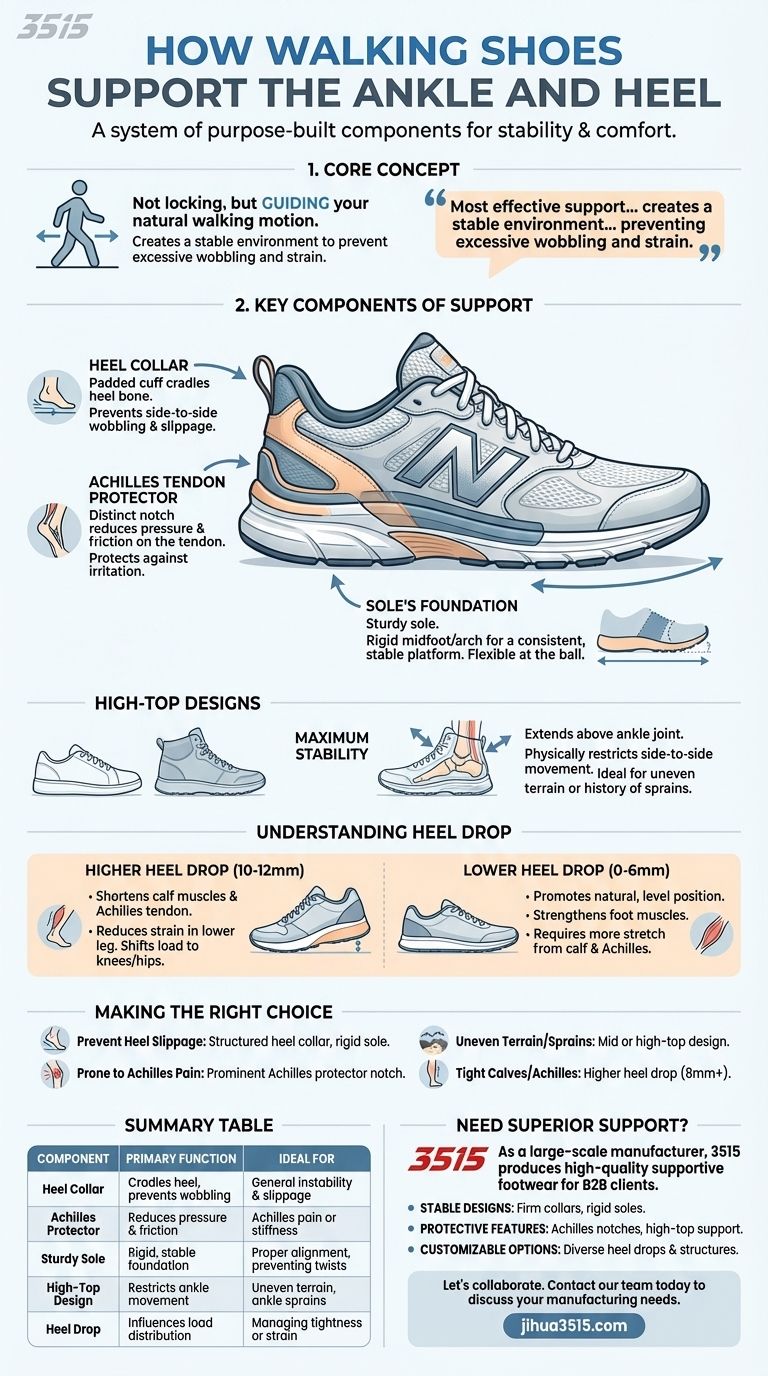
At its core, a walking shoe supports your ankle and heel through a system of purpose-built components. These include a firm heel collar to prevent side-to-side motion, a protective notch for the Achilles tendon, and a strategically rigid sole that provides a stable foundation for your entire foot.
The most effective support isn't about locking your foot in place. It's about creating a stable environment that guides your natural walking motion while preventing the excessive wobbling and strain that lead to pain and injury.
The Key Components of Heel and Ankle Support
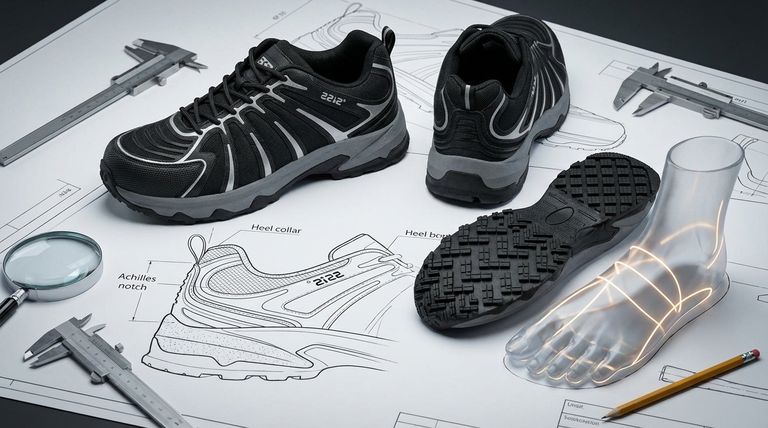
To understand how a shoe provides stability, we need to look at its specific structural elements. Each part plays a distinct role in securing your foot.
The Heel Collar
The heel collar is the padded cuff at the top-rear of the shoe that wraps around your heel.
Its primary job is to cradle the heel bone (calcaneus), preventing it from wobbling or slipping from side to side as you walk. This simple feature is a first line of defense against instability.
The Achilles Tendon Protector
Just below the collar, you'll often find a distinct notch or groove. This is the Achilles tendon protector.
This design reduces direct pressure and friction on your Achilles tendon, the sensitive cord connecting your calf muscle to your heel. It helps protect against the stiffness and pain associated with tendon irritation.
The Sole's Foundation
While not directly part of the heel, the sole's structure is the foundation of all support.
A good walking shoe has a sturdy sole that is flexible at the ball of the foot but remains rigid through the midfoot and arch. This prevents the foot from twisting improperly and provides a consistent, stable platform for every step.
High-Top Designs for Maximum Stability
For those walking on uneven terrain or needing the highest level of support, a high-top design provides mechanical stability.
By extending above the ankle joint, this design physically restricts excessive side-to-side movement, helping to maintain balance and reduce the risk of sprains or lower limb injuries.
Understanding the Trade-off: Heel Drop
One of the most overlooked aspects of heel support is the shoe's heel-to-toe drop. This is the height difference between the cushioning under your heel and the cushioning under your forefoot.
What is Heel Drop?
Heel drop is typically measured in millimeters. A higher number means the heel is significantly more elevated than the toe, while a lower number indicates a more level or "flat" foot position.
Higher Heel Drop (10-12mm)
A higher drop slightly shortens the calf muscles and Achilles tendon, which can reduce strain on these areas.
However, this elevation shifts some of the load forward onto the knees and hips. This is common in traditional running and walking shoes.
Lower Heel Drop (0-6mm)
A lower drop promotes a more natural, level foot position, often described as a "barefoot-like" feel.
This can help strengthen the muscles in your feet and may reduce strain on the knees. Conversely, it asks more of your calf and Achilles tendon, which must stretch more with each step.
Making the Right Choice for Your Needs
Selecting the right features depends entirely on your body mechanics, walking environment, and personal comfort.
- If your primary focus is preventing heel slippage and general instability: Look for a shoe with a well-padded, structured heel collar and a sole that does not bend in the middle.
- If you are prone to Achilles tendon pain or stiffness: Prioritize a shoe with a prominent Achilles protector notch to minimize pressure on the tendon.
- If you walk on uneven trails or have a history of ankle sprains: A mid or high-top shoe will provide the most significant external stability.
- If you have tight calves or Achilles tendons: A shoe with a higher heel drop (8mm or more) may feel more comfortable by reducing the load on your lower leg.
Understanding these design principles empowers you to choose a shoe that works with your body, not against it.
Summary Table:
| Component | Primary Function | Ideal For |
|---|---|---|
| Heel Collar | Cradles the heel to prevent side-to-side wobbling | Preventing general instability and heel slippage |
| Achilles Protector | Reduces pressure and friction on the tendon | Walkers prone to Achilles pain or stiffness |
| Sturdy Sole | Provides a rigid, stable foundation for the foot | Ensuring proper foot alignment and preventing twists |
| High-Top Design | Restricts excessive ankle movement | Uneven terrain or a history of ankle sprains |
| Heel Drop | Influences load distribution on legs and feet | Managing calf/Achilles tightness or knee/hip strain |
Need Walking Shoes with Superior Support?
As a large-scale manufacturer, 3515 produces a comprehensive range of high-quality footwear for distributors, brand owners, and bulk clients. Our production capabilities encompass all types of supportive walking shoes and boots, designed with the precise components detailed above.
We can help you provide your customers with:
- Stable Designs: Shoes built with firm heel collars and rigid soles for maximum stability.
- Protective Features: Models incorporating Achilles notches and high-top support for injury prevention.
- Customizable Options: A variety of heel drops and structures to meet diverse customer needs.
Let's collaborate to create the perfect supportive footwear for your market.
Contact our team today to discuss your manufacturing needs.
Visual Guide
Related Products
- Durable Rubber Sole Outdoor Shoes Wholesale & Custom Manufacturing
- Wholesale Durable Camouflage Canvas Shoes with High-Traction Cleated Rubber Sole
- Premium Suede Sport Safety Shoes for Wholesale & Bulk Orders
- Wholesale Comfortable Business Casual Shoes Custom Manufacturing
- Premium Lightweight Safety Shoes for Wholesale & Bulk Orders
People Also Ask
- What is the function of the sole in outdoor shoes? Find the Perfect Grip and Support
- What role do outdoor shoes and sneakers play in navigating external terrains? Engineered Stability for Every Surface
- How is AI utilized in the design of outdoor and safety footwear? Harnessing Big Data for Market-Driven Shoe Innovation
- Why is durability important when selecting outdoor shoes? A Guide to Safety & Long-Term Value
- What are the key components of outdoor shoes that affect comfort and sturdiness? A Guide to Durable, High-Performance Footwear