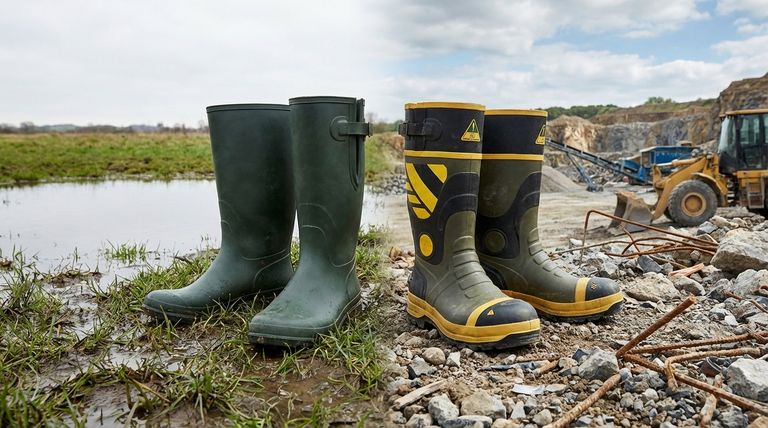
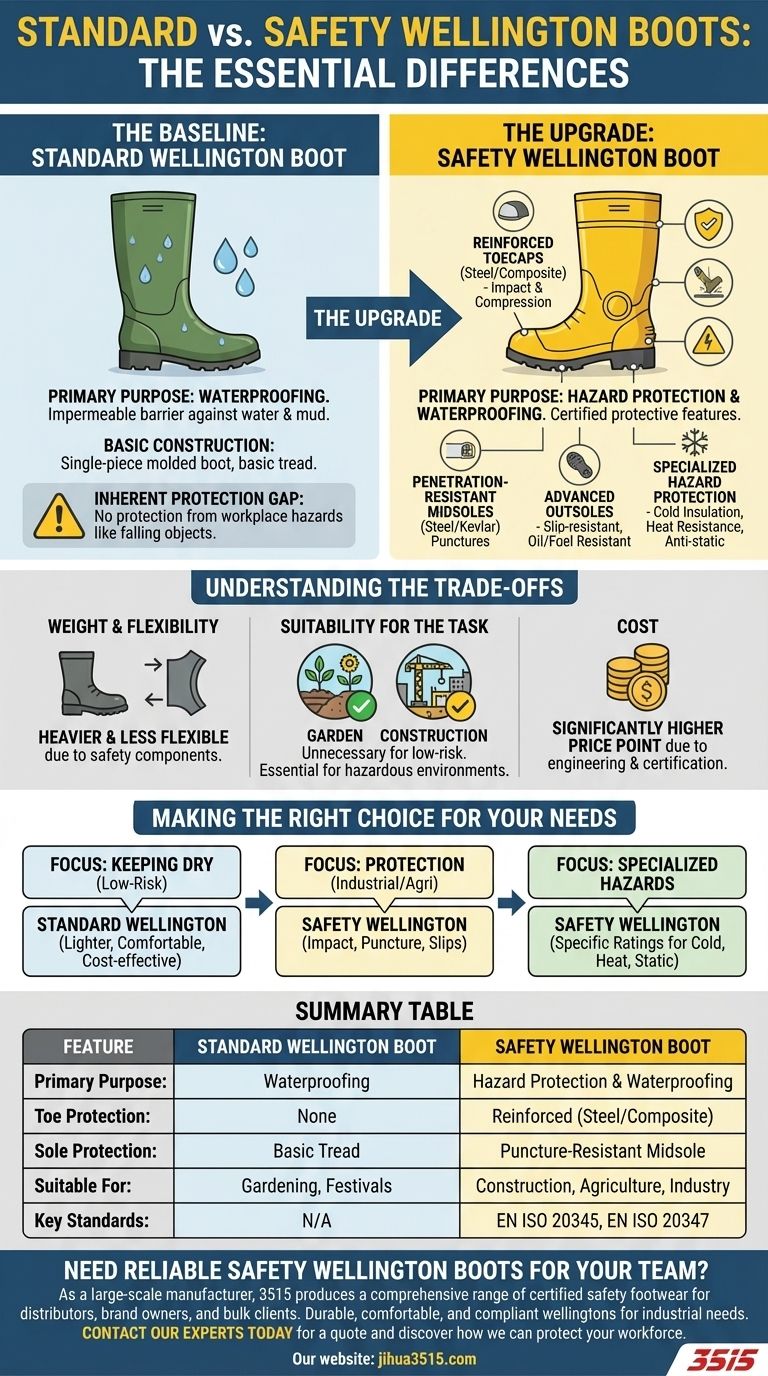
The fundamental difference between safety wellington boots and standard wellingtons is their core purpose. While standard wellingtons are designed solely for waterproofing in wet or muddy conditions, safety wellingtons incorporate specific protective features engineered to shield the wearer from workplace hazards.
The transition from a standard wellington to a safety wellington is a move from passive water protection to active hazard mitigation, equipping the boot with features like reinforced toecaps and penetration-resistant soles required for hazardous environments.
The Baseline: The Standard Wellington Boot
Standard wellingtons, often made of rubber or PVC, serve a single, straightforward function. Their design prioritizes keeping the feet and lower legs dry.
Primary Purpose: Waterproofing
The sole job of a standard wellington is to act as an impermeable barrier against water, mud, and other non-hazardous liquids.
Basic Construction
They are typically a simple, one-piece molded boot reaching just below the knee, with a basic tread for grip in muddy conditions.
The Inherent Protection Gap
Crucially, a standard wellington is not designed to prevent physical injury from workplace accidents like falling objects or sharp debris underfoot.
The Upgrade: Key Features of Safety Wellingtons
Safety wellingtons build upon the waterproof foundation of a standard boot by adding layers of certified protection. These features are what truly distinguish them.
Reinforced Toecaps
This is the most critical feature, providing protection against impact and compression. Toecaps are typically made from steel or lighter composite materials.
Penetration-Resistant Midsoles
A protective plate, often steel or flexible kevlar, is embedded in the sole to prevent sharp objects like nails or glass from piercing through to the foot.
Advanced Outsoles
The outsoles on safety wellingtons are engineered for performance. They often feature enhanced slip-resistance and are made from compounds that resist degradation from oil and fuel.
Specialized Hazard Protection
Modern safety wellingtons can be tailored to specific industrial risks. This includes features like cold insulation for low-temperature work, heat resistance for high-temperature environments, and anti-static properties to prevent electrostatic discharge.
Understanding the Trade-offs
Choosing a safety wellington involves acknowledging a few key differences in wearability and cost that stem directly from their protective features.
Weight and Flexibility
The addition of steel toecaps, midsoles, and thicker soles makes safety wellingtons noticeably heavier and less flexible than their standard counterparts.
Cost
The engineering, specialized materials, and safety certifications required for these boots result in a significantly higher price point.
Suitability for the Task
For low-risk activities like gardening or casual walks, the added weight and rigidity of a safety wellington can be uncomfortable and unnecessary. The right tool is always determined by the task.
Making the Right Choice for Your Needs
Selecting the correct boot depends entirely on a clear assessment of your environment and potential risks.
- If your primary focus is keeping dry in low-risk environments: A standard wellington is the lighter, more comfortable, and cost-effective choice.
- If your primary focus is protection in industrial or agricultural settings: A safety wellington is essential to protect against impact, punctures, and slips.
- If your primary focus is dealing with specialized hazards: You must select a safety wellington with the specific ratings for cold, heat, or static electricity that your job requires.
Ultimately, understanding the distinction empowers you to choose the precise level of protection your environment demands.
Summary Table:
| Feature | Standard Wellington Boot | Safety Wellington Boot |
|---|---|---|
| Primary Purpose | Waterproofing | Hazard Protection & Waterproofing |
| Toe Protection | None | Reinforced (Steel/Composite) |
| Sole Protection | Basic Tread | Puncture-Resistant Midsole |
| Suitable For | Gardening, Festivals | Construction, Agriculture, Industry |
| Key Standards | N/A | EN ISO 20345, EN ISO 20347 |
Need reliable safety wellington boots for your team?
As a large-scale manufacturer, 3515 produces a comprehensive range of certified safety footwear for distributors, brand owners, and bulk clients. We offer durable, comfortable, and fully compliant safety wellingtons tailored to your specific industrial needs.
Contact our experts today for a quote and discover how we can protect your workforce.
Visual Guide
Related Products
- Durable Waterproof Rain Boots | Custom Manufacturer for Wholesale & Brands
- Puncture-Resistant Velcro Safety Boots for Wholesale & Custom Manufacturing
- Wholesale Durable Safety Boots | Custom Steel Toe & Puncture-Resistant Manufacturing
- Premium Wholesale Tactical Style Safety Shoes Boots with Quick Lacing
- Premium High-Cut Waterproof Safety Boots Manufacturing & Wholesale Solutions
People Also Ask
- What are the main materials for waterproof rain boots? Choose the Right Material for Durability & Comfort
- What is the overall recommendation for choosing rain boot materials? A Guide to Rubber vs. PVC
- How does boot height affect waterproofing? Choose the Right Height for Ultimate Protection
- Why are rain boots more flexible and comfortable than snow boots? The Key Differences Explained
- What are the best types of shoes for different gardening conditions? Find Your Perfect Match.