
Real-world accident experiences are the most definitive proof of a motorcycle boot's effectiveness, consistently demonstrating the difference between walking away with minor bruises and suffering life-altering limb injuries. Anecdotal evidence from countless riders shows that in a crash, proper boots absorb impacts and resist forces that would shatter an ankle in regular footwear. Scenarios that result in severe damage or trapped feet for those wearing hiking boots often end with only minor swelling for riders in purpose-built gear.
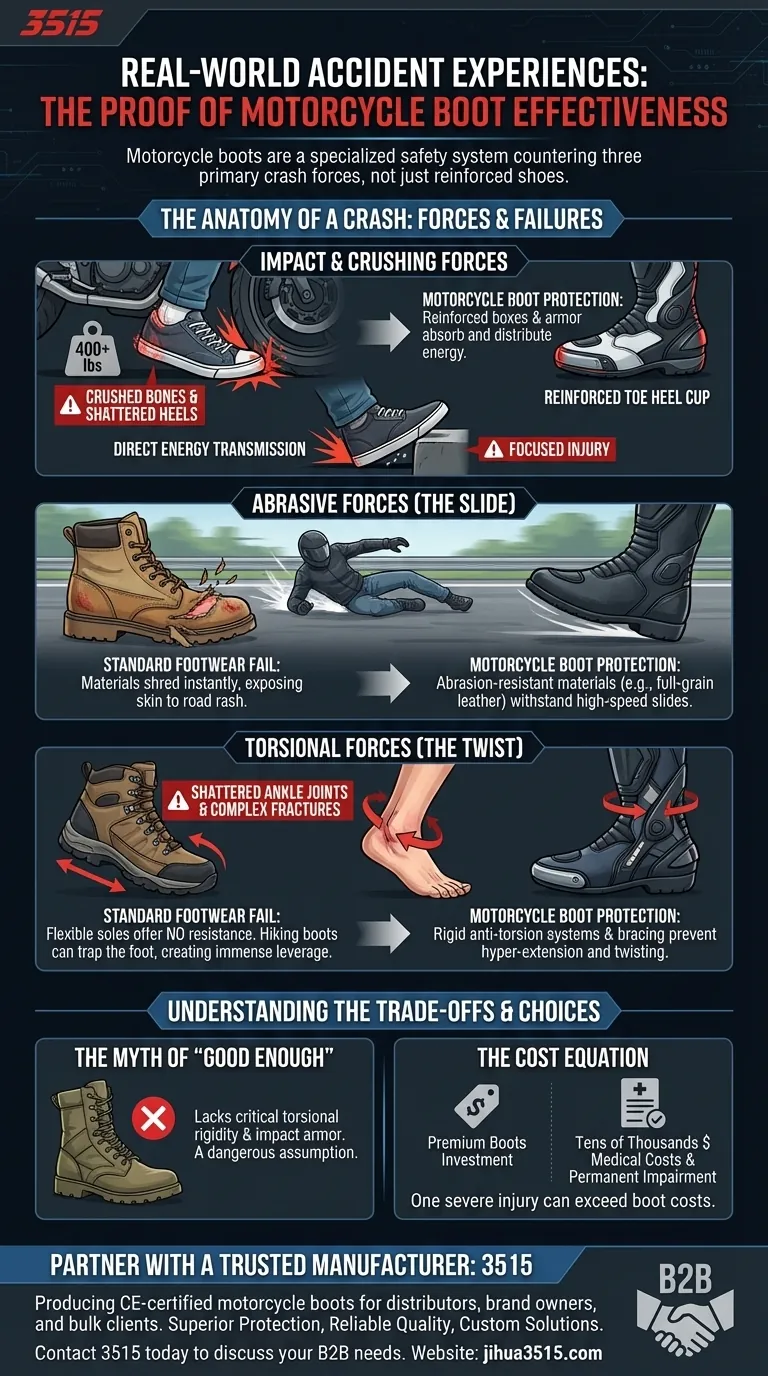
The crucial takeaway from accident reports is that motorcycle boots are not merely reinforced shoes; they are a specialized safety system designed to counter the three primary forces that injure a rider's feet and ankles: impact, abrasion, and torsion. Standard footwear fails catastrophically against all three.
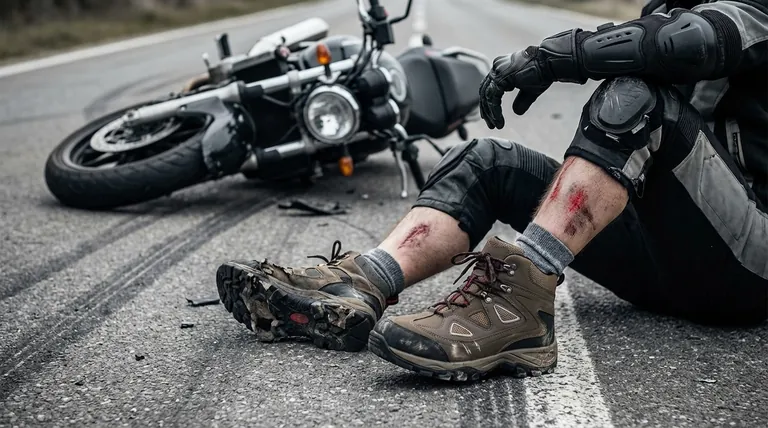
The Anatomy of a Crash: Forces on the Lower Leg
To understand why purpose-built boots are so critical, we must first analyze the specific dangers your feet and ankles face during an accident. The injuries are predictable and the result of overwhelming mechanical forces.
Impact and Crushing Forces
In many accidents, the motorcycle falls on the rider's leg, pinning it against the pavement. This can weigh over 400 pounds.
A direct impact with a curb, another vehicle, or road debris also transmits a massive amount of focused energy directly to the bones of the foot and ankle.
Abrasive Forces (The Slide)
When a rider goes down at speed, they slide. Pavement acts like a high-speed belt sander, and materials not designed for this reality—like canvas, soft leather, or denim—are shredded in seconds.
This abrasion will quickly wear through the footwear and then begin to remove skin, muscle, and bone.
Torsional Forces (The Twist)
This is the most insidious and damaging force. During a tumble or if the foot gets caught, the ankle can be violently twisted, bent sideways, or hyper-extended far beyond its natural range of motion.
These torsional forces are what cause complex fractures, shattered ankle joints, and severe ligament damage that can lead to permanent disability.
How Standard Footwear Fails in the Real World
The accounts of riders who crashed in non-motorcycle footwear provide a stark contrast and highlight the specific failure points of shoes not designed for the task.
Hiking Boots and the "Trapped Foot"
Riders often report that the aggressive, grippy soles of hiking boots get caught on bike components or the pavement during a crash.
Instead of sliding free, the foot is anchored while the body continues to move, creating immense leverage that twists and breaks the ankle. This is a common mechanism for severe injury.
The Illusion of Protection
While a sturdy work boot or hiking boot feels substantial, it lacks the most critical feature for crash safety: torsional rigidity.
These boots are designed to flex for walking comfort. In a crash, this flexibility offers no resistance to the twisting forces that destroy ankle joints.
Material Disintegration
The materials in sneakers, work boots, and fashion boots are not designed to withstand high-speed abrasion.
Accident reports frequently describe these shoes being torn apart, exposing the foot to the road surface and resulting in severe "road rash," deep lacerations, and broken bones from subsequent impacts.
Understanding the Trade-offs: Protection vs. Convenience
It is undeniable that proper motorcycle boots can be stiffer, warmer, and less convenient for walking than a pair of sneakers. This is the core trade-off.
The Myth of the "Good Enough" Boot
Many riders attempt to compromise with military-style or heavy-duty work boots, believing they offer sufficient protection.
Real-world experience proves this is a dangerous assumption. They lack the specific ankle bracing, impact armor, and abrasion-resistant construction needed to prevent the most common motorcycle-related lower leg injuries.
The Cost Equation
While quality boots represent a significant investment, this cost must be weighed against the potential for medical bills, lost work, and permanent physical impairment.
A single severe ankle injury can easily exceed tens of thousands of dollars in medical costs, making the price of premium protective gear seem negligible in comparison.
Making the Right Choice for Your Safety
Your choice of footwear is a direct investment in your ability to walk away from an accident. The evidence is clear: boots designed for the specific forces of a motorcycle crash are the only reliable option.
- If your primary focus is daily commuting: Look for CE-rated riding shoes or short boots that incorporate reinforced toe/heel boxes and integrated ankle protection.
- If your primary focus is touring or spirited road riding: A full-height touring or sport boot with explicit anti-torsion bracing is the minimum standard for protecting against higher-speed impacts.
- If your primary focus is track riding: Only a top-tier race boot with the highest levels of armor, sliders, and torsional rigidity can provide the protection required for that environment.
Ultimately, choosing to wear proper motorcycle boots is one of the most important safety decisions you can make every time you ride.
Summary Table:
| Force in a Crash | How Standard Footwear Fails | How Motorcycle Boots Protect |
|---|---|---|
| Impact & Crushing | Bones are crushed by the bike's weight (400+ lbs). | Reinforced toe/heel boxes and armor absorb and distribute impact energy. |
| Abrasion (The Slide) | Materials like canvas shred instantly, exposing skin to pavement. | Abrasion-resistant materials (e.g., full-grain leather) withstand high-speed slides. |
| Torsion (The Twist) | Flexible soles offer no resistance, leading to shattered ankles. | Rigid anti-torsion systems and ankle bracing prevent hyper-extension and twisting. |
Don't Compromise on Your Safety—Partner with a Trusted Manufacturer
As a large-scale manufacturer, 3515 produces a comprehensive range of CE-certified motorcycle boots designed specifically to protect against the real-world forces described in this article. We equip distributors, brand owners, and bulk clients with footwear that combines advanced safety features with proven durability.
Our production capabilities ensure you get:
- Superior Protection: Boots engineered with anti-torsion bracing, impact armor, and high-abrasion resistance.
- Reliable Quality: Consistent, high-volume manufacturing for brands that demand excellence.
- Custom Solutions: Tailored products to meet the specific safety and design needs of your market.
Ready to offer your customers the protection that real-world accidents demand? Contact 3515 today to discuss your manufacturing needs and secure a partner dedicated to rider safety.
Visual Guide
Related Products
- Wholesale Tactical Boots High-Traction & Reflective for Bulk & Brand Orders
- High Performance Fire-Retardant Waterproof Safety Boots
- Durable Goodyear Welt Leather Work Boots for Wholesale & Private Label
- Wholesale High-Traction Camo Boots - Custom Manufacturer for Brands
- Heavy-Duty Waterproof Nubuck Safety Boots Safety Shoes for Bulk Supply
People Also Ask
- How do tactical boots protect against injuries? Discover the Integrated Safety System
- How should one choose the right tactical boots? Match Your Mission for Optimal Performance & Safety
- How does creative short video content support functional footwear sales? Boost Trust and Traffic with Visual Proof
- What is the necessity of high-performance tactical boots in exoskeletons? Enhancing Load Efficiency and Safety
- How does the extraction of sociodemographic factors via NLP influence the design of tactical boots and work shoes?



















