
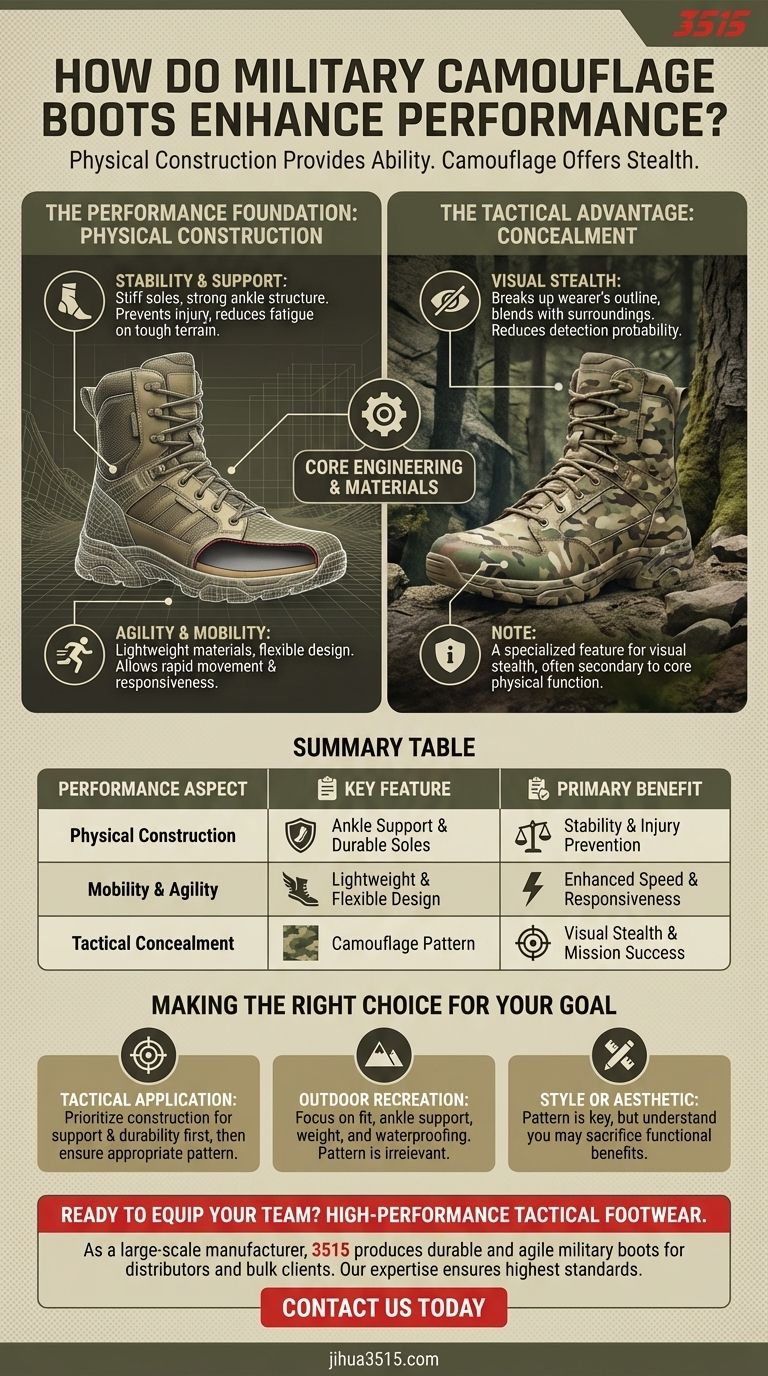
The performance of military boots comes from two distinct elements: their physical construction provides agility and support, while the camouflage pattern offers the tactical advantage of concealment. These features work together to help personnel navigate demanding terrains effectively and remain undetected in high-pressure situations.
The true performance enhancement of a military boot lies in its functional design—support, durability, and mobility. The camouflage pattern is a specialized tactical feature for stealth, which is often secondary to the boot's core construction.
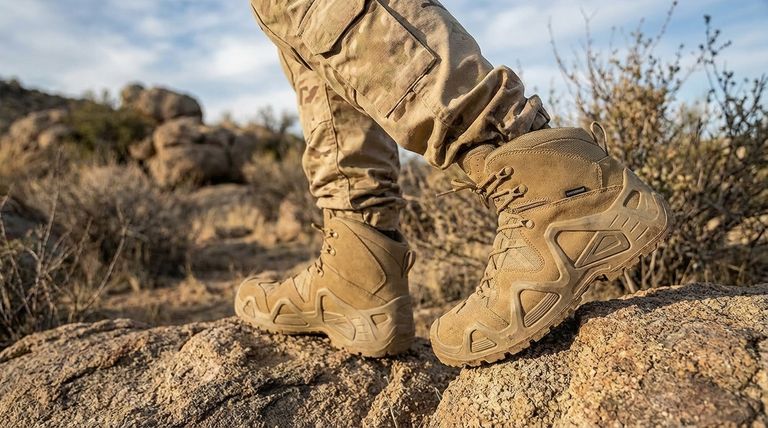
Deconstructing a Boot's Performance
The term "performance" in military footwear refers to the physical capabilities the boot provides to the wearer. This is almost entirely a result of its engineering and materials, not its color or pattern.
The Foundation: Stability and Support
Military operations require navigating unpredictable and often hazardous terrain. High-quality boots are engineered with stiff soles and strong ankle support to prevent injuries and reduce fatigue during long marches with heavy gear.
This structural integrity is the primary performance feature, allowing the wearer to move with confidence over rocks, rubble, and uneven ground.
Engineered for Agility
Despite their rugged construction, modern military boots are also designed for agility. They use advanced materials to reduce weight and incorporate flexible designs that allow for running, climbing, and quick changes in direction without feeling cumbersome.
This allows personnel to remain mobile and responsive in dynamic tactical environments.
The Specific Role of Camouflage
The camouflage pattern serves a very specific, tactical purpose. While often associated with the boot's overall performance, its contribution is focused entirely on visual concealment.
The Tactical Advantage: Concealment
The primary function of camouflage is to break up the wearer's outline and help them blend into their natural surroundings. For footwear, this reduces the chance of being spotted by an adversary, enhancing stealth during patrols or reconnaissance missions.
This is a critical performance factor in situations where avoiding detection is paramount to mission success.
From Function to Fashion
Beyond its tactical application, the camouflage pattern has also become a significant style element. It contributes to a rugged, military-inspired aesthetic that is popular among both tactical enthusiasts and the general public, though this has no bearing on functional performance.
Understanding the Trade-offs
It is crucial to distinguish between a boot that is built for military performance and one that simply looks the part. The presence of a camouflage pattern does not guarantee functional quality.
Pattern Does Not Equal Performance
Many commercially available boots feature camouflage patterns but lack the essential support, durability, and material quality of genuine military-issue footwear. A stylish pattern can easily mask poor construction.
For a true performance boot, the underlying architecture is far more important than the exterior visual design.
The Limits of Concealment
While useful, the camouflage on a pair of boots is a small part of an individual's total visual signature. Its effectiveness depends on the rest of the uniform, the environment, and the wearer's discipline in using cover and concealment. It is a component of stealth, not a complete solution.
Making the Right Choice for Your Goal
To select the right boot, you must first be clear about its intended purpose.
- If your primary focus is tactical application: Prioritize the boot's construction for support and durability first, then ensure the camouflage pattern is appropriate for your specific operational environment.
- If your primary focus is hiking or outdoor recreation: Ignore the pattern and concentrate entirely on fit, ankle support, weight, and waterproofing. A solid-color boot with superior construction will always outperform a poorly made camo boot.
- If your primary focus is style or a tactical aesthetic: The camouflage pattern is a key consideration, but be aware that you may be choosing aesthetics over the functional benefits of a true performance boot.
Ultimately, understanding that a boot's physical engineering provides the performance and the pattern provides the concealment empowers you to choose the right tool for your specific mission.
Summary Table:
| Performance Aspect | Key Feature | Primary Benefit |
|---|---|---|
| Physical Construction | Ankle Support & Durable Soles | Stability & Injury Prevention |
| Mobility & Agility | Lightweight & Flexible Design | Enhanced Speed & Responsiveness |
| Tactical Concealment | Camouflage Pattern | Visual Stealth & Mission Success |
Ready to equip your team with high-performance tactical footwear?
As a large-scale manufacturer, 3515 produces a comprehensive range of durable and agile military boots for distributors, brand owners, and bulk clients. Our expertise ensures your footwear meets the highest standards of support and tactical advantage.
Contact us today to discuss your specific needs and discover how we can enhance your operational performance.
Visual Guide
Related Products
- Durable Military Combat Boots with Water Drainage for Wholesale & OEM
- High-Traction Suede Tactical Boots Wholesale & Custom Manufacturing
- Durable High-Ankle Tactical Boots for Wholesale & Custom Manufacturing
- Durable Mid-Cut Tactical Boots for Wholesale & Private Label
- Wholesale Waterproof Tactical Boots Custom Suede & High-Traction Soles
People Also Ask
- Why must gait validation for military applications be conducted in combat boots? Ensure Data Accuracy for Soldiers
- What are the common types of combat boots? Find the Right Boot for Your Mission
- What factors should be considered when choosing military boots for hiking? Durability vs. Weight for Your Terrain
- What are the key considerations when choosing military boots? Prioritize Compliance, Environment & Fit
- How should the midfoot and heel fit in military boots? Achieve a Snug, Secure Fit for Blister Prevention



















