
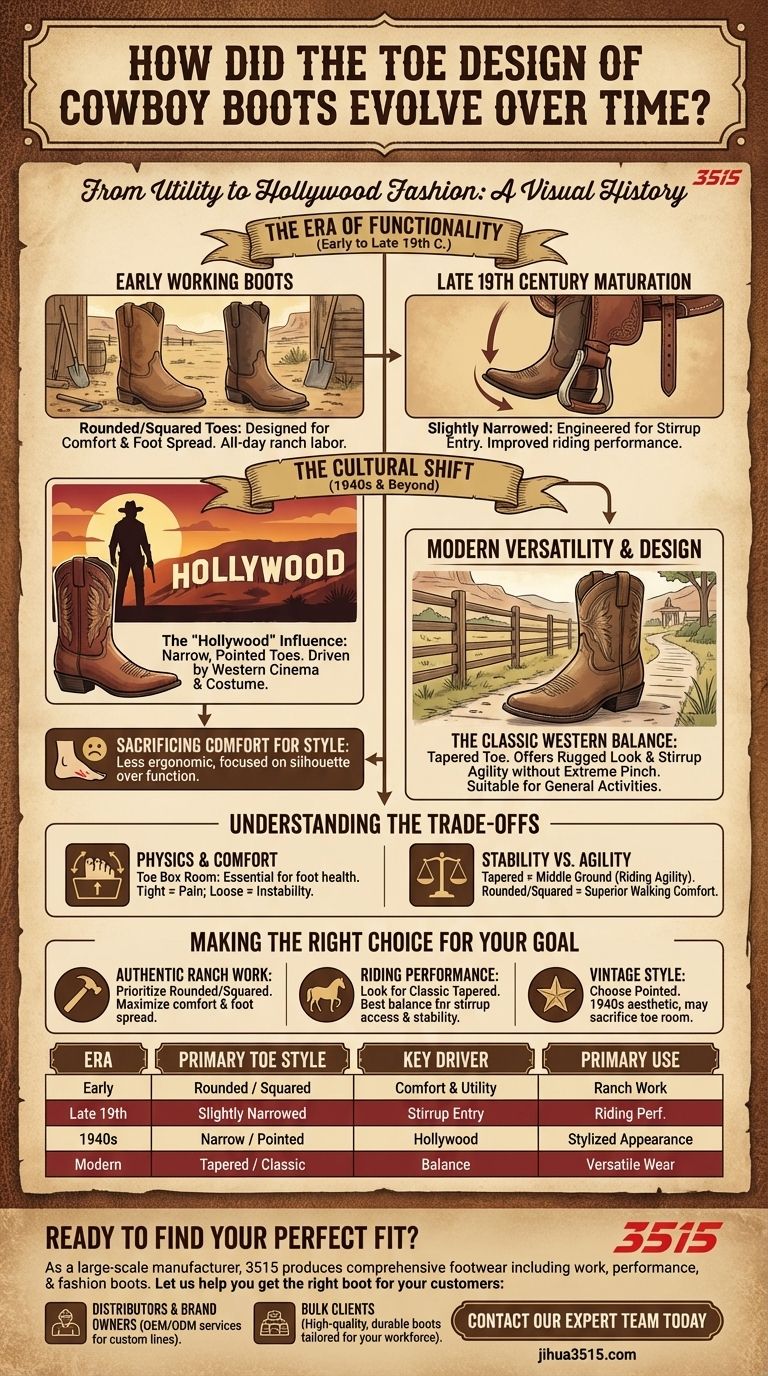
The evolution of the cowboy boot toe reflects a distinct shift from practical utility to cultural aesthetics. Originally featuring rounded or squared toes for maximum comfort during long workdays, the design narrowed slightly in the late 19th century to facilitate stirrup insertion, before ultimately transforming into the iconic narrow, pointed toe in the 1940s driven by the fashion of Western cinema.
The history of the cowboy boot is a tug-of-war between the physical demands of ranching and the visual language of Hollywood. While the pointed toe is now synonymous with the "cowboy look," the authentic working boot began as a wider, comfort-first tool, proving that the modern silhouette is largely a product of pop culture rather than equestrian necessity.

The Era of Functionality
Prioritizing All-Day Comfort
Early cowboy boots were strictly utilitarian tools designed for working men.
The original designs featured rounded or squared toes.
This shape was chosen specifically for comfort, allowing the rider’s toes to spread naturally during long days of labor.
Optimizing for the Saddle
As the design matured in the late 19th century, a functional modification was introduced.
Bootmakers began to slightly narrow the toes.
This was not a fashion statement; it was an engineering decision to make it easier for the cowboy to insert their foot into the stirrup quickly and safely.
The Cultural Shift
The "Hollywood" Influence
The most dramatic change in boot architecture occurred in the 1940s.
Influenced heavily by Western movies and the stylized costumes of screen stars, boot manufacturers began producing very narrow, pointed toes.
This aesthetic became the prevailing style, effectively redefining what the general public considered a "cowboy boot."
Sacrificing Comfort for Style
This shift to the pointed toe marked a departure from the boot's working roots.
While visually striking, these extreme shapes were often less comfortable for actual riders compared to the earlier, wider designs.
The design priority had moved from the ergonomics of the foot to the silhouette of the leg.
Modern Versatility and Design
The Classic Western Balance
Today, the "Classic" or "Western" toe attempts to bridge the gap between these eras.
This style features a slightly pointed toe that tapers at the end, offering a rugged look without the extreme pinch of fashion boots.
It retains the practical advantage of allowing quick movement through stirrups while remaining suitable for general ranch activities and walking.
Understanding the Trade-offs
The Physics of the Toe Box
When selecting a boot today, you must recognize the mechanical trade-off between the pointed aesthetic and foot health.
Regardless of the shape—pointed, rounded, or square—the toe box must provide enough room for the toes to move.
A toe box that is too tight will inevitably cause pain and long-term discomfort.
Stability vs. Agility
Conversely, a toe box that is too loose can negatively affect your stride and stability.
The Classic tapered toe is often the middle ground, offering the agility needed for riding without completely compressing the foot.
However, for pure walking comfort, the historical squared or rounded profile remains superior.
Making the Right Choice for Your Goal
To select the right boot, you must decide if you are dressing for the stirrup, the screen, or the work site.
- If your primary focus is authentic ranch work: Prioritize rounded or squared toes to maximize foot spread and comfort during long hours of labor.
- If your primary focus is riding performance: Look for a Classic tapered toe, which provides the best balance of stirrup access and foot stability.
- If your primary focus is vintage style: Choose the pointed toe, recognizing that this 1940s "movie" aesthetic may require sacrificing some room in the toe box.
By understanding the history behind the shape, you can choose a boot that not only fits your foot but fits your purpose.
Summary Table:
| Era | Primary Toe Style | Key Driver | Primary Use |
|---|---|---|---|
| Early Working Boots | Rounded / Squared | Comfort & Utility | All-day ranch work |
| Late 19th Century | Slightly Narrowed | Ease of Stirrup Entry | Riding Performance |
| 1940s & Beyond | Narrow & Pointed | Hollywood Fashion | Stylized Appearance |
| Modern (Classic) | Tapered / Slightly Pointed | Balance of Style & Function | Versatile Riding & Casual Wear |
Ready to Find Your Perfect Fit?
As a large-scale manufacturer, 3515 produces a comprehensive range of footwear for distributors, brand owners, and bulk clients. Our production capabilities encompass all types of shoes and boots, including authentic work boots, performance riding boots, and stylish fashion cowboy boots.
Let us help you get the right boot for your customers:
- Distributors & Brand Owners: We offer OEM/ODM services to create a custom boot line that perfectly matches your market's needs.
- Bulk Clients: Get high-quality, durable boots tailored for your workforce or organization.
Contact our expert team today to discuss your specific requirements and discover how we can support your business.
Visual Guide
Related Products
- High-Traction Suede Tactical Boots Wholesale & Custom Manufacturing
- Wholesale High-Traction Camo Boots - Custom Manufacturer for Brands
- Wholesale Lightweight Tactical Boots Custom Manufacturer for Desert & Combat Use
- Durable Leather Tactical Boots Wholesale & Custom Manufacturing for Brands
- Wholesale Durable Mid-Cut Tactical Boots for Custom & Private Label Brands
People Also Ask
- Why is sequential analysis utilized to evaluate tactical boots? Master Dynamic Boot Development and Ergonomic Performance
- How does the material of tactical boots affect their performance? Choose the Right Material for Your Mission
- How do tactical boots differ from regular boots? Performance, Durability & Design Explained
- How do military uniforms and tactical boots impact the prediction of thermal risk? Essential Safety Insights
- What are the benefits of integrating FES and sEMG into tactical boots? Safety, Reliability & Field-Ready Performance


















