
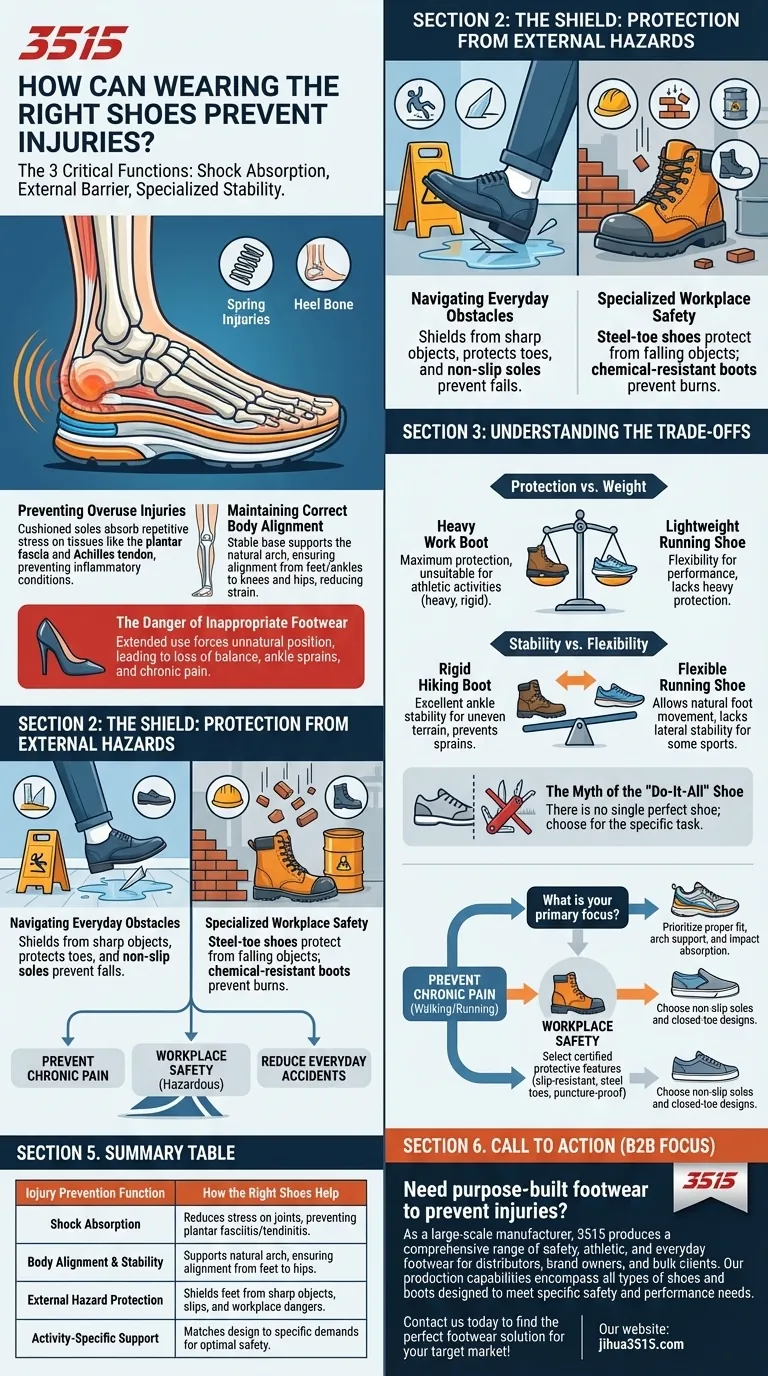
The right shoes prevent injuries by providing three critical functions: absorbing shock to protect your joints, creating a physical barrier against external hazards, and offering specialized stability for your specific environment. They are not just accessories, but essential pieces of protective equipment for both athletic and everyday activities.
The core principle of injury prevention through footwear is not finding one "perfect" shoe, but rather matching the specific design features of a shoe—like its cushioning, sole, and material—to the specific demands of your activity and environment.
The Foundation: Support and Shock Absorption
Proper footwear serves as the primary interface between your body and the ground. Its design directly impacts the forces that travel up your legs with every step.
Preventing Overuse Injuries
Well-designed shoes, particularly for walking or running, incorporate cushioning that absorbs impact. This reduces the repetitive stress on tissues like the plantar fascia on the bottom of your foot and the Achilles tendon at your heel, helping to prevent inflammatory conditions like plantar fasciitis and tendinitis.
Maintaining Correct Body Alignment
The right shoes provide a stable base that supports the natural arch of your foot. This ensures proper alignment not just in your feet and ankles, but also up the kinetic chain to your knees and hips, preventing strain caused by poor biomechanics.
The Danger of Inappropriate Footwear
Conversely, wearing shoes not suited for an activity can actively cause injury. Extended use of high heels, for example, forces the foot into an unnatural position, leading to a loss of balance, increased risk of ankle sprains, and chronic leg and foot pain.
The Shield: Protection from External Hazards
Beyond internal support, shoes are your first line of defense against the physical world. This protective function ranges from minor household incidents to serious workplace dangers.
Navigating Everyday Obstacles
In a home or office, shoes act as a simple barrier. They shield your feet from sharp objects on the floor, protect your toes from being stubbed on furniture, and provide non-slip soles to prevent falls on wet or slick surfaces.
Specialized Workplace Safety
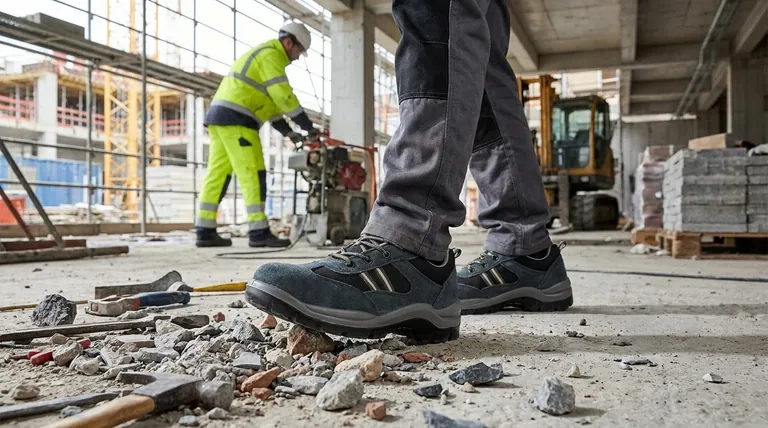
In hazardous environments, footwear becomes critical safety equipment. Steel-toe shoes protect construction workers from falling objects, while chemical-resistant boots prevent burns in industrial plants. This specialized construction is designed to mitigate specific, known risks.
Understanding the Trade-offs
Choosing the right shoe involves balancing competing needs. A feature that provides a benefit in one context can be a drawback in another.
Protection vs. Weight
A heavy-duty work boot with a steel toe offers maximum protection from impact. However, its weight and rigidity make it completely unsuitable for athletic activities where lightweight flexibility is essential for performance and preventing fatigue.
Stability vs. Flexibility
A rigid hiking boot provides excellent ankle stability for uneven terrain, preventing twists and sprains. That same rigidity would hinder the natural foot movement required for running, potentially causing strain by restricting motion.
The Myth of the "Do-It-All" Shoe
There is no single shoe that is perfect for every activity. A great running shoe lacks the lateral stability needed for basketball, and a comfortable walking shoe lacks the protective features of a work boot. The "right" shoe is always the right shoe for the specific task.
Making the Right Choice for Your Goal
To select footwear that effectively prevents injury, you must first define its primary purpose.
- If your primary focus is preventing chronic pain from walking or running: Prioritize proper fit, arch support, and sufficient cushioning to absorb repetitive impact.
- If your primary focus is safety in a hazardous workplace: Select shoes with certified protective features designed for your specific risks, such as slip-resistance, steel toes, or puncture-proof soles.
- If your primary focus is reducing everyday household accidents: Choose footwear with non-slip soles and a closed-toe design to protect against common slips, trips, and stubs.
Ultimately, viewing your footwear as purpose-built equipment is the most effective strategy for staying safe and injury-free.
Summary Table:
| Injury Prevention Function | How the Right Shoes Help |
|---|---|
| Shock Absorption | Reduces stress on joints, preventing plantar fasciitis and tendinitis. |
| Body Alignment & Stability | Supports natural arch, ensuring proper alignment from feet to hips. |
| External Hazard Protection | Shields feet from sharp objects, slips, and workplace dangers. |
| Activity-Specific Support | Matches design (e.g., cushioning, sole) to specific demands for optimal safety. |
Need purpose-built footwear to prevent injuries?
As a large-scale manufacturer, 3515 produces a comprehensive range of safety, athletic, and everyday footwear for distributors, brand owners, and bulk clients. Our production capabilities encompass all types of shoes and boots designed to meet specific safety and performance needs.
Contact us today to find the perfect footwear solution for your target market!
Visual Guide
Related Products
- Premium Suede Sport Safety Shoes for Wholesale & Bulk Orders
- Premium Lightweight Safety Shoes for Wholesale & Bulk Orders
- Wholesale Anti-Smash & Puncture-Proof Safety Shoes Custom Manufacturing for Brands
- Premium KPU Injection Athletic Style Safety Shoes
- Premium Safety Shoes with Rotating Buckle Safety Sneakers
People Also Ask
- What industries have specific OSHA footwear requirements? Ensure Compliance & Protect Your Workforce
- What are the primary functions of professional safety shoes? Maximize Safety in Water Supply Confined Spaces
- What role do specialized safety shoes play in preventing falls? Engineering Stability in Industrial Environments
- Why is barefoot walking used as a baseline in gait safety research? Unlocking Natural Biomechanics for Shoe Design
- Why should ergonomics and comfort be prioritized when selecting safety shoes? Boost Compliance & Worker Health



















