
To be considered OSHA-compliant, safety footwear must feature a specific label that identifies the ASTM standard it meets and the exact type of hazards it protects against. This permanent, indelible marking is typically found on the tongue of the shoe or boot and uses a clear coding system to detail its performance ratings for impact, compression, and other specialized protections.
The label inside a safety shoe is not a branding element; it is a technical specification. Learning to read its codes is the only reliable method to ensure the footwear you choose is appropriate for the specific hazards of your workplace and meets OSHA requirements.
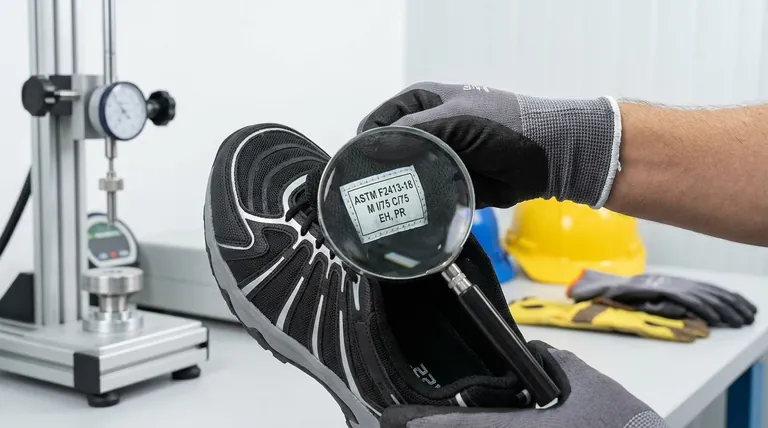
Decoding the Safety Shoe Label
OSHA's regulations for protective footwear point to consensus standards from ASTM International, specifically ASTM F2413. The label inside the shoe provides a concise summary of which parts of this standard the shoe meets. The information is typically presented in a specific three- or four-line format.
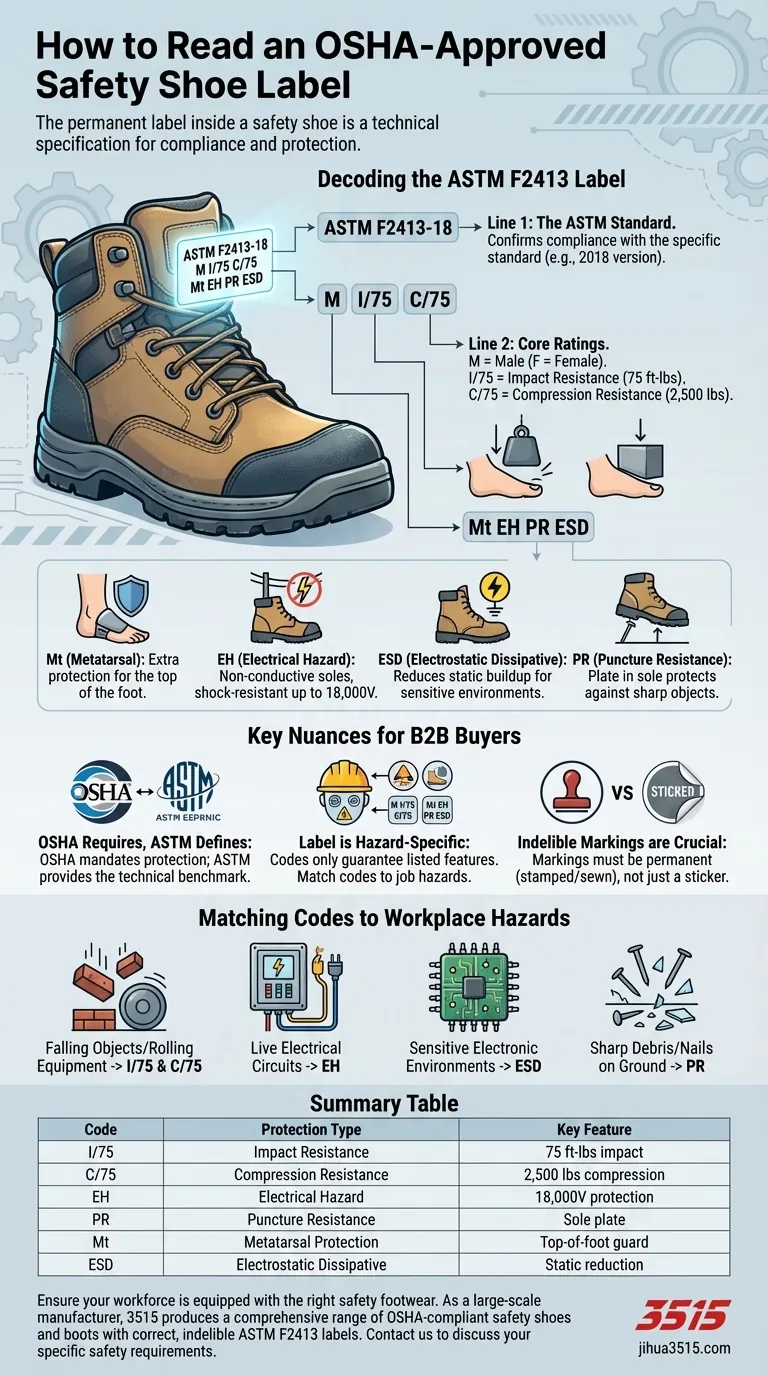
Line 1: The ASTM Standard
The first line identifies the shoe's compliance with the specific ASTM standard.
It will read ASTM F2413-18, for example. The "18" indicates the year the standard was issued (2018). This confirms the shoe was tested against a modern, relevant version of the safety specification.
Line 2: Gender and Protection Ratings
The second line is the most critical, as it details the core safety features.
It starts by identifying if the shoe is designed for a male (M) or female (F).
Immediately following this are the codes for impact (I) and compression (C) resistance. The number 75 is the highest rating, indicating protection against 75 foot-pounds of impact and 2,500 pounds of compression. A compliant label will read I/75 C/75.
Line 3 & 4: Specialized Hazard Protection
Any subsequent lines on the label list the codes for additional, specialized protections the shoe provides.
- Mt (Metatarsal): The shoe includes extra protection for the top of the foot (the metatarsal bones).
- EH (Electrical Hazard): The shoe is made with non-conductive, electric shock-resistant soles and heels. This protects the wearer from open circuits of up to 18,000 volts.
- ESD (Electrostatic Dissipative): The shoe is designed to reduce the buildup of static electricity by conducting it safely to the ground. This is critical in environments with sensitive electronics.
- PR (Puncture Resistance): The shoe has a puncture-resistant plate built into the sole to protect against sharp objects from below.
Understanding the Nuances
Simply seeing "safety shoe" on a box is not enough. The specific label codes are what determine compliance and, more importantly, actual safety in a given environment.
OSHA Sets the Requirement, ASTM Defines the Test
OSHA's role is to mandate that employers ensure workers are protected from foot-related hazards. The ASTM standard is the technical benchmark that defines how a shoe must perform to be considered protective. The label is proof the shoe has met that benchmark.
A Label is Hazard-Specific
A shoe’s label only guarantees the features that are explicitly listed. An EH-rated boot is not automatically puncture-resistant unless it also has a PR marking. You must match the codes on the label to the specific hazards of the job.
The Importance of "Indelible" Markings
The references specify that the markings must be indelible, meaning permanent. This is why the information is typically stamped or sewn into the tongue. A simple sticker or hang-tag is not a compliant label.
How to Apply This to Your Role
Your selection process must be based on a clear assessment of workplace hazards, not on brand or style. Use the label as your definitive guide.
- If your primary focus is protection from falling objects and rolling equipment: The I/75 and C/75 ratings are the most critical features to verify.
- If your primary focus is working near live electrical circuits: An EH rating is non-negotiable and provides a foundational layer of protection.
- If your primary focus is preventing static discharge in a sensitive environment: You must select footwear with an explicit ESD rating.
- If your primary focus is protection from nails or sharp debris on the ground: A PR rating is an essential requirement.
Ultimately, interpreting a safety shoe's label is a fundamental skill for ensuring both worker safety and regulatory compliance.
Summary Table:
| Label Code | Protection Type | Key Feature |
|---|---|---|
| I/75 | Impact Resistance | Protects against 75 ft-lbs of impact |
| C/75 | Compression Resistance | Withstands 2,500 lbs of compression |
| EH | Electrical Hazard | Protects against open circuits up to 18,000 volts |
| PR | Puncture Resistance | Shields against sharp objects from below |
| Mt | Metatarsal Protection | Guards the top of the foot (metatarsal bones) |
| ESD | Electrostatic Dissipative | Reduces static buildup in sensitive environments |
Ensure your workforce is equipped with the right safety footwear. As a large-scale manufacturer, 3515 produces a comprehensive range of OSHA-compliant safety shoes and boots for distributors, brand owners, and bulk clients. Our production capabilities encompass all types of protective footwear, each featuring the correct, indelible ASTM F2413 labels for guaranteed hazard protection.
Contact us today to discuss your specific safety requirements and benefit from our expertise in manufacturing certified safety footwear.
Visual Guide
Related Products
- Premium Lightweight Safety Shoes for Wholesale & Bulk Orders
- Wholesale Safety Footwear Manufacturer for Bulk & Custom OEM Orders
- Athletic Safety Shoes with Dial Closure & Steel Toe for Wholesale & Custom Manufacturing
- Premium Wholesale Tactical Style Safety Shoes Boots with Quick Lacing
- Heavy-Duty Waterproof Nubuck Safety Boots Safety Shoes for Bulk Supply
People Also Ask
- How is the absence of PPE (safety shoes & helmets) categorized in construction motion data labeling? Unlock Real-Time Safety Insights!
- What role does blockchain play in footwear supply chain transparency? Enhance Safety Shoe Traceability and Verification
- What is a recommended alternative to using hairspray for slip resistance? Ditch Unreliable Hacks for Real Safety
- What workplace hazards indicate the need for safety shoes? Identify risks to protect your workforce.
- What role do specialized safety shoes play in preventing falls? Engineering Stability in Industrial Environments


















