
Firstly, I'll provide a direct answer to the user's initial question: "Yes, quality insoles can significantly improve boot comfort." However, I won't stop there. I understand that the user isn't just seeking a simple yes or no; they want to know how and why insoles work, and how to choose the right one.
My analysis reveals a deeper need: the user is experiencing discomfort stemming from a mismatch between the rigid, generic interior of their boots and the unique shape of their foot. My goal is to bridge this gap, offering a practical solution that addresses pain, fatigue, and overall comfort, not just superficial cushioning.
To achieve this, I'll leverage the provided references. References 1 & 2 provide a straightforward affirmation, emphasizing "quality" as a crucial factor. Reference 3 highlights specific benefits like reduced foot pain and moisture management. Reference 4, although focused on boot design, emphasizes the importance of anatomical footbeds, which aligns perfectly with what a quality insole should offer.
My plan is to synthesize this information into a structured, informative response. I'll begin by framing the problem: discomfort is often a result of inadequate support, not just lack of softness. Then, I'll delve into the mechanisms of action, explaining how insoles provide anatomical support, reduce fatigue and impact, prevent common ailments like Plantar Fasciitis, and enhance the overall fit and stability of the boot.
To maintain objectivity, I'll also address the limitations and trade-offs. I'll emphasize that an insole is not a magic fix for a fundamentally ill-fitting boot and that some supportive insoles may require a break-in period. Importantly, I'll differentiate between cheap, ineffective inserts and structured, ergonomic insoles, reiterating the importance of "quality."
Finally, I'll provide actionable advice. I'll guide the user in choosing the right insole based on their specific needs, whether it's all-day standing, addressing specific pain, or improving the fit of a slightly loose boot. My goal is to empower the user to make an informed decision, ensuring they select an insole that truly enhances their boot-wearing experience. Yes, a quality insole can fundamentally transform the comfort of your boots. The standard footbeds included with most boots are often inexpensive, generic placeholders. Upgrading to a proper insole introduces superior support, cushioning, and an anatomical shape that the original boot lacks, directly addressing the primary causes of foot fatigue and pain.
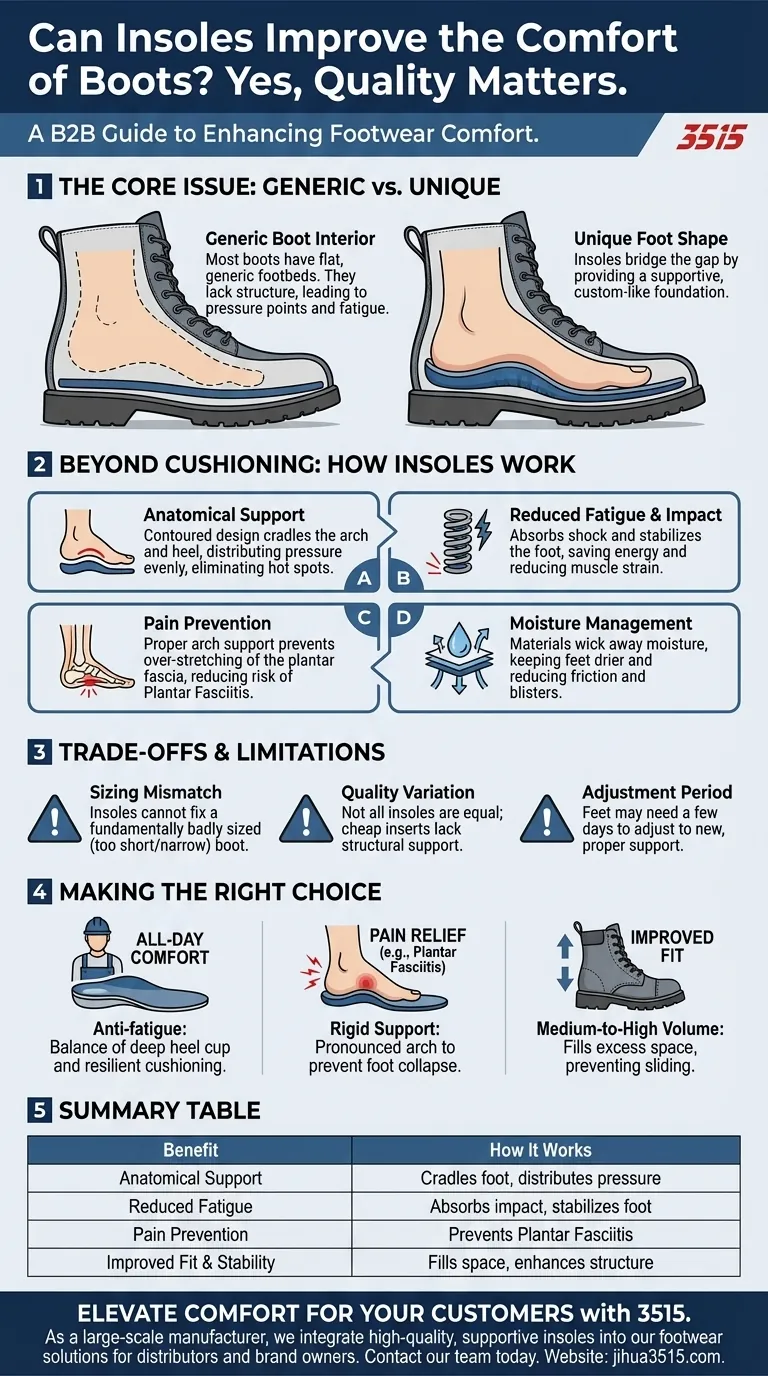
The core issue with boot discomfort is rarely a lack of softness, but a lack of proper structure. A boot's flat interior fails to support the three-dimensional arch of your foot, leading to strain and fatigue. A well-designed insole corrects this by creating a supportive foundation that cradles your foot's natural shape.
Beyond Cushioning: How Insoles Truly Work
Many assume an insole's only job is to add a soft layer, but its most critical function is to provide structure. This structural improvement is what delivers long-term comfort and reduces pain.
Providing Anatomical Support
Most factory footbeds are completely flat. A quality insole is contoured with an anatomical design, particularly through the arch and heel.
This cradles your foot, distributing pressure evenly across the entire sole. This eliminates the "hot spots" on the ball and heel of your foot that cause aching and soreness.
Reducing Fatigue and Impact
Anti-fatigue insoles are engineered to provide both support and shock-absorbing cushioning.
This combination stabilizes the foot to prevent wasted energy and absorbs the repeated impact from walking on hard surfaces, which significantly reduces overall muscle fatigue in your feet and legs.
Preventing Common Ailments
By providing proper arch support, insoles help prevent the over-stretching of the plantar fascia—the ligament running along the bottom of your foot.
This is a leading cause of Plantar Fasciitis, a common and painful foot condition. Proper support keeps your foot in its optimal alignment, reducing strain on critical ligaments and tendons.
Managing Moisture
Some performance insoles are also designed with materials that help wick moisture and reduce sweat.
Keeping your feet drier not only improves general comfort but also helps prevent the friction that can lead to blisters during extended wear.
Understanding the Trade-offs and Limitations
While insoles are a powerful tool, they are not a universal fix for every footwear problem. Understanding their limitations is key to using them effectively.
An Insole Cannot Fix a Badly Sized Boot
An insole can enhance the fit of a boot that is the correct size but lacks internal structure.
However, it cannot fix a boot that is fundamentally too short or too narrow. Placing a supportive insole in an already tight boot will only create more pressure and discomfort.
Not All Insoles Are Created Equal
There is a significant difference between a cheap, flimsy foam or gel insert and a structured, supportive insole.
While a simple gel insert might provide temporary cushioning, it lacks the rigid arch and heel cup needed to provide true anatomical support and reduce fatigue over a long day.
There Can Be an Adjustment Period
If your feet are accustomed to unsupportive footwear, a structured insole with a firm arch may feel strange or even slightly uncomfortable at first.
This is often a sign that the insole is working to realign your foot. It may take a few days of wear for your feet to adjust to the new support.
Making the Right Choice for Your Goal
Selecting the right insole depends entirely on the problem you are trying to solve.
- If your primary focus is all-day comfort while standing or walking: Choose an anti-fatigue insole that offers a balance of deep heel cupping for stability and resilient cushioning to absorb impact.
- If your primary focus is alleviating specific pain like Plantar Fasciitis: Opt for a more rigid, supportive insole with a pronounced arch designed to prevent the foot from collapsing and straining the plantar fascia.
- If your primary focus is to improve the fit of a slightly loose boot: Select a medium-to-high volume insole that provides structure while also taking up excess space, preventing your foot from sliding.
By correctly identifying your need, you can choose an insole that makes your boots feel like they were custom-made for your feet.
Summary Table:
| Benefit | How It Works |
|---|---|
| Anatomical Support | Contoured arch and heel cup cradle the foot, distributing pressure evenly. |
| Reduced Fatigue | Absorbs impact and stabilizes the foot to prevent muscle strain. |
| Pain Prevention | Proper arch support helps prevent conditions like Plantar Fasciitis. |
| Improved Fit & Stability | Takes up excess space and enhances the boot's internal structure. |
Ready to elevate comfort for your customers?
As a large-scale manufacturer, 3515 produces a comprehensive range of footwear for distributors, brand owners, and bulk clients. Our production capabilities encompass all types of shoes and boots, and we can integrate high-quality, supportive insoles directly into your orders to deliver superior comfort from day one.
Let's discuss how we can enhance your product line with anatomically designed footwear solutions. Contact our team today for a consultation.
Visual Guide
Related Products
- Wholesale Waterproof Tactical Boots Custom Suede & High-Traction Soles
- Premium Wholesale Waterproof Safety Boots High Performance Protection for Industrial Markets
- Premium Waterproof High-Cut Industrial Safety Boots for Wholesale and Bulk Orders
- Durable Leather Moc Toe Work Boots for Wholesale & Custom Manufacturing
- Durable Leather High-Ankle Tactical Boots for Wholesale & Custom Manufacturing
People Also Ask
- What waterproof technology is used in tactical boots? Unlock All-Weather Performance & Protection
- What are the advantages and disadvantages of waterproof tactical boots? A Guide to the Key Trade-Offs
- What is the significance of waterproof functionality in tactical boots? Essential for Health & Performance
- What is the role of professional 3D medical imaging software in optimizing tactical boot design and performance?
- What features enhance breathability and comfort in tactical boots? A Guide to Superior Footwear Performance


















