
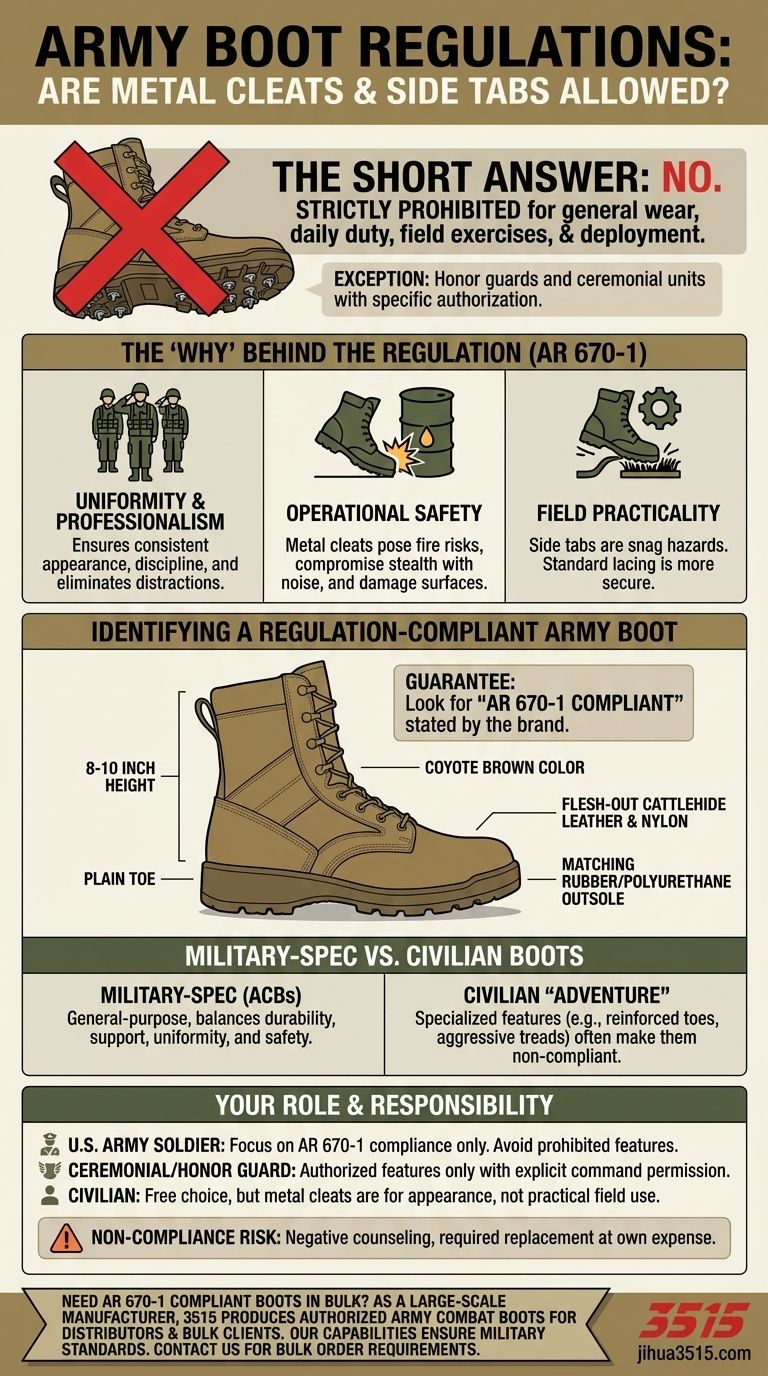
The short answer is no. For general wear, Army boots are not authorized to have metal cleats or side tabs. These features are strictly prohibited for daily duty, field exercises, and deployment. The only exception is for honor guards and other ceremonial units specifically authorized to wear them during official ceremonial duties.
The core principle behind Army boot regulations is to ensure operational safety, uniformity, and field readiness. Features like metal cleats and side tabs are considered non-standard modifications that compromise these priorities for the vast majority of Soldiers.
The "Why" Behind the Regulation
Army Regulation 670-1 dictates the standards for wear and appearance of the uniform. The rules regarding footwear are not arbitrary; they are based on decades of experience prioritizing soldier safety and effectiveness.
Prioritizing Uniformity and Professionalism
A standardized uniform is essential for discipline and morale. Prohibiting non-regulation features ensures a consistent, professional appearance across the force, eliminating distractions and personal modifications.
Operational Safety
Metal cleats pose significant and unnecessary risks in an operational environment. They can create sparks (a hazard near fuel or munitions), generate noise that compromises stealth, and severely damage surfaces like aircraft floors or naval vessel decks.
Field Practicality
Side tabs, often used as pull-on loops, can become a snag hazard in the field, potentially causing injury or entanglement. The standard lacing system is considered the most secure and reliable method for military footwear.
Identifying a Regulation-Compliant Army Boot
When purchasing boots, you must ensure they meet the standards outlined in AR 670-1. While the regulation is detailed, compliant boots share several key characteristics.
Authorized Color and Materials
Standard issue Army Combat Boots (ACBs) must be the color coyote brown. They are constructed from flesh-out cattlehide leather combined with a nylon fabric.
Required Height and Design
The boots must be between 8 to 10 inches in height. They feature a plain toe and a rubber or polyurethane outsole that matches the color of the boot.
The Guarantee of Compliance
The most reliable way to ensure a boot is authorized is to purchase from a reputable brand that explicitly states the boot is "AR 670-1 compliant." This indicates the manufacturer has designed it to meet all Army requirements.
Understanding the Trade-offs: Military-Spec vs. Civilian Boots
It's crucial to distinguish between boots designed for military compliance and those designed for civilian recreational activities, even if they look similar.
The Purpose of Army Combat Boots
ACBs are general-purpose tools designed for a wide range of conditions, from garrison to rugged field environments. They balance durability, support, and comfort with the strict requirements of uniformity and safety.
The Purpose of "Adventure" Boots
Civilian hiking or "adventure" boots are specialized. They might have features like reinforced toe boxes or aggressive treads designed for specific activities like off-roading. These specialized features often make them non-compliant for military wear.
The Risk of Non-Compliant Footwear
Choosing to wear unauthorized boots is a risk. It can result in a negative counseling from your leadership and require you to purchase a new, compliant pair at your own expense. It signals a disregard for regulations and can impact how you are perceived by your peers and superiors.
Making the Right Choice for Your Role
Your specific role and mission dictate your footwear requirements. For Soldiers, compliance is the only factor that matters.
- If your primary focus is duty use as a U.S. Army Soldier: Your only goal is AR 670-1 compliance. Always verify boots are authorized and avoid any with prohibited features like metal cleats or side tabs.
- If you are a member of a ceremonial or honor guard unit: You may be authorized or required to wear boots with these features, but only with explicit permission from your command for specific, official duties.
- If you are a civilian seeking military-style boots: You are free to choose any features you like, but understand that metal cleats are for ceremonial appearance, not practical field or trail use.
Ultimately, ensuring your footwear is compliant is a basic responsibility that reflects your professionalism and readiness.
Summary Table:
| Feature | Regulation Status | Key Reason |
|---|---|---|
| Metal Cleats | Prohibited (Except Ceremonial) | Safety hazard, damages surfaces, compromises stealth |
| Side Tabs | Prohibited | Snag hazard, non-standard modification |
| Boot Height | 8-10 inches | Mandatory for uniformity and support |
| Color/Material | Coyote brown, leather/nylon | Standardized appearance and durability |
Need AR 670-1 Compliant Boots in Bulk?
As a large-scale manufacturer, 3515 produces a comprehensive range of authorized Army combat boots for distributors, brand owners, and bulk clients. Our production capabilities ensure your footwear meets all military standards for safety, durability, and professionalism.
Contact us today to discuss your bulk order requirements and get compliant boots delivered reliably.
Visual Guide
Related Products
- Durable Military Combat Boots with Water Drainage for Wholesale & OEM
- High-Traction Suede Tactical Boots Wholesale & Custom Manufacturing
- Durable High-Ankle Tactical Boots for Wholesale & Custom Manufacturing
- Wholesale Waterproof Tactical Boots Custom Suede & High-Traction Soles
- Durable Mid-Cut Tactical Boots for Wholesale & Private Label
People Also Ask
- Why must gait validation for military applications be conducted in combat boots? Ensure Data Accuracy for Soldiers
- What are the common types of combat boots? Find the Right Boot for Your Mission
- What factors should be considered when choosing military boots for hiking? Durability vs. Weight for Your Terrain
- What are the key considerations when choosing military boots? Prioritize Compliance, Environment & Fit
- How should the midfoot and heel fit in military boots? Achieve a Snug, Secure Fit for Blister Prevention


















