It’s a scene that plays out far too often in kitchens, hospitals, and on factory floors. A team member, equipped with company-issued "slip-resistant" shoes, loses their footing on a freshly mopped surface or an unseen patch of grease. The result ranges from a startling close call to a serious, recordable injury. As a manager, you're left with a frustrating question: we invested in safety footwear, so why do these dangerous slips keep happening?
The Vicious Cycle of Slips, Falls, and False Fixes
If you're grappling with this issue, you are not alone. Many organizations find themselves in a reactive cycle: an incident occurs, they review their footwear policy, perhaps switch to a different model that looks more rugged, but the underlying problem persists.
This isn't just a safety issue; it's a significant business drain. Each slip-and-fall incident carries a cascade of negative consequences:
- Direct Costs: Worker's compensation claims and increased insurance premiums can cost tens of thousands of dollars for a single incident.
- Operational Disruption: Lost workdays from the injured employee and the time spent on incident reports and investigations disrupt workflow and kill productivity.
- Decreased Morale: When teams don't feel safe in their environment, their confidence falters, and their overall performance can suffer.
In an attempt to solve this, many fall into common traps. They might choose shoes based on the most aggressive-looking sole, or worse, employees resort to unreliable DIY "solutions" like scuffing soles with sandpaper or applying sprays. These methods provide a false sense of security because they fail to address the real reason people slip.
The Real Enemy Isn't the Spill—It's Hydroplaning
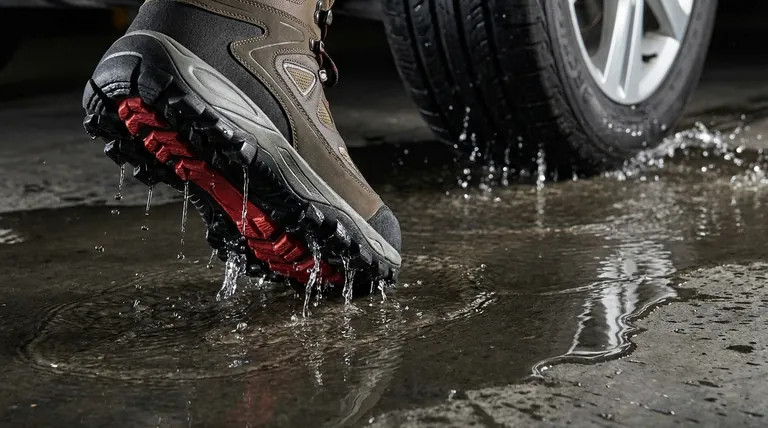
The common assumption is that slipping is a failure of "stickiness." But the problem is rarely the floor itself or a shoe's simple lack of grip. The true culprit is the thin, often invisible layer of liquid—be it water, oil, or grease—that gets trapped between the shoe's outsole and the floor.
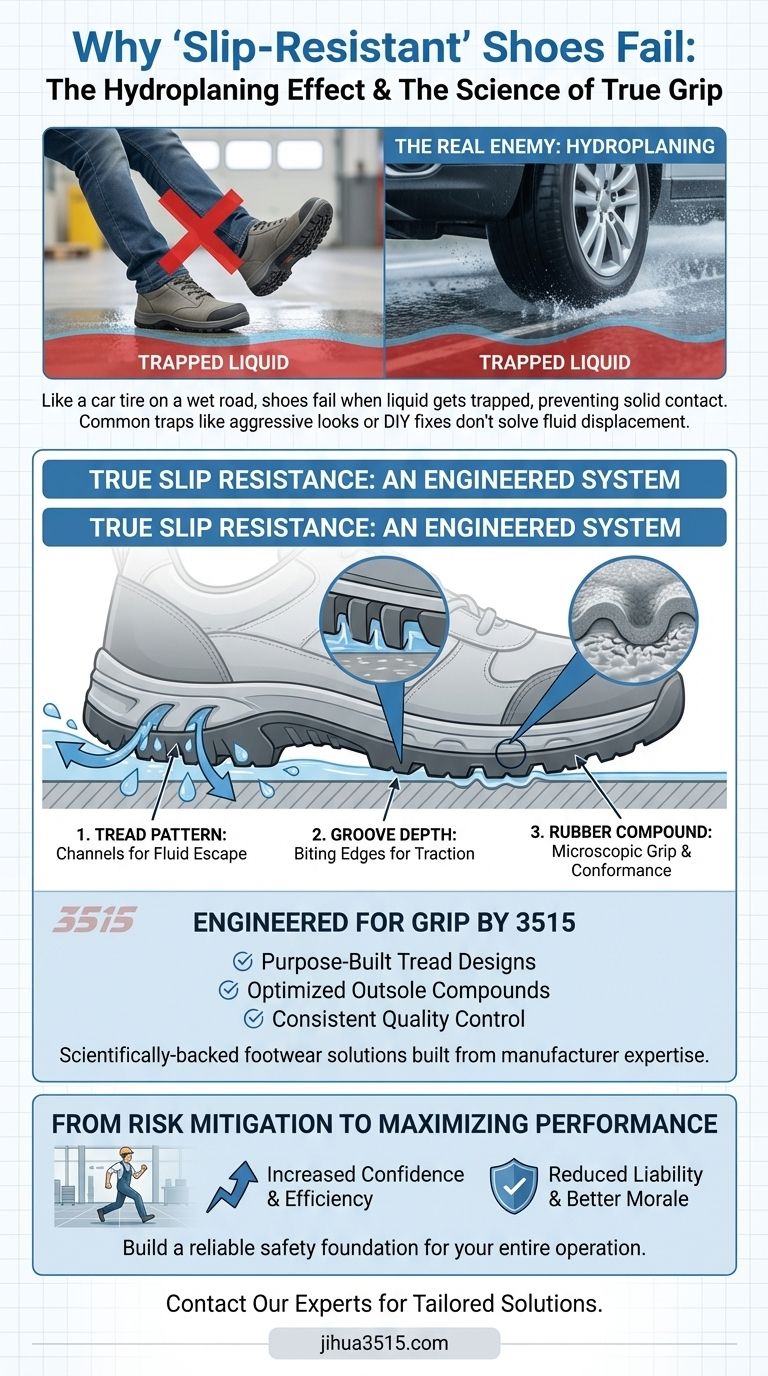
Think of it like a car tire on a wet road. Even the best tire will hydroplane if it can't channel water away from its path fast enough. Your feet experience the exact same phenomenon. A shoe fails not because it isn't "grippy," but because its design allows it to ride on top of the liquid instead of making solid contact with the ground.
True slip resistance is not a single feature; it's an engineered system designed to defeat this hydroplaning effect. It relies on three critical components working in harmony:
1. The Tread Pattern: Channels for Fluid Escape
The intricate patterns on a properly designed outsole aren't for show. They function as a network of channels specifically designed to direct liquids out and away from the center of the foot, clearing a path for the sole to connect with the surface.
2. The Groove Depth: Biting Edges for Traction
Once the liquid is channeled away, deep grooves provide the edges needed to "bite" into the floor. This creates the mechanical friction necessary to maintain a secure grip, especially when pushing off, turning, or stopping suddenly.
3. The Rubber Compound: Microscopic Grip
The material itself is the final piece of the puzzle. Most standard boots use a hard, durable rubber. In contrast, high-performance slip-resistant shoes use a softer rubber compound. This allows the sole to conform to the microscopic imperfections of a floor surface, dramatically increasing the contact area and creating a powerful hold where hard rubber would simply glide over the top.
The "rugged" boot fails because its tread isn't designed to channel water. The DIY-scuffed sole fails because it lacks the deep grooves and proper material to make contact. They are all treating the wrong problem.
Engineered for Grip: More Than Just Rubber and Treads
To consistently prevent hydroplaning on your feet, you need footwear that was intentionally designed as a fluid-displacement system. This requires a deep understanding of materials science and fluid dynamics—the kind of expertise that comes from manufacturing at scale.
As a foundational manufacturer for numerous brands and distributors, 3515 builds this science into every pair of shoes we produce. Our footwear isn't just assembled; it's engineered to solve the core problem of slip resistance:
- Purpose-Built Tread Designs: We engineer outsole patterns that efficiently expel water and oil, ensuring the sole makes maximum contact with the floor.
- Optimized Outsole Compounds: We formulate and mold specific rubber compounds that offer the perfect balance of softness for superior grip and durability for long-term wear in professional environments.
- Consistent Quality Control: Our large-scale production capabilities ensure that every shoe delivered meets the precise specifications required for reliable, certified safety performance.
We don't just add a "slip-resistant" label. We build the solution to the underlying physics of the problem directly into the product's DNA.
From Mitigating Risk to Maximizing Performance
When you solve the slip-and-fall problem at its root, something powerful happens. You move beyond simply preventing accidents and start enabling higher performance. With a reliable safety foundation underfoot, your team can operate with greater confidence and efficiency. You reduce the financial and operational drag of injuries and unlock new levels of productivity.
For distributors and brand owners, providing footwear built on this science means offering a product you can trust. It translates to greater customer satisfaction, reduced liability, and a stronger reputation for quality and safety in the market.
Solving your team's slip-and-fall challenges isn't just about ordering a new boot; it's about implementing a reliable safety foundation for your entire operation. Whether you're outfitting a restaurant chain, a hospital network, or a construction crew, the right footwear is a critical asset that impacts productivity, morale, and your bottom line. We specialize in partnering with distributors, brand owners, and large-scale clients to develop footwear solutions tailored to specific workplace hazards. Contact Our Experts to discuss how a scientifically-backed approach to footwear can transform your business.
Visual Guide
Related Products
- Premium Suede Sport Safety Shoes for Wholesale & Bulk Orders
- Heavy-Duty Waterproof Nubuck Safety Boots Safety Shoes for Bulk Supply
- Advanced KPU Athletic Safety Shoe with Steel Toe Cap Anti-Slip Rotary Lacing System
- Durable High-Traction Canvas Sneakers Wholesale & Custom Manufacturing
- Durable Leather Moc Toe Work Boots for Wholesale & Custom Manufacturing
Related Articles
- The Ghost in the Machine: Why an Obsolete Footwear Standard Creates Modern Risk
- Beyond the Steel Toe: The Hidden Ergonomics of Workplace Safety
- Why Traditional Laces Are a Hidden Safety Risk—And What to Do About It
- The True Cost of Skipping Safety Shoes: Long-Term Risks and Smart Protection
- How Safety Shoe Engineering Prevents Workplace Injuries Across Industries