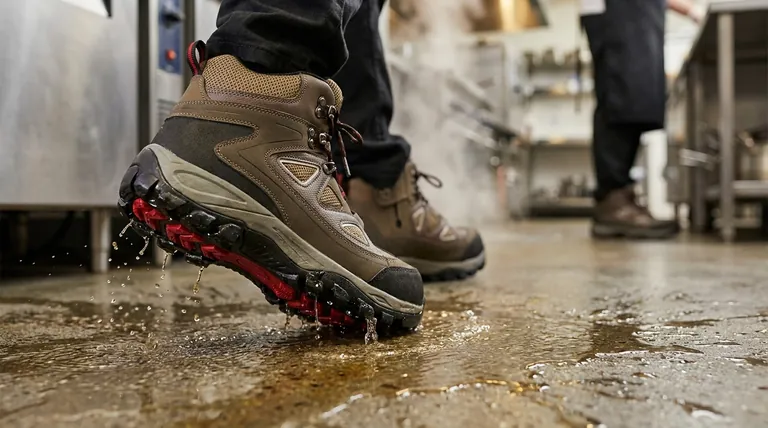
Is this scene familiar? You've invested in so-called "non-slip" shoes for your entire team. You've checked the box on safety compliance. Yet, a report lands on your desk: another employee has suffered a costly slip-and-fall accident on a wet or greasy floor. You're left asking a frustrating, and often expensive, question: "We bought the right shoes. Why does this keep happening?"
This isn't just bad luck. It's a sign of a fundamental misunderstanding of what actually makes a shoe safe.
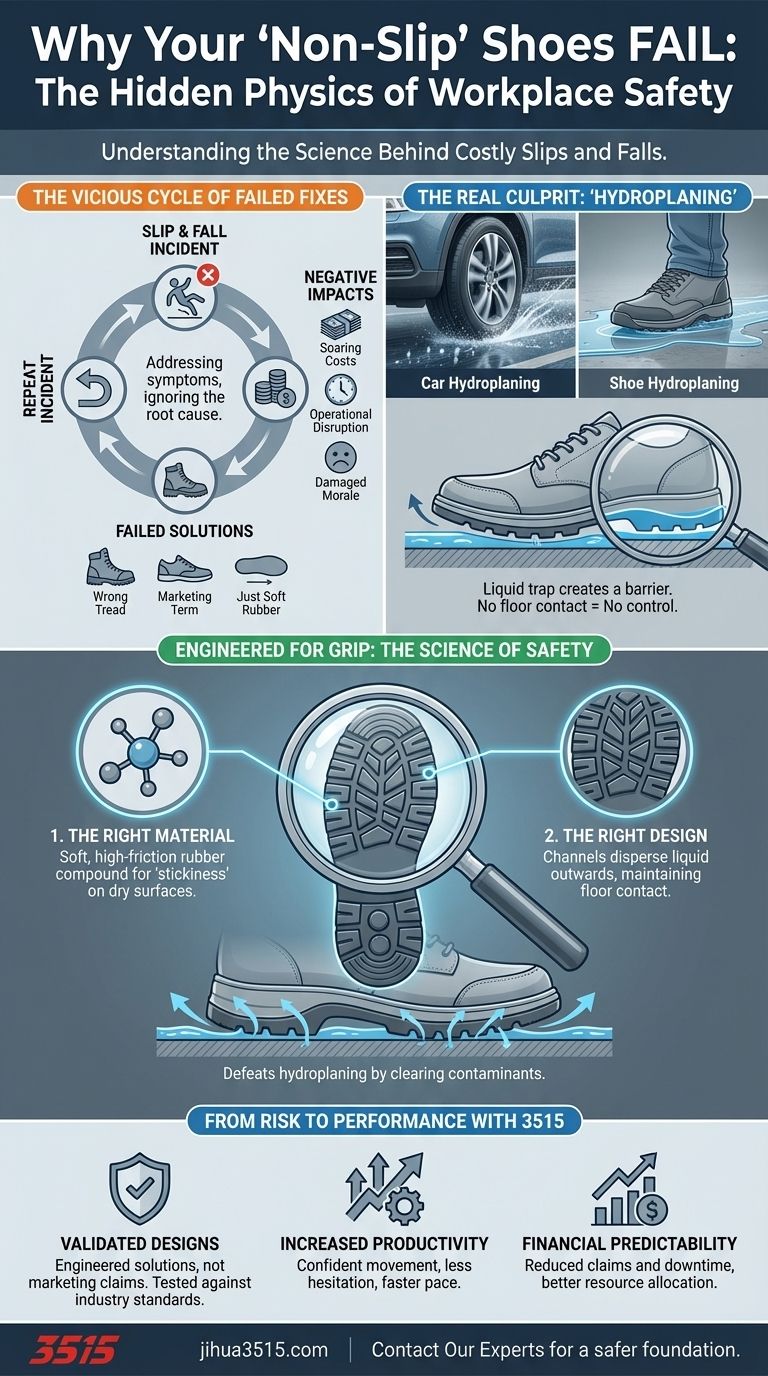
The Vicious Cycle of Slips, Falls, and Failed Fixes
Workplace slips, trips, and falls are not a minor issue; they are one of the leading causes of disabling injuries across industries, from commercial kitchens to manufacturing floors. The consequences go far beyond the immediate incident. A single fall can trigger a cascade of negative business impacts:
- Soaring Costs: Workers' compensation claims, medical bills, and potential legal fees can easily run into tens of thousands of dollars per incident.
- Operational Disruption: Lost workdays from the injured employee, time spent on incident reports, and potential work stoppages cripple productivity.
- Damaged Morale: When employees don't feel safe, their confidence plummets, their pace slows, and the overall work environment becomes tense.
In an attempt to solve this, managers often find themselves in a frustrating loop. They might try:
- Buying rugged, heavy-tread boots, assuming that a deep tread designed for hiking will grip a smooth, wet floor.
- Choosing any shoe marketed as "non-slip", without understanding the difference between a marketing term and an engineering standard.
- Focusing only on the rubber material, believing that any soft sole is inherently safe.
These solutions fail time and again because they only address the symptoms, not the root cause. They ignore the simple physics at play in every single slip.
The Real Culprit: It's Not the Floor, It's 'Hydroplaning'
The most dangerous element on a slippery floor isn't the floor itself. It's the invisible, paper-thin layer of liquid—be it water, oil, or grease—that sits on top of it.
When an employee steps on this surface with the wrong kind of shoe, that liquid has nowhere to go. It gets trapped under the sole, creating a barrier that lifts the shoe off the floor. This is exactly the same principle as a car hydroplaning on a wet road. The tire loses contact with the asphalt, and the driver loses all control. In that moment, it doesn't matter how "grippy" the rubber is, because it isn't even touching the ground.
This is precisely why common "solutions" fail:
- Hiking boot treads have large, deep lugs designed to dig into soft ground like dirt and mud. On a hard, flat surface, these wide lugs are terrible at clearing away a thin film of water. They simply glide over the top of it.
- A soft rubber sole with no tread pattern might feel sticky to the touch, but it creates the perfect smooth surface for hydroplaning.
The only way to stop a slip is to defeat this hydroplaning effect. You need a shoe that acts like a high-performance car tire, intelligently clearing liquid out of the way to maintain direct, solid contact with the floor.
Engineered for Grip: How the Right Shoe Defeats the Physics of a Slip
A genuinely slip-resistant shoe is not just a piece of footwear; it's an engineered safety system designed with this principle in mind. To solve the root cause, a shoe must combine two critical elements:
1. The Right Material for Friction
The foundation is a soft, high-grade rubber compound. This material is selected for its high coefficient of friction, providing the essential "stickiness" needed to grip a dry surface. But as we've learned, material alone isn't enough when liquids are involved.
2. The Right Design for Displacement
This is the game-changer. The sole must feature an intricate tread pattern with fine, deep channels. This isn't for aesthetics. These channels are engineered to do one job perfectly: disperse liquid away from the center of the sole. As pressure is applied with each step, the channels force water and oil outwards, allowing the solid parts of the tread to make firm contact with the actual floor.
At 3515, we don't just manufacture shoes; we engineer solutions based on a deep understanding of this science. Our slip-resistant footwear is the direct result of this knowledge. We combine advanced rubber compounds with meticulously designed tread patterns that are proven to channel contaminants and maintain grip. Furthermore, we validate our designs against official industry safety standards (like ASTM), so you aren't just trusting a marketing claim—you're investing in objectively tested and certified performance.
From Managing Risk to Maximizing Performance
When you equip your team with footwear that truly solves the problem of slips and falls, you do more than just prevent accidents. You unlock new potential for your entire operation.
Imagine a work environment where your team can move with speed and confidence, no longer hesitant on slick surfaces. Productivity naturally increases. When you eliminate the constant threat of costly injury claims and operational downtime, you gain financial predictability and can reallocate resources from damage control to business growth. You stop managing risk and start empowering your workforce. A genuine commitment to safety becomes a powerful tool for improving morale and positioning your company as an employer of choice.
Solving this persistent problem isn't about finding a better shoe—it's about adopting a better safety strategy built on proven science. If you're ready to break the cycle of slips, falls, and frustration, our team is here to help you build a safer, more productive foundation for your business, from the ground up. Let's discuss the specific challenges of your environment and how the right engineered footwear can make all the difference. Contact Our Experts.
Visual Guide
Related Products
- Premium Suede Sport Safety Shoes for Wholesale & Bulk Orders
- Premium Lightweight Safety Shoes for Wholesale & Bulk Orders
- Wholesale Anti-Smash & Puncture-Proof Safety Shoes Custom Manufacturing for Brands
- Premium KPU Injection Athletic Style Safety Shoes
- Premium Safety Shoes with Rotating Buckle Safety Sneakers
Related Articles
- The Ghost in the Machine: Why an Obsolete Footwear Standard Creates Modern Risk
- Beyond the Steel Toe: The Hidden Ergonomics of Workplace Safety
- Why Traditional Laces Are a Hidden Safety Risk—And What to Do About It
- The True Cost of Skipping Safety Shoes: Long-Term Risks and Smart Protection
- How Safety Shoe Engineering Prevents Workplace Injuries Across Industries