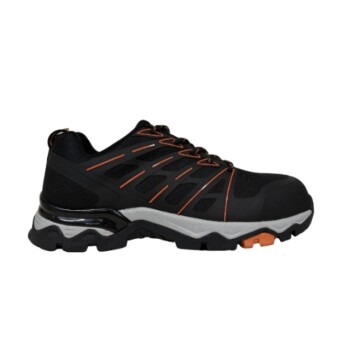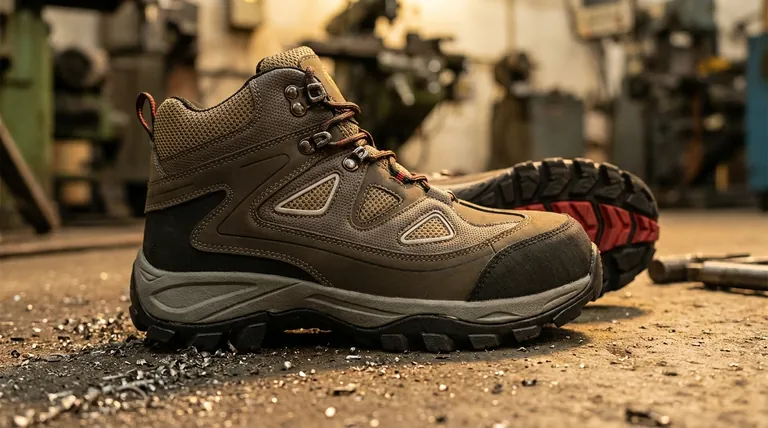
The Silent Contract of a Ten-Hour Shift
Consider a worker at the end of a long shift on a factory floor. They've walked miles, stood for hours, and navigated potential hazards. Yet, their feet feel supported, not exhausted.
This isn't a happy accident. It's the result of a silent contract fulfilled by an object we often take for granted: the safety shoe.
A modern safety trainer isn't a single item. It's an engineered system—a carefully orchestrated symphony of materials where every component has a purpose, and every choice involves a deliberate trade-off. Understanding this architecture reveals the deep psychology behind true workplace safety.
The Anatomy of a Protective System
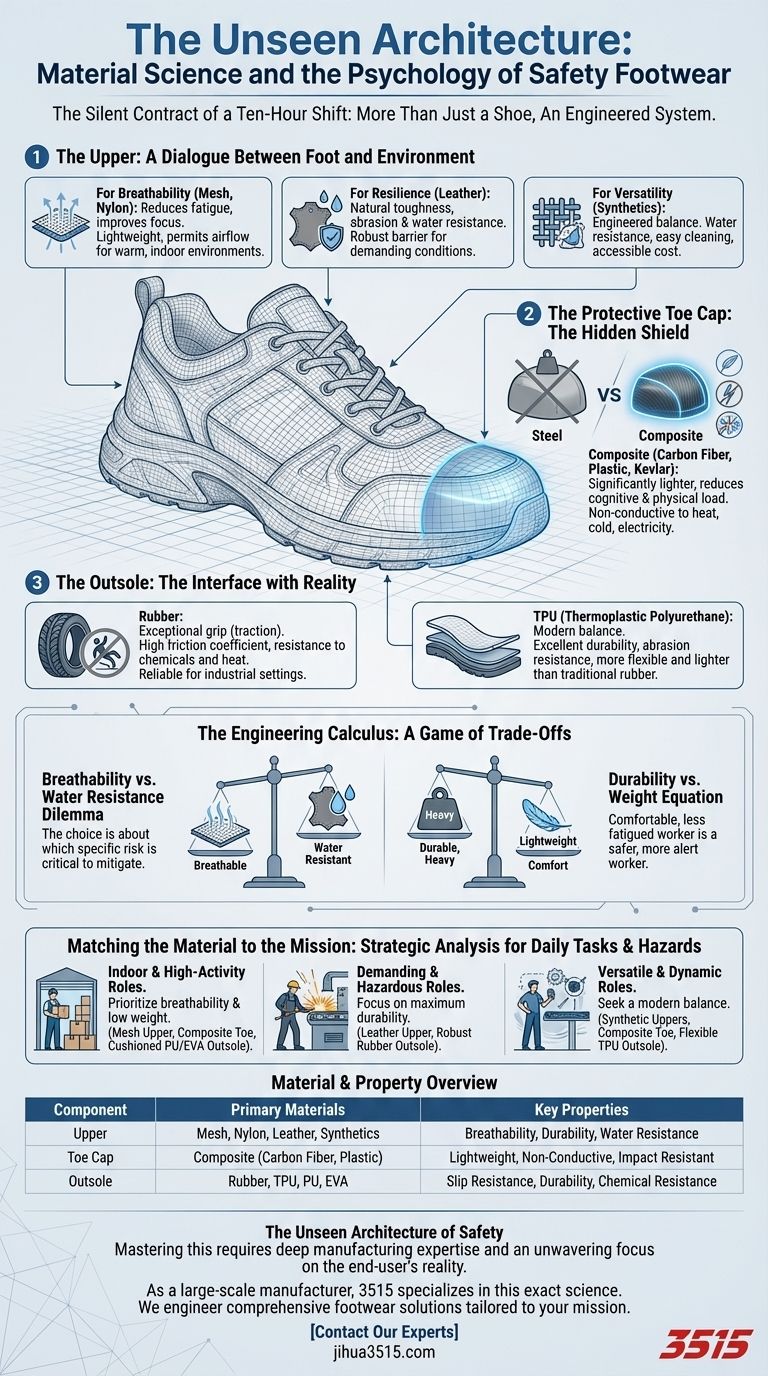
To understand the whole, we must deconstruct its parts. A safety trainer is fundamentally composed of three critical zones, each a solution to a different problem.
The Upper: A Dialogue Between Foot and Environment
The upper is the material that encases the foot. It acts as the shoe's skin, managing the relationship between the wearer and their surroundings.
- For breathability, textiles like mesh and nylon are chosen. They are lightweight and permit airflow, a crucial factor in reducing fatigue and improving focus in warm, indoor environments.
- For resilience, leather is the classic choice. It offers a natural toughness against abrasion and water, providing a robust barrier in more demanding conditions.
- For versatility, synthetics provide an engineered balance, offering properties like water resistance or easy cleaning at an accessible cost.
The Protective Toe Cap: The Hidden Shield
The soul of a safety shoe is its protective toe cap. For decades, this meant steel. But modern engineering favors a different approach.
Composite toe caps—made from materials like carbon fiber, plastic, or Kevlar—are now the standard in high-performance trainers. The reason is as much psychological as it is physical. They are significantly lighter, reducing the cognitive and physical load on the wearer over thousands of steps.
Critically, they don't conduct heat, cold, or electricity, removing hidden environmental stressors.
The Outsole: The Interface with Reality
The outsole is where the shoe meets the world. Its material composition is the foundation of the wearer's confidence and stability.
- Rubber is prized for its exceptional grip (traction). Its high friction coefficient provides security on slippery surfaces, while its resistance to chemicals and heat makes it a reliable choice for industrial settings.
- TPU (Thermoplastic Polyurethane) offers a more modern balance. It provides excellent durability and abrasion resistance while remaining more flexible and lighter than many traditional rubber compounds.
The Engineering Calculus: A Game of Trade-Offs
There is no single "best" material. The design of a superior safety shoe lies in mastering the inherent compromises. This is the quiet calculus performed by engineers.
The Breathability vs. Water Resistance Dilemma
A highly breathable mesh upper is a gift in a hot warehouse but a liability in a wet environment. A water-resistant leather boot offers protection from the elements but can become heavy and warm.
The choice is not about which is better, but what specific risk is more critical to mitigate for the user.
The Durability vs. Weight Equation
The most resilient materials are often the heaviest. A thick rubber outsole can withstand extreme punishment but adds weight that accumulates into end-of-day fatigue.
Conversely, lightweight materials like EVA in the midsole and composites in the toe cap drastically improve comfort. This isn't just a luxury; a comfortable, less fatigued worker is a safer, more alert worker.
Matching the Material to the Mission
The right safety shoe is an extension of its environment. The selection process is a strategic analysis of daily tasks and potential hazards.
- Indoor & High-Activity Roles: Prioritize breathability and low weight. A trainer with a mesh upper, composite toe, and a cushioned PU/EVA outsole is ideal.
- Demanding & Hazardous Roles: Focus on maximum durability. A shoe with a leather upper and a robust rubber outsole will resist abrasion, chemicals, and heat.
- Versatile & Dynamic Roles: Seek a modern balance. A trainer combining synthetic uppers, a composite toe, and a flexible TPU outsole provides agility without sacrificing core protection.
This complex interplay of materials, performance, and human factors is the unseen architecture of safety. It's a field where small choices have a significant impact on well-being and productivity. Mastering this requires deep manufacturing expertise and an unwavering focus on the end-user's reality.
| Component | Primary Materials | Key Properties |
|---|---|---|
| Upper | Mesh, Nylon, Leather, Synthetics | Breathability, Durability, Water Resistance |
| Toe Cap | Composite (Carbon Fiber, Plastic) | Lightweight, Non-Conductive, Impact Resistant |
| Outsole | Rubber, TPU, PU, EVA | Slip Resistance, Durability, Chemical Resistance |
As a large-scale manufacturer, we at 3515 specialize in this exact science. We engineer and produce comprehensive footwear solutions for distributors and brands, ensuring that every shoe is a precisely balanced system tailored to its intended mission.
If you need footwear that is built on a deep understanding of material science and user psychology, Contact Our Experts.
Visual Guide
Related Products
- Premium Suede Sport Safety Shoes for Wholesale & Bulk Orders
- Premium Lightweight Safety Shoes for Wholesale & Bulk Orders
- Wholesale Anti-Smash & Puncture-Proof Safety Shoes Custom Manufacturing for Brands
- Premium KPU Injection Athletic Style Safety Shoes
- Premium Safety Shoes with Rotating Buckle Safety Sneakers
Related Articles
- The Ghost in the Machine: Why an Obsolete Footwear Standard Creates Modern Risk
- Beyond the Steel Toe: The Hidden Ergonomics of Workplace Safety
- Why Traditional Laces Are a Hidden Safety Risk—And What to Do About It
- The True Cost of Skipping Safety Shoes: Long-Term Risks and Smart Protection
- How Safety Shoe Engineering Prevents Workplace Injuries Across Industries