The Psychology of a Safe Fall
In most areas of life, we associate safety with grip. The tread on our car tires, the soles of our hiking boots—they are designed to hold on, to prevent a slip.
The world of equestrian sports operates on a counter-intuitive principle. The single most dangerous event for a rider is not the fall itself, but the failure to separate from the horse during that fall. Being "hung up"—with a foot caught in the stirrup while the horse moves—is a scenario where physics works against you with devastating force.
This is why a Western riding boot is not merely footwear. It is a purpose-built release mechanism, engineered for the moment you hope never comes.
The Anatomy of a Clean Ejection
Understanding the boot's design is to understand a system built for failure—a safe, controlled failure. Each component serves a critical function in the geometry of a safe dismount.
The Smooth Sole: Your Release Plane
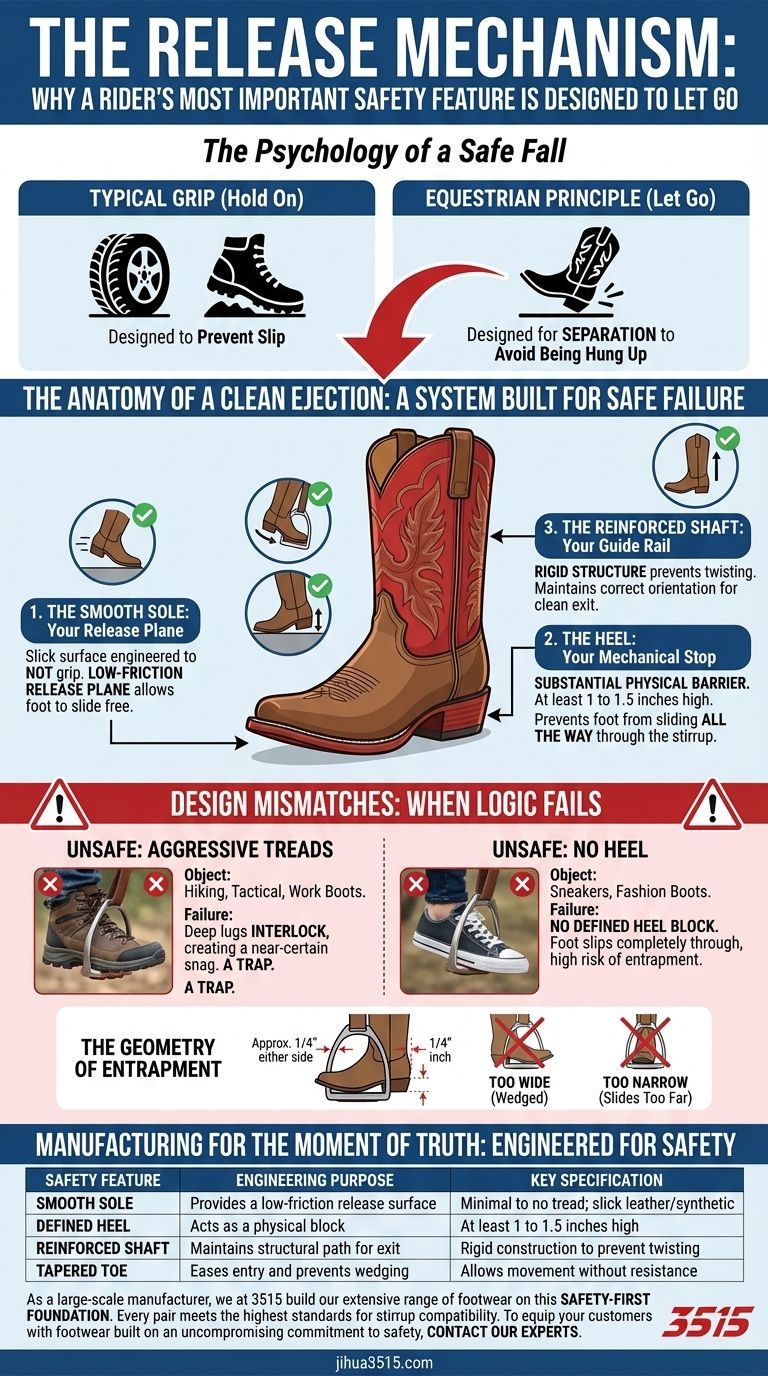
The sole of a proper riding boot is smooth leather or a comparable synthetic with almost no tread. This is not a design flaw or a stylistic choice; it is the core of the release system.
Its slick surface is engineered to not grip the stirrup. In an emergency, it allows the foot to slide free in any direction, without catching or binding. It's the polar opposite of a work boot, whose aggressive lugs would act like hooks, locking the foot into a dangerous connection.
The Heel: Your Mechanical Stop
If the sole is for release, the heel is for prevention. It is the most important physical barrier in the system.
A substantial heel, at least 1 to 1.5 inches high and sharply defined from the sole, acts as a mechanical stop. It physically blocks the foot from sliding all the way through the stirrup. Losing a stirrup is an inconvenience; having your foot pass completely through it can trap your ankle and lead to a catastrophic loss of control.
The Reinforced Shaft: Your Guide Rail
The rigid structure of the boot's shaft serves two roles. The first is obvious: protecting the leg from pinching, rubbing, and impact.
The second is more subtle but just as crucial. Its structural integrity prevents the boot from twisting or collapsing under pressure during a chaotic fall. This ensures the foot and ankle maintain the correct orientation to exit the stirrup cleanly. It acts as a guide rail for your foot’s ejection.
Design Mismatches: When Logic Fails
Most footwear mistakes happen when riders apply logic from other domains to the saddle. They choose boots based on comfort or traction, inadvertently creating a hazardous situation.
The Danger of Aggressive Treads
- The Object: Hiking boots, tactical boots, or heavy-tread work boots.
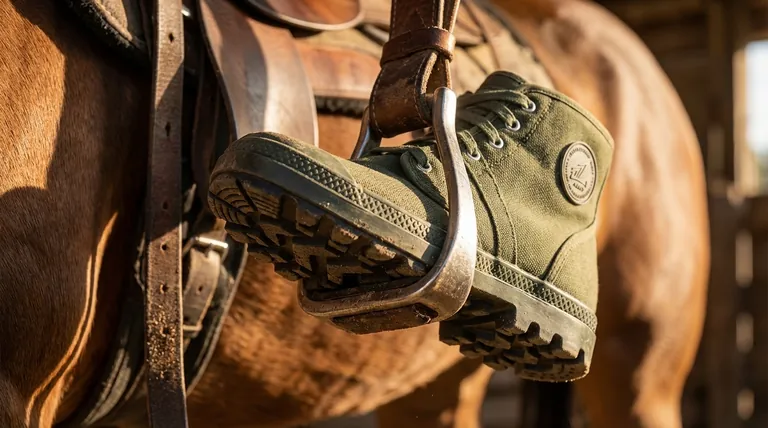
- The Failure: The deep lugs are designed to interlock with terrain. In a metal stirrup, they do the same, creating a near-certain snag. They turn a release mechanism into a trap.
The Peril of No Heel
- The Object: Sneakers, fashion boots, and moccasins.
- The Failure: Without a defined heel block, there is nothing to prevent the rider's foot from slipping completely through the stirrup, dramatically increasing the risk of entanglement.
The Geometry of Entrapment
The interface between the boot and stirrup must be precise. As a rule, there should be about a quarter-inch of space on either side of the ball of the foot.
- Too Wide: A wide boot can become wedged.
- Too Narrow: A narrow foot may slide too far forward, bypassing the heel's safety function.
Manufacturing for the Moment of Truth
For brands and distributors, providing safe equestrian footwear is a non-negotiable responsibility. It requires a deep, first-principles understanding of rider kinematics, not just assembling materials into the shape of a boot. Every design choice must be weighed against its function during the worst-case scenario.
| Safety Feature | Engineering Purpose | Key Specification |
|---|---|---|
| Smooth Sole | Provides a low-friction release surface | Minimal to no tread; slick leather/synthetic |
| Defined Heel | Acts as a physical block | At least 1 to 1.5 inches high |
| Reinforced Shaft | Maintains structural path for exit | Rigid construction to prevent twisting |
| Tapered Toe | Eases entry and prevents wedging | Allows movement without resistance |
As a large-scale manufacturer, we at 3515 build our extensive range of footwear on this safety-first foundation. Our production capabilities are dedicated to creating boots that not only perform for the rider but protect them when it matters most. We engineer for that critical moment of release, ensuring every pair meets the highest standards for stirrup compatibility.
To equip your customers with footwear built on an uncompromising commitment to safety, Contact Our Experts.
Visual Guide
Related Products
- Heavy-Duty Goodyear Welted Pull-On Safety Rigger Boot
- Premium Wholesale Tactical Style Safety Shoes Boots with Quick Lacing
- Wholesale High-Traction Camo Boots - Custom Manufacturer for Brands
- Wholesale Tactical Boots High-Traction & Reflective for Bulk & Brand Orders
- High-Traction Suede Tactical Boots Wholesale & Custom Manufacturing
Related Articles
- Beyond the Tread: The Molecular Battle for Grip on Oily Surfaces
- How to Choose Safety Boot Certifications for Your Industry's Hazards
- How Safety Boot Features Address Industry-Specific Workplace Hazards
- The True Cost of a Safety Boot: Why Your Footwear Budget Is Breaking
- How Safety Boot Engineering Protects Against Workplace Hazards: A Buyer's Guide