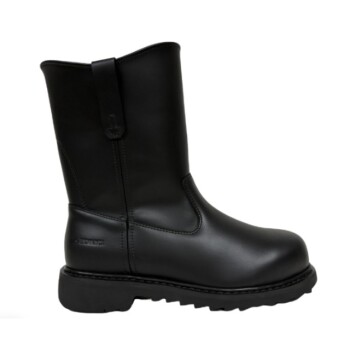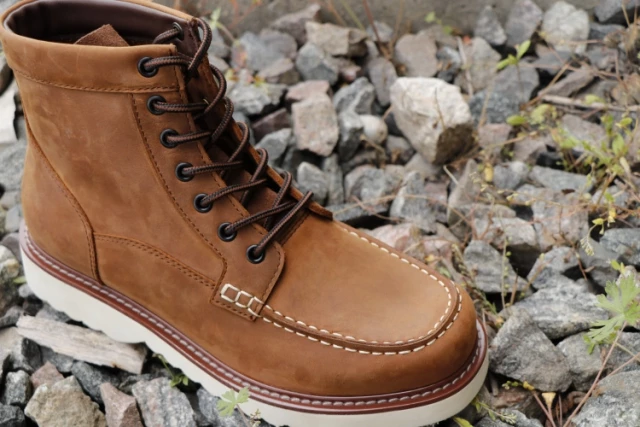
Security guards face demanding work environments that require footwear offering uncompromising safety, durability, and cost-efficiency. While cement construction is common in safety boots, Goodyear welt construction consistently outperforms in critical areas—from long-term wear to hazard protection. This article examines why stitched reliability, repairability, and compliance with industry standards make Goodyear welt the superior choice for security professionals.
Cement vs. Goodyear Welt: Security Boot Safety Deep Dive
How Construction Impacts Durability in Hazardous Environments
Cement construction bonds the upper and sole with adhesive, creating a lightweight but less resilient boot. Repeated stress—common in security roles involving prolonged standing or rapid movement—can weaken the glue, leading to premature separation.
In contrast, Goodyear welt construction uses a strip of leather (the welt) stitched to the upper and outsole. This method:
- Distributes weight and impact evenly
- Withstands flexing and torsion without degradation
- Maintains structural integrity in wet or extreme temperatures
Research shows stitched footwear retains its shape 2–3 times longer than glued alternatives in high-stress scenarios.
Safety Risks of Sole Separation vs. Stitched Reliability
A detached sole isn’t just inconvenient—it’s hazardous. Guards navigating uneven terrain or chasing suspects risk slips or falls if the sole fails. ASTM F2413 testing confirms:
- Cement boots show higher failure rates in impact resistance after 6–12 months of use
- Goodyear welt boots maintain consistent protection due to redundant stitching
"Have you considered how often your boots endure sudden pivots or debris? Stitched construction ensures the sole stays attached when it matters most."
Repairability and Lifetime Costs: A Financial Perspective
The Hidden Expense of Disposable Footwear
Cement boots are cheaper upfront but often require full replacement after 8–14 months. Goodyear welt boots, though initially more expensive, offer:
- Resoleability: Replace worn soles without discarding the upper
- Extended lifespan: 3–5 years of use with proper maintenance
- Lower cost per year: 50–70% savings over time
Warranty and Value Retention
Manufacturers like 3515 typically offer longer warranties on Goodyear welt boots because their design allows repairs. Cement boots, once damaged, are rarely salvageable.
Industry Standards and Certifications for Security Footwear
Security boots must meet region-specific certifications (e.g., ASTM F2413, CSA Z195) for toe protection, puncture resistance, and electrical hazards. Goodyear welt construction inherently aligns with these demands due to:
- Layered materials: Welt stitching adds a barrier against punctures
- Consistent performance: No adhesive breakdown to compromise safety ratings
For guards in high-risk settings—airports, hospitals, or industrial sites—stitched boots provide reliable compliance with evolving safety regulations.
Step Into Long-Term Protection with 3515
Security professionals deserve footwear that matches their endurance. 3515’s Goodyear welt boots combine proven safety engineering with cost-saving durability, ensuring guards stay protected shift after shift.
Ready to invest in boots that last? Explore 3515’s range of security-optimized footwear designed for distributors and bulk buyers who prioritize value and performance.
Related Products
- Durable Goodyear Welt Leather Work Boots for Wholesale & Private Label
- Heavy-Duty Goodyear Welted Pull-On Safety Rigger Boot
- Wholesale Durable Leather Work Boots | 8-Inch Goodyear Welt Manufacturer
- Durable Leather Work Boots Wholesale Manufacturer & Custom Factory
- Durable Leather Work Boots for Wholesale & Custom Manufacturing
Related Articles
- How Job-Specific Work Boot Designs Enhance Safety and Efficiency
- How Work Boots Engineer Safety: The Science Behind Impact and Compression Protection
- The Unseen Physics of Failure: Why Work Boots Are Your Most Critical PPE
- How to Choose Work Boots That Match Your Job's Safety Demands
- How to Match Work Boot Features to Your Job's Hidden Hazards