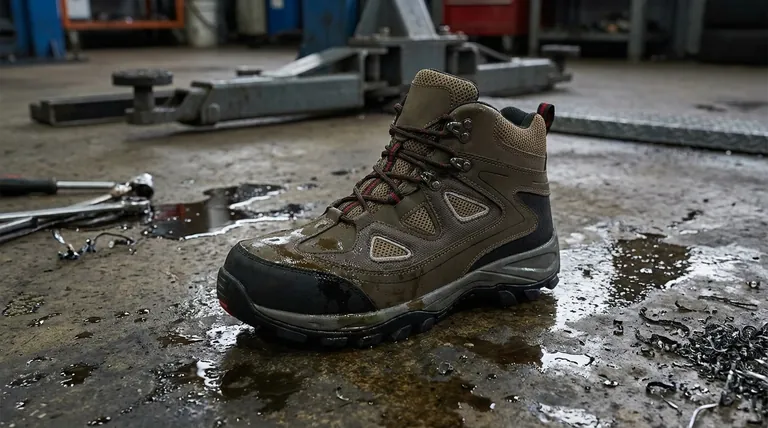
The Invisible War on the Workshop Floor
An auto mechanic's world is governed by physics. The torque on a bolt, the pressure in a hydraulic lift, the momentum of a rolling chassis. We are intuitively aware of these immediate, forceful dangers.
But a more subtle battle is waged every day underfoot. It’s a chemical war. Spilled oil, solvents, and grease don’t just create a slip hazard; they actively attack the very material of a worker's boots.
Our minds are wired to react to sudden impacts, not slow degradation. We fear the falling object, but we rarely notice the gradual swelling and hardening of a rubber sole until it fails. This is the psychological blind spot where true industrial safety is born. It’s why a high-quality safety boot isn't just assembled; it's engineered to win this invisible war.
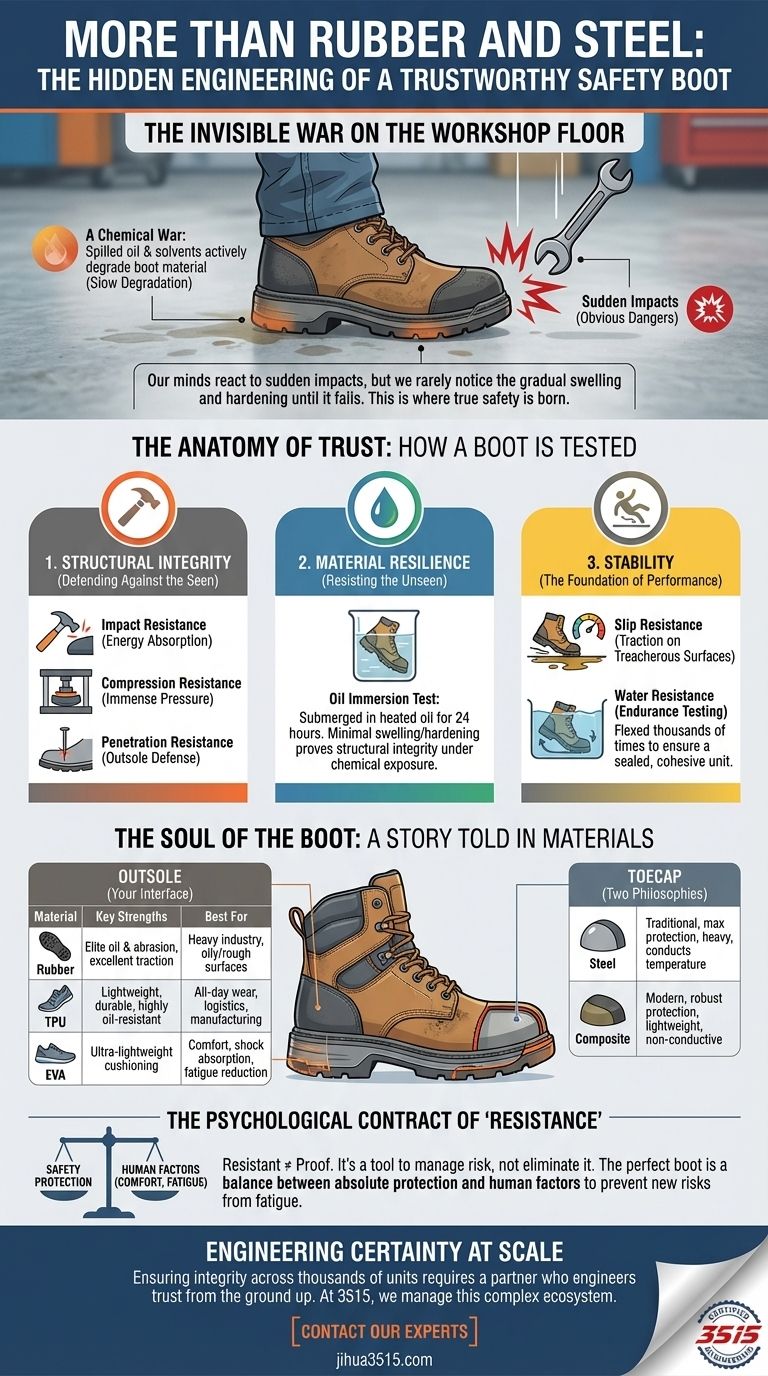
The Anatomy of Trust: How a Boot is Tested
To trust a boot is to trust the science behind it. Rigorous, standardized testing protocols transform a piece of footwear into a reliable piece of personal protective equipment. These tests fall into three critical domains.
Defending Against the Seen: Structural Integrity
This is the classic test of brute force, simulating the obvious dangers of a worksite.
- Impact Resistance: A heavy weight is dropped onto the toecap. The goal isn't just to see if the cap breaks, but to measure if it deforms enough to cause injury. It’s a test of pure energy absorption.
- Compression Resistance: The toecap is slowly squeezed under immense pressure, mimicking the crushing force of a vehicle's wheel. It must hold its shape to protect the delicate bones of the foot.
- Penetration Resistance: A sharp steel nail is forced into the outsole. The boot fails if the nail can puncture through, proving the sole is the last line of defense against unseen ground-level threats.
Resisting the Unseen: Material Resilience
This is what separates a standard work boot from a true oil-resistant safety boot.
The core test involves immersing the outsole material in a reference oil, often heated to accelerate the process. After 24 hours, technicians look for microscopic changes. Did it swell? Did it become brittle?
A quality sole will show almost no change in volume or hardness. It proves the material can withstand constant chemical exposure without compromising its structural integrity or protective qualities.
The Foundation of Performance: Stability
A boot can be indestructible but useless if it can't keep you on your feet.
- Slip Resistance: This is the most critical performance test for oily environments. The boot is placed on standardized surfaces (like steel or tile) coated with oil or soap, and the coefficient of friction is measured. The resulting grade tells you exactly how much stability you can expect on a treacherous surface.
- Water Resistance: For waterproof models, the boot is submerged and flexed thousands of times, simulating miles of walking through water. It’s a test of endurance, ensuring the boot remains a sealed, cohesive unit.
The Soul of the Boot: A Story Told in Materials
The ability to pass these tests is determined long before production, in the quiet science of material selection. Each component is a deliberate engineering choice.
The Outsole: Your Interface with the World
| Material | Key Strengths | Best For |
|---|---|---|
| Rubber | Elite oil and abrasion resistance; excellent traction | Heavy industry, extremely oily or rough surfaces |
| Thermo-Polyurethane (TPU) | Lightweight, durable, and highly oil-resistant | All-day wear, logistics, and modern manufacturing |
| Ethylene-Vinyl Acetate (EVA) | Ultra-lightweight cushioning for the midsole | Comfort, shock absorption, reducing worker fatigue |
The Toecap: A Tale of Two Philosophies
- Steel: The traditional standard. It offers maximum protection against impact and compression, but it's heavy and conducts temperature.
- Composite: The modern alternative. Made from materials like carbon fiber or Kevlar, it provides robust protection without the weight or thermal conductivity of steel, reducing fatigue.
The Psychological Contract of "Resistance"
Understanding the language of safety is as important as the materials themselves.
"Resistant" does not mean "proof." An oil-resistant, non-slip sole dramatically improves traction, but it cannot defy the laws of physics in extreme conditions. It is a tool to manage risk, not eliminate it.
There is always a trade-off between absolute protection and human factors. The heaviest, most impenetrable boot might offer the most safety on paper, but if it's too fatiguing for a 12-hour shift, it can introduce new risks. The perfect boot is a balance.
Engineering Certainty at Scale
Choosing the right safety boot isn't about picking a single product; it's about understanding and trusting an entire system of design, material science, and verification.
For distributors, brand owners, and large-scale enterprises, ensuring this integrity across thousands of units requires a manufacturing partner who doesn't just assemble footwear, but engineers trust from the ground up. At 3515, we manage this complex ecosystem, producing a comprehensive range of boots rigorously tested to meet the highest standards for any industrial environment.
To ensure your team is protected by footwear built on a foundation of scientific rigor, Contact Our Experts
Visual Guide
Related Products
- Puncture-Resistant Velcro Safety Boots for Wholesale & Custom Manufacturing
- Wholesale Durable Safety Boots | Custom Steel Toe & Puncture-Resistant Manufacturing
- Premium Grain Leather Safety Boots for Bulk Supply
- Heavy-Duty Waterproof Nubuck Safety Boots Safety Shoes for Bulk Supply
- Premium High-Cut Waterproof Safety Boots Manufacturing & Wholesale Solutions
Related Articles
- The Unseen Engineering: Why Steel Toes Succeed or Fail in Oily Environments
- The Anatomy of Trust: A Systems Approach to Workplace Foot Protection
- The Lacing Paradox: Why the Safest Boots Contain Their Own Greatest Risk
- How Industrial Professionals Can Balance Safety Boot Requirements with Professional Appearance
- How to Choose Safety Boots That Reduce Fatigue Without Sacrificing Protection