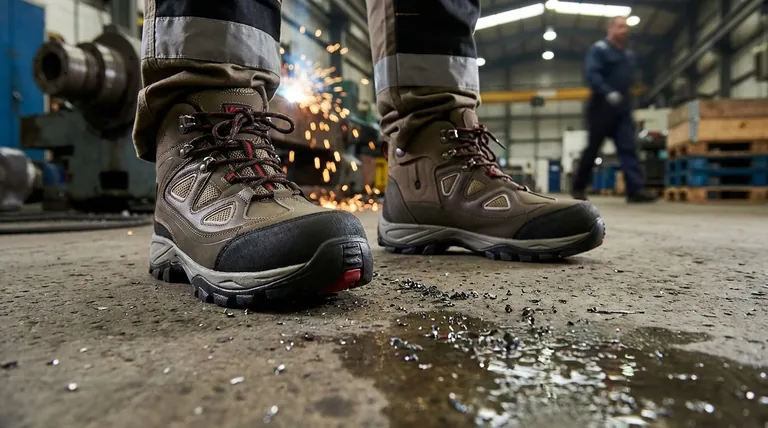
The Unseen Architecture of Safety
A sprawling factory floor is a system of controlled chaos. Forklifts hum, machinery presses, and people navigate a landscape of predictable, yet ever-present, physical risks. In this environment, safety isn't a checklist; it's an engineered system designed to manage energy and mitigate human error.
Most of our attention goes to the big machines and the visible processes. But the most critical interface in this entire system is often the most overlooked: the last three feet surrounding every worker, and specifically, the point of contact between them and the ground.
This is where the entire system of safety can succeed or fail. And it's why the humble safety boot is not merely a piece of equipment, but the foundation upon which a resilient workplace is built.
The Physics of Prevention
We tend to think of safety shoes in simple terms—a steel toe to stop a falling object. But the engineering is far more nuanced. Each feature is a direct countermeasure to a specific law of physics that can cause harm.
Defying Gravity and Momentum
The classic steel or composite toe cap is a marvel of force distribution. It's not just about brute strength; it's about redirecting the kinetic energy of a falling object or the crushing force of a moving vehicle away from the delicate bones of the foot. It’s a personal shield designed for a world governed by mass and acceleration.
Navigating a Treacherous Landscape
Slips, trips, and falls are not just accidents; they are failures of friction. A well-designed outsole is a masterclass in tribology. The tread pattern, material compound, and channel design work in concert to maintain grip on surfaces contaminated with water, oil, or debris. This provides the psychological confidence for a worker to move decisively, knowing their footing is secure. Add a puncture-resistant midsole, and you've armored the foot against the unseen threats lurking below.
Insulating Against Invisible Forces
Some of the greatest workplace dangers are completely invisible. Electricity, extreme temperatures, and corrosive chemicals don't announce their presence. Specialized footwear acts as a non-conductive barrier or an insulated shield, providing a layer of protection against forces the human body has no natural defense against.
The Economics of Trust
While the physics protects the individual, the implementation of a safety footwear program has profound effects on the entire organization. This is where engineering meets psychology and economics.
Compliance is the Floor, Not the Ceiling
Meeting regulatory standards (like OSHA requirements) is the absolute minimum. It’s the baseline for a functional safety system. But true safety culture transcends compliance. It views these rules not as a burden, but as the starting point for building something better.
The Compounding Cost of an Incident
A single foot injury is never just a single cost. It ripples outwards.
- Direct Costs: Medical bills and compensation.
- Indirect Costs: Lost productivity, the time spent on incident reports, and potentially hiring and training a replacement.
- Cultural Costs: A decline in morale, an increase in anxiety, and a breakdown of trust between employees and management. An injury erodes the psychological safety that is essential for a high-performing team.
The ROI of a Well-Made Boot
Providing high-quality, comfortable safety footwear is one of the most powerful signals a company can send. It says, "We value your well-being." This is not a trivial point. When an employee feels cared for, they are more engaged, more proactive, and more likely to invest themselves in the company's collective safety culture. The return on investment is measured in loyalty and vigilance.
Debugging the Human Interface
Even the best-engineered systems can fail if the human element is not properly considered. Implementing a safety shoe program means anticipating and solving for human behavior.
The Comfort Bug: When Protection Becomes a Nuisance
Humans are hardwired to solve for immediate discomfort over abstract future risk. If a safety boot is heavy, ill-fitting, or painful to wear for an eight-hour shift, compliance will plummet. The best-intentioned policy fails. The solution isn't stricter enforcement; it's better design. Sourcing footwear that balances robust protection with ergonomic, lightweight materials is non-negotiable for a successful program.
The Specificity Mismatch: The Fallacy of a Single Solution
Assigning a generic "safety shoe" to every worker is a critical design flaw. An electrician's needs are fundamentally different from a welder's or a warehouse associate's.
- Electrician: Needs electrical hazard (EH) rated soles.
- Roofer: Needs high-traction, flexible soles for uneven surfaces.
- Mechanic: Needs oil- and slip-resistant outsoles.
A world-class safety program requires a portfolio of footwear solutions. As a large-scale manufacturer, 3515 specializes in producing a comprehensive range of footwear, ensuring that every role gets the specific, tailored protection it requires.
The Maintenance Gap
Safety shoes are consumable tools. Worn-out treads, cracked uppers, or a compromised toe cap render them ineffective. A system must be in place for regular inspection and timely replacement to ensure the integrity of the protection is never in doubt.
| Challenge | Psychological Driver | System-Level Solution |
|---|---|---|
| Non-Compliance | Prioritizing short-term comfort over risk | Source ergonomically designed, comfortable footwear that workers want to wear. |
| Inadequate Protection | A "one-size-fits-all" procurement mindset | Partner with a manufacturer capable of providing a diverse range of specialized boots for different job hazards. |
| Equipment Failure | Negligence or lack of awareness | Implement clear inspection protocols and a straightforward replacement program. |
Building a truly resilient safety culture starts from the ground up, with equipment engineered for the specific realities your team faces every day. To architect a footwear program that protects your people and empowers your business, Contact Our Experts.
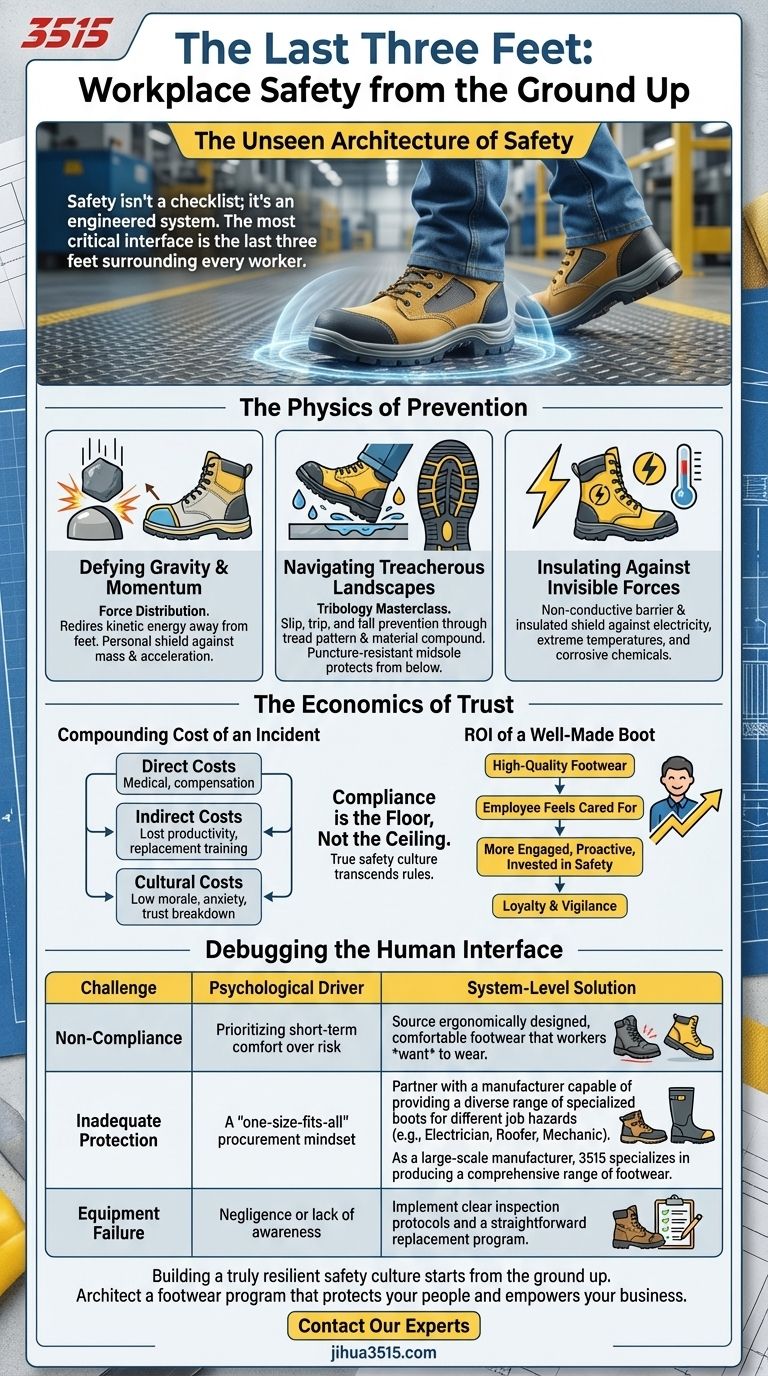
Visual Guide
Related Products
- Premium Suede Sport Safety Shoes for Wholesale & Bulk Orders
- Premium Lightweight Safety Shoes for Wholesale & Bulk Orders
- Wholesale Anti-Smash & Puncture-Proof Safety Shoes Custom Manufacturing for Brands
- Premium KPU Injection Athletic Style Safety Shoes
- Premium Safety Shoes with Rotating Buckle Safety Sneakers
Related Articles
- The Ghost in the Machine: Why an Obsolete Footwear Standard Creates Modern Risk
- Beyond the Steel Toe: The Hidden Ergonomics of Workplace Safety
- Why Traditional Laces Are a Hidden Safety Risk—And What to Do About It
- The True Cost of Skipping Safety Shoes: Long-Term Risks and Smart Protection
- How Safety Shoe Engineering Prevents Workplace Injuries Across Industries



















