The Anatomy of a Fatal Misunderstanding
Imagine a safety manager outfitting a new team of utility lineworkers. They source boots with a prominent "EH" rating, confident they've secured protection against electrical hazards.
This is a common, understandable, and potentially fatal mistake.
The world of safety footwear contains a hidden cognitive trap. We see a label for "electrical protection" and assume it's a monolithic category. In reality, there are two fundamentally different universes of protection. Confusing them isn't a minor compliance issue; it's a misunderstanding of physics that can erase the line between a routine task and a catastrophe.
The Physics of Insulation: Becoming an Island
To grasp the stakes, we must first understand the principle. An electrical current needs a path to travel. When a person touches a live source, their body becomes a conductor, and the current flows through them to the ground.
A dielectric material is an insulator. It stubbornly refuses to conduct electricity.
When engineered into a boot's outsole, this material turns the wearer into an electrical island. It creates a robust barrier between the body and the ground, breaking the circuit. Even if you touch a live wire, the current has nowhere to go. You remain isolated, and therefore, safe. The entire protective system hinges on the integrity of that sole.
Two Worlds of Protection: The Shield vs. The Safety Net
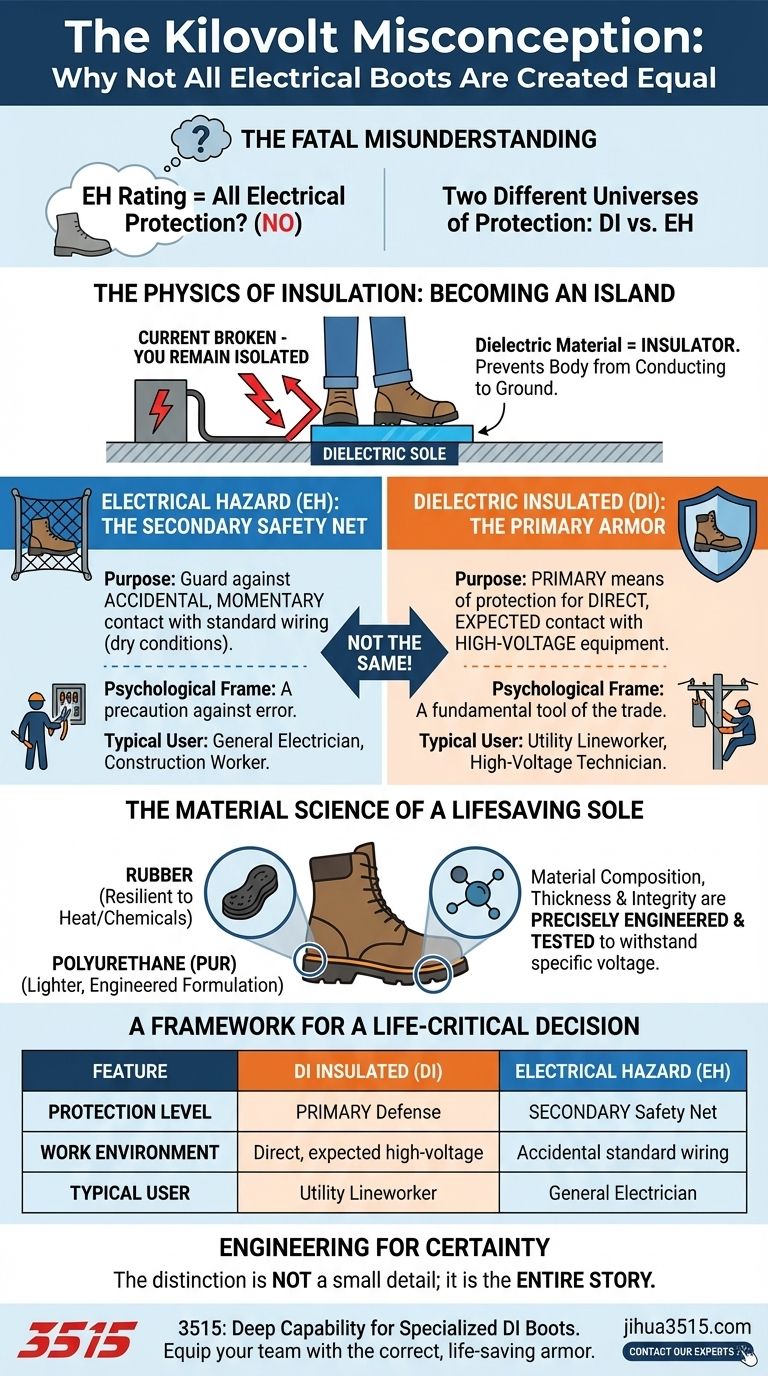
The confusion between Dielectric (DI) and Electrical Hazard (EH) ratings is the most dangerous part of this landscape. They are designed for entirely different scenarios and mindsets.
Electrical Hazard (EH): The Secondary Safety Net
EH-rated footwear is the industry standard for most trades. It is designed as a secondary source of protection.
Think of it as a safety net for an electrician working on building wiring. Its purpose is to guard against accidental, momentary contact with a live circuit in dry conditions. It's a crucial precaution for a "what if" scenario, but it is not designed for sustained, direct contact.
Dielectric Insulated (DI): The Primary Armor
DI footwear is a far more specialized and robust category. It is a primary means of protection.
This is the purpose-built armor for a professional, like a utility lineworker, who expects to work in direct proximity to or contact with high-voltage equipment. For them, the electrical hazard is not an accident; it's the job site. The DI boot is not a precaution; it's a fundamental tool of the trade, as critical as their insulated gloves.
The Material Science of a Lifesaving Sole
The performance of this life-critical equipment comes down to materials and manufacturing precision. The outsole is the single most important component.
Outsoles are typically crafted from specialized rubber or polyurethane (PUR) compounds.
- Rubber is prized for its exceptional dielectric properties and its resilience to heat and chemicals.
- Polyurethane can offer lighter weight and better comfort, but its specific formulation is key to its insulating strength.
For a DI boot, the material's composition, thickness, and integrity are not negotiable variables. They are precisely engineered and tested to withstand a specific voltage, creating a reliable barrier between the worker and thousands of volts. This level of engineering is what separates a standard work boot from a piece of life-saving equipment.
A Framework for a Life-Critical Decision
Choosing the right boot isn't about ticking a box. It's an act of risk assessment based entirely on the work environment. The selection must be driven by the nature of the hazard, not the availability of a product.
This table clarifies the decision framework:
| Feature | Dielectric Insulated (DI) | Electrical Hazard (EH) |
|---|---|---|
| Protection Level | Primary Defense System | Secondary Safety Net |
| Work Environment | Direct, expected contact with high-voltage | Accidental, unexpected contact with standard wiring |
| Psychological Frame | A tool engineered for the core task. | A precaution against an operational error. |
| Typical User | Utility Lineworker, High-Voltage Technician | General Electrician, Construction Worker |
Engineering for Certainty
The distinction between a secondary safety net and primary armor is not a small detail; it is the entire story. In high-voltage environments, understanding this difference is fundamental to ensuring a team comes home safely.
Procuring equipment that carries this level of responsibility demands a manufacturing partner who grasps the physics and engineers for certainty. As a large-scale producer of a comprehensive range of footwear, 3515 has the deep capability to manufacture the highly specialized DI boots required for primary, high-voltage protection. We work with distributors, brand owners, and organizations to ensure that the final product meets these unforgiving standards.
Equip your team with the correct, life-saving armor for the task at hand. Contact Our Experts
Visual Guide
Related Products
- Premium Grain Leather Safety Boots for Bulk Supply
- Wholesale Safety Boots Manufacturer for Custom & Private Label Orders
- Premium Wholesale Tactical Style Safety Shoes Boots with Quick Lacing
- Premium Lightweight Safety Shoes for Wholesale & Bulk Orders
- High Performance Fire-Retardant Waterproof Safety Boots
Related Articles
- How Industrial Professionals Can Balance Safety Boot Requirements with Professional Appearance
- How to Choose Safety Boots That Reduce Fatigue Without Sacrificing Protection
- The Lacing Paradox: Why the Safest Boots Contain Their Own Greatest Risk
- The Anatomy of Trust: A Systems Approach to Workplace Foot Protection
- Beyond the Boot: Why a 'One-Size-Fits-All' Safety Footwear Strategy Is Costing Your Business