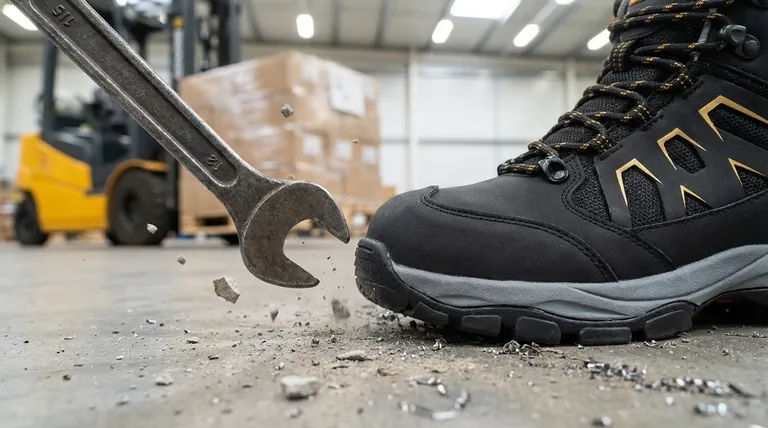
We Are All Bad at Predicting Catastrophe
Our brains are wired for patterns. We get used to the familiar hum of the warehouse, the predictable path of the forklift, the weight of a tool in our hand. We perform the same tasks hundreds of times without incident, and this repetition creates a powerful illusion of safety.
But the laws of physics don't care about our routines. Gravity is constant. A heavy object's potential energy is always waiting to be converted. A one-in-a-million accident is a statistical certainty given enough opportunities.
The decision to wear a safety toe boot isn't about your job title. It's a pragmatic hedge against a single moment where routine breaks and physics takes over.
The Two Forces That Define Your Risk
Forget industry labels for a moment. Whether you're on a construction site or a farm, only two fundamental physical risks necessitate a safety toe.
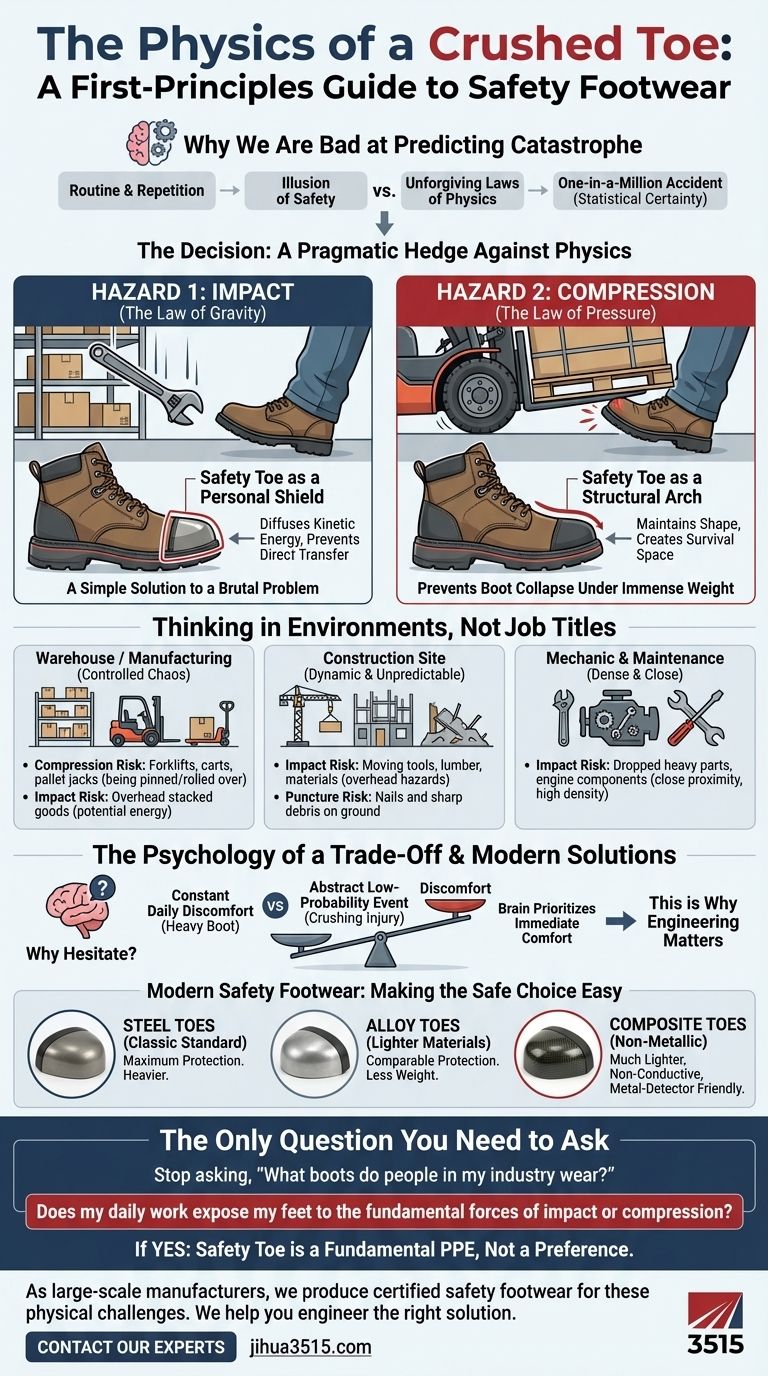
Hazard 1: Impact (The Law of Gravity)
This is the risk of a sudden, focused force from above. Think of a dropped wrench, a falling box, or a dislodged piece of equipment. The hardened cap in a safety boot is a personal shield, engineered to diffuse this kinetic energy and prevent it from being transferred directly to your foot.
It's a simple, elegant solution to a brutal problem.
Hazard 2: Compression (The Law of Pressure)
This is the risk of sustained, immense weight. It’s the slow-moving forklift tire, the pallet jack that drifts, or the weight of large livestock. The safety toe acts as a structural arch, maintaining its shape under immense pressure to prevent the boot from collapsing.
It creates a pocket of survival space where there would otherwise be none.
Thinking in Environments, Not Job Titles
Applying this physical framework changes how we see the workplace. The risks become clearer when we analyze the environment itself.
Case Study: The Controlled Chaos of a Warehouse
A warehouse or manufacturing floor is a system of kinetic and potential energy.
- Compression Risk: Forklifts, carts, and pallet jacks are in constant motion. The primary danger here is being pinned or rolled over.
- Impact Risk: Goods are stacked high on shelves. Every pallet stored overhead represents potential energy waiting for a mistake to release it.
Case Study: The Dynamic Construction Site
A construction site is an environment defined by unpredictability. Hazards are not static; they change daily.
- Impact Risk: The most common threat. Tools, lumber, pipes, and materials are constantly being moved, often overhead.
- Puncture Risk: Beyond impact, the ground itself is a hazard, littered with nails and sharp debris.
Case Study: The Mechanic and the Engine Block
In a maintenance bay, workers interact directly with objects of extreme density and weight.
- Impact Risk: A dropped engine component or a heavy industrial part doesn't need to fall far to cause a devastating injury. The proximity to the hazard is constant.
The Psychology of a Trade-Off
If the risks are so clear, why would anyone hesitate to wear protective footwear? Because of a simple psychological bias.
The discomfort of a heavy, rigid boot is a small, but constant, negative feedback. You feel it every day. The risk of a crushing injury, however, is an abstract, low-probability event. Our brains are naturally wired to prioritize alleviating the immediate, certain discomfort over protecting against a distant, uncertain catastrophe.
This is why engineering matters.
Modern safety footwear addresses this trade-off directly. The goal is to make the safe choice the easy choice.
- Steel Toes: The classic standard, offering maximum protection.
- Alloy Toes: Made from lighter materials like aluminum or titanium, providing comparable protection with less weight.
- Composite Toes: Non-metallic options (Kevlar, carbon fiber, plastic) that are much lighter, don't conduct cold, and won't set off metal detectors.
These innovations reduce the daily "cost" of being safe, making it easier for individuals and teams to stay protected without sacrificing comfort and mobility.
The Only Question You Need to Ask
Stop asking, "What boots do people in my industry wear?"
Instead, ask this: "Does my daily work expose my feet to the fundamental forces of impact or compression?"
If the answer is yes—if you work around heavy mobile equipment, handle dense materials, or operate under stacked goods—then a safety toe isn't a preference. It is a fundamental piece of personal protective equipment.
Understanding this principle is the key to creating a truly safe work environment. As large-scale manufacturers, we produce a comprehensive range of certified safety footwear designed for these specific physical challenges. We help distributors, brands, and large-scale clients engineer the right solution for their team's unique risk profile.
To ensure your workforce is protected against the unforgiving laws of physics, Contact Our Experts.
Visual Guide
Related Products
- Puncture-Resistant Velcro Safety Boots for Wholesale & Custom Manufacturing
- Wholesale Durable Safety Boots | Custom Steel Toe & Puncture-Resistant Manufacturing
- Premium Grain Leather Safety Boots for Bulk Supply
- Heavy-Duty Waterproof Nubuck Safety Boots Safety Shoes for Bulk Supply
- Premium High-Cut Waterproof Safety Boots Manufacturing & Wholesale Solutions
Related Articles
- The Unseen Engineering: Why Steel Toes Succeed or Fail in Oily Environments
- The Anatomy of Trust: A Systems Approach to Workplace Foot Protection
- The Lacing Paradox: Why the Safest Boots Contain Their Own Greatest Risk
- How Industrial Professionals Can Balance Safety Boot Requirements with Professional Appearance
- How to Choose Safety Boots That Reduce Fatigue Without Sacrificing Protection