The Illusion of a Safe Floor
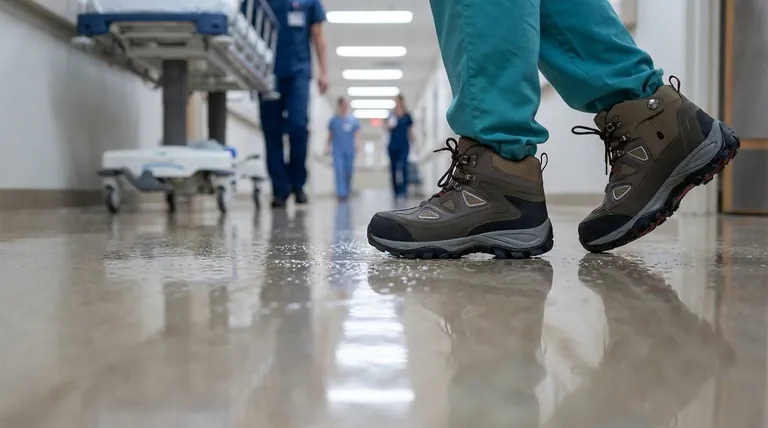
A hospital corridor at shift change is a study in controlled chaos. A floor, still damp from its last cleaning, reflects the overhead lights. A nurse, twelve hours into her day, moves quickly toward a patient's room. A supply cart rattles by, and a heavy gurney is maneuvered around a corner.
In this single moment, multiple invisible risks converge: a slip, a crush, a puncture, a spill. Yet, the most common consideration for footwear in this environment is often just immediate comfort.
We are psychologically wired to prioritize alleviating present, chronic discomfort—like sore feet—over protecting ourselves from abstract, low-probability but high-consequence events. This cognitive bias explains why many healthcare professionals default to athletic shoes or clogs. It’s an understandable choice, but one that leaves them dangerously exposed to the hidden physics of their workplace.
Deconstructing the Invisible Threats
A healthcare facility is an engineered environment, and every tool within it must be engineered to match. Footwear is not an accessory; it is a critical piece of Personal Protective Equipment (PPE) that must be specified to counter concrete, quantifiable risks.
The Puncture Threat: A Millimeter of Steel vs. a Contaminated Needle
The most insidious risk is often the smallest. A dropped hypodermic needle, a shard of a broken glass vial, or a scalpel that falls from a tray. A standard rubber or foam sole offers negligible resistance.
The danger isn’t just the physical wound, but the potential exposure to pathogens. This is a pure engineering problem that requires an engineered solution.
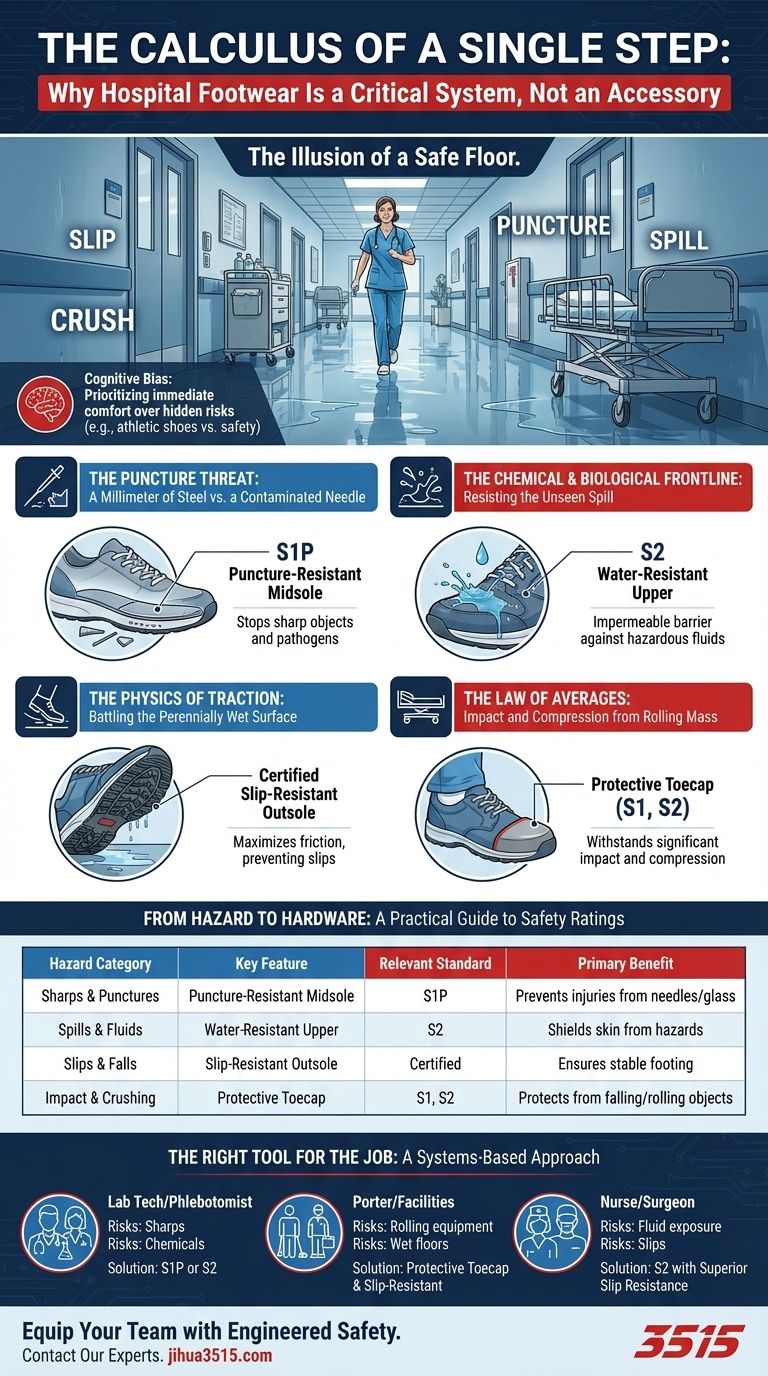
- The Solution: Puncture-resistant footwear, often designated S1P, incorporates a specialized composite or steel plate into the midsole. This barrier is designed to stop a sharp object before it can reach the foot, neutralizing a catastrophic risk with a simple layer of material science.
The Chemical and Biological Frontline: Resisting the Unseen Spill
Floors in clinical settings are conduits for countless fluids: cleaning agents, bodily fluids, and hazardous chemicals like chemotherapy drugs. A porous, mesh upper on a running shoe acts like a sponge, drawing these substances directly to the skin.
This isn't about keeping your socks dry. It's about creating an impermeable barrier against chemical burns and biohazardous exposure.
- The Solution: Footwear with S2 classification features a water-resistant upper. This treated material ensures that liquids bead up and roll off, giving the wearer crucial time to decontaminate and preventing absorption.
The Physics of Traction: Battling the Perennially Wet Surface
Slips, trips, and falls are the most common cause of injury for healthcare workers. The combination of smooth, polished floors and frequent spills creates a predictably low-friction environment.
Securing a stable footing is a matter of maximizing the coefficient of friction between the shoe and the floor.
- The Solution: Certified slip-resistant outsoles are designed with specific tread patterns and rubber compounds that channel away liquids and grip the surface, dramatically reducing the risk of a fall.
The Law of Averages: Impact and Compression from Rolling Mass
Over the course of a career, the probability of having a foot rolled over by a 500-pound patient bed, a heavy equipment cart, or a dropped oxygen canister approaches certainty.
The human foot contains 26 bones, many of which are small and fragile. A compression or impact injury can be debilitating.
- The Solution: A protective toecap (steel, alloy, or composite) provides a rigid shield over the toes, capable of withstanding significant impact and compression forces. It’s the difference between a minor incident and a long-term injury.
From Hazard to Hardware: A Practical Guide to Safety Ratings
Choosing the right footwear is a technical decision. The "S-codes" from European standards provide a clear language for specifying protection. For bulk procurement by hospitals, distributors, or brand owners, understanding these codes is the first step in responsible risk management.
| Hazard Category | Key Feature | Relevant Standard | Primary Benefit |
|---|---|---|---|
| Sharps & Punctures | Puncture-Resistant Midsole | S1P | Prevents injuries from needles, glass, and scalpels |
| Spills & Fluids | Water-Resistant Upper | S2 | Shields skin from chemical and biological hazards |
| Slips & Falls | Slip-Resistant Outsole | (Certified) | Ensures stable footing on unpredictable surfaces |
| Impact & Crushing | Protective Toecap | S1, S2 | Protects foot from falling or rolling objects |
The Right Tool for the Job: A Systems-Based Approach
There is no single "best" shoe for healthcare. The level of protection must match the specific risk profile of the role. A systems-based approach ensures that every team member has the appropriate tool for their unique environment.
- For Lab Technicians & Phlebotomists: The primary risks are dropped sharps and chemical spills. An S1P or S2 shoe is non-negotiable.
- For Porters & Facilities Staff: The chief dangers come from rolling heavy equipment and navigating wet floors. A protective toecap and slip-resistant outsole are essential.
- For Nurses & Surgeons: A combination of fluid exposure and slip hazards makes an S2 shoe with superior slip resistance the baseline for safety.
For organizations looking to equip their entire workforce, a comprehensive manufacturing partner is key. The capability to produce a full spectrum of certified footwear—from S1P boots for maintenance crews to S2 shoes for clinical teams—ensures a consistent and appropriate standard of safety across the board. As a large-scale manufacturer, 3515 partners with distributors and brand owners to solve this systemic safety challenge at scale.
Choosing what you put on your feet is a daily calculation of risk. By understanding the hidden forces at play, you can make an engineered choice for safety, not just a preferential one for comfort.
Ensure your team has the protection they truly need. Contact Our Experts
Visual Guide
Related Products
- Heavy-Duty Waterproof Nubuck Safety Boots Safety Shoes for Bulk Supply
- Premium Safety Shoes with Rotating Buckle Safety Sneakers
- Premium KPU Injection Athletic Style Safety Shoes
- Safety Footwear Wholesale Manufacturer for Custom OEM/ODM Production
- Premium Wholesale Tactical Style Safety Shoes Boots with Quick Lacing
Related Articles
- How to Choose Safety Boots That Reduce Fatigue Without Sacrificing Protection
- How Industrial Professionals Can Balance Safety Boot Requirements with Professional Appearance
- The Lacing Paradox: Why the Safest Boots Contain Their Own Greatest Risk
- The Anatomy of Trust: A Systems Approach to Workplace Foot Protection
- Beyond the Steel Toe: The Engineering of Trust in Work Boots