The Illusion of the "Tough" Boot
Picture a construction site. A new worker chooses the heaviest, most rugged-looking steel-toed boots on the shelf. They feel indestructible. By noon, however, his feet ache. By the end of the week, the sheer weight has caused so much fatigue that his awareness drops, creating a new, invisible risk.
This is a common story. We often judge safety footwear by its appearance—its form. But the real story of safety is in its function, a direct response to the specific hazards of an environment.
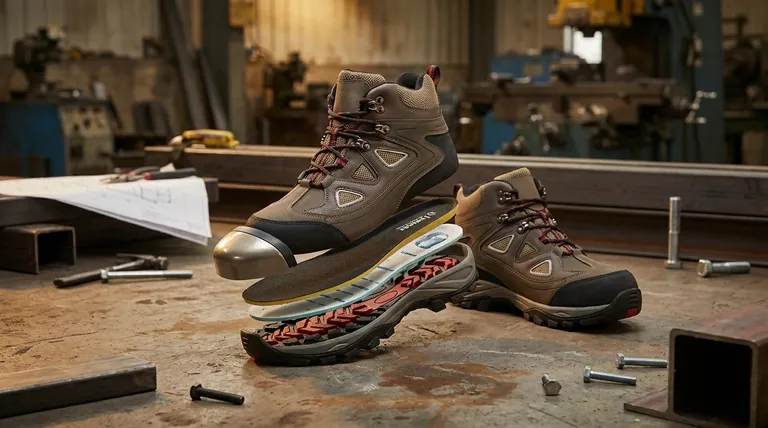
The style of a shoe is just the chassis. The real protection comes from the engineering within.
The Five Foundational Chassis
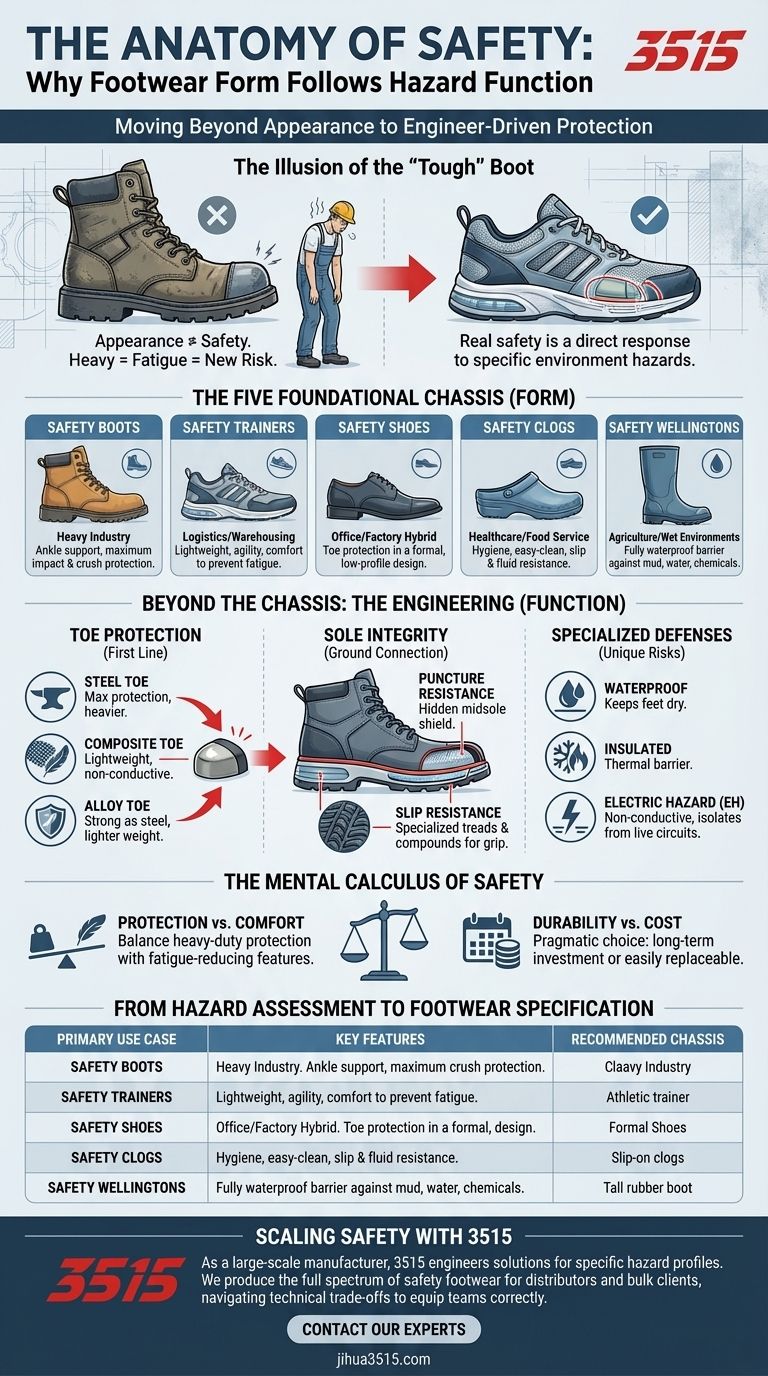
First, let's establish the basic forms. The style of footwear provides a starting point, defining its coverage, flexibility, and suitability for a general environment.
Safety Boots
The classic choice for heavy industry. Extending over the ankle, they provide a fortress of support against impact, crushing forces, and sprains.
Safety Trainers
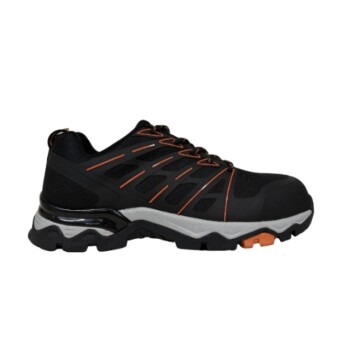
Engineered for agility. They look like athletic sneakers but hide protective components. Ideal for logistics, warehousing, or any role requiring miles of walking on hard surfaces. Comfort here isn't a luxury; it's a safety feature that prevents fatigue.
Safety Shoes
The hybrid solution. They offer certified toe protection in a more conventional or formal design, perfect for managers and engineers who bridge the gap between the office and the factory floor.
Safety Clogs
Designed for hygiene and convenience. Easy to slip on and clean, their primary role in healthcare or food service is preventing slips and repelling fluids.
Safety Wellingtons
The barrier against the elements. Fully waterproof, they are essential for anyone working in agriculture, food processing, or environments defined by mud, water, and chemicals.
Beyond the Chassis: The Engineering That Keeps You Safe
The true safety of footwear is determined by its components. These are not arbitrary features; they are specific solutions to quantifiable risks.
Toe Protection: The First Line of Defense
This is the most fundamental safety feature, but the material choice is a critical trade-off.
- Steel Toe: The traditional benchmark. It offers maximum protection against impact and compression but comes with a weight penalty.
- Composite Toe: The modern athlete. Made from carbon fiber, Kevlar, or plastic, it's significantly lighter, doesn't conduct heat or cold, and is essential for metal-free environments.
- Alloy Toe: The best of both worlds. Using aluminum or titanium, it provides steel-level protection at a fraction of the weight, directly reducing foot fatigue over a long shift.
Sole Integrity: Your Connection to the Ground
The sole assembly is a multi-layered defense system.
- Puncture Resistance: A hidden shield in the midsole prevents nails, glass, and other sharp objects from penetrating from below. It’s insurance against unseen threats.
- Slip Resistance: This is about physics, not just rubber. Specialized tread patterns and compounds are engineered to channel away water or oil, maintaining a critical grip on treacherous surfaces.
Specialized Defenses for Unique Risks
Some environments are hostile in unique ways, demanding purpose-built protection.
- Waterproof Boots: For outdoor or wet work, keeping feet dry is crucial for preventing everything from blisters to fungal infections and maintaining focus.
- Insulated Boots: In cold storage or extreme weather, a thermal barrier isn't about comfort—it's about preventing frostbite and maintaining blood circulation.
- Electric Hazard (EH) Boots: Built with non-conductive materials, they are a life-saving tool designed to isolate the wearer from the ground, protecting them from open electrical circuits.
The Mental Calculus of Safety
There is no single "best" boot. The right choice is a calculated balance of competing factors, guided by a clear-eyed assessment of the work to be done.
Protection vs. Comfort
The most protective footwear is often the heaviest and least flexible. But fatigue is a hazard. For a delivery driver constantly climbing in and out of a truck, a lighter composite-toe trainer prevents the exhaustion that leads to slips, trips, and costly mistakes.
Durability vs. Cost
A highly specialized boot is a long-term investment. But in an environment with corrosive chemicals that destroy footwear in months, a less expensive, easily replaceable option may be the more pragmatic and safer choice.
From Hazard Assessment to Footwear Specification
Your choice should not be based on habit or appearance. It must be dictated by risk.
- For heavy industry or construction: Prioritize maximum impact protection. Choose Safety Boots with steel or alloy toes and puncture-resistant soles.
- For logistics, warehousing, or delivery: Prioritize fatigue reduction. Select lightweight Safety Trainers with composite toes.
- For healthcare or food service: Prioritize hygiene and slip resistance. Opt for Safety Clogs or Wellingtons.
- For work near live circuits: Your only choice is footwear specifically rated for Electric Hazard (EH) protection.
This table provides a simple starting point:
| Type | Primary Use Case | Key Features |
|---|---|---|
| Safety Boots | Heavy Industry, Construction | Ankle support, maximum impact/crush protection |
| Safety Trainers | Warehousing, Logistics | Lightweight, athletic comfort, composite toes |
| Safety Shoes | Office/Factory Hybrid | Formal design, toe protection, low profile |
| Safety Clogs | Healthcare, Food Service | Slip-on, easy to clean, slip-resistant |
| Safety Wellies | Agriculture, Wet Environments | Fully waterproof, chemical/mud resistance |
Scaling Safety: From Individual Choice to Industrial Supply
Understanding the anatomy of safety footwear reveals a complex landscape of materials, standards, and human factors. Making the right choice, especially at scale for an entire workforce, is a critical operational discipline.
As a large-scale manufacturer, 3515 produces the full spectrum of safety footwear. Our expertise lies not just in manufacturing, but in engineering solutions for specific hazard profiles. We produce boots, shoes, trainers, and more for distributors, brand owners, and bulk clients, ensuring that every pair is a precise answer to a specific safety question.
Navigating these technical trade-offs to equip your team correctly is what we do best. Contact Our Experts
Visual Guide
Related Products
- Premium Suede Sport Safety Shoes for Wholesale & Bulk Orders
- Premium Lightweight Safety Shoes for Wholesale & Bulk Orders
- Wholesale Anti-Smash & Puncture-Proof Safety Shoes Custom Manufacturing for Brands
- Premium KPU Injection Athletic Style Safety Shoes
- Premium Safety Shoes with Rotating Buckle Safety Sneakers
Related Articles
- The Ghost in the Machine: Why an Obsolete Footwear Standard Creates Modern Risk
- Beyond the Steel Toe: The Hidden Ergonomics of Workplace Safety
- Why Traditional Laces Are a Hidden Safety Risk—And What to Do About It
- The True Cost of Skipping Safety Shoes: Long-Term Risks and Smart Protection
- How Safety Shoe Engineering Prevents Workplace Injuries Across Industries