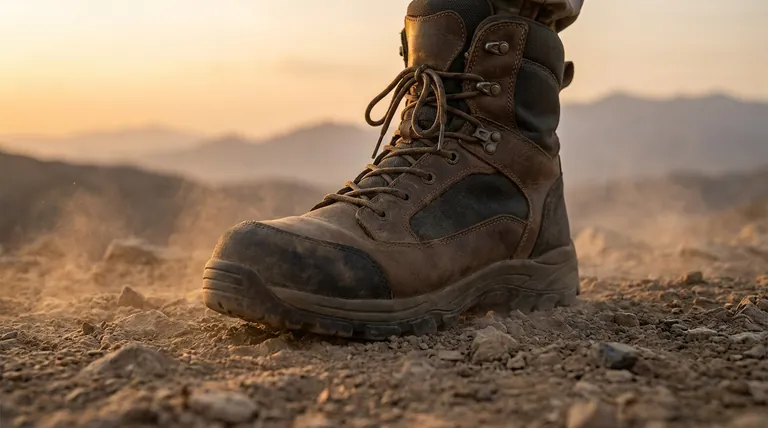
The Unseen Calculus of a Soldier's Step
A boot is not just equipment; it's the primary interface between an operator and their environment. For a technician on the steel deck of a naval vessel, it's a shield against crushing force. For an infantry soldier on a long-range patrol, it's an extension of their own endurance.
The choice of what protects their toes—be it steel, composite, or nothing at all—is far from trivial. It's a deliberate calculation, a trade-off between absolute protection and operational performance. Understanding this balance is the first principle of outfitting personnel for success.
The Physics of Protection: Establishing the Standard
Before weighing options, we must understand the objective measure of "safety." A safety-rated boot isn't just tough; it's certified to withstand specific, measurable forces. This is engineering, not opinion.
The Impact Standard: A Controlled Collision
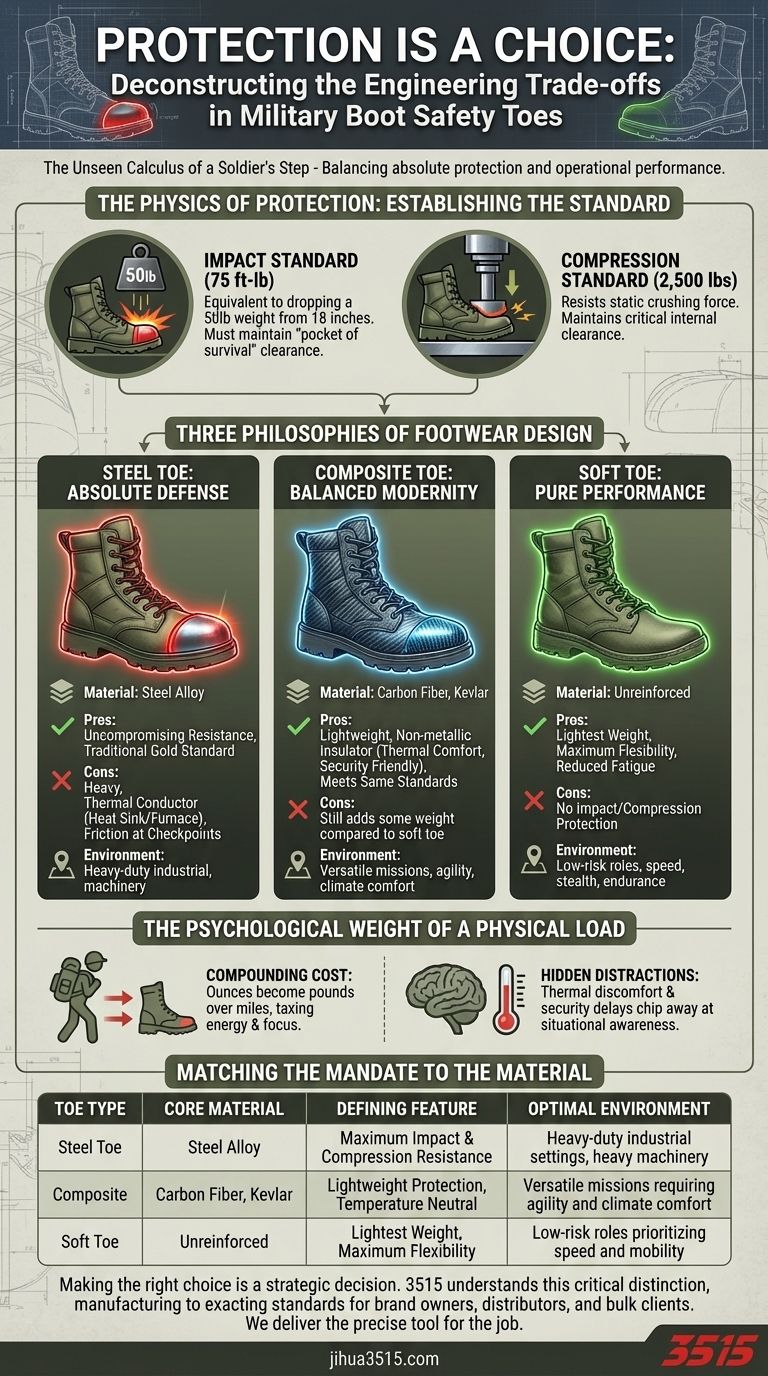
A certified safety toe must withstand a 75 foot-pound impact. This is the equivalent of dropping a 50-pound weight from about 18 inches. After this sudden, violent force, a minimum clearance must remain inside the toe cap—a literal pocket of survival for the wearer's toes.
The Compression Standard: A Static Siege
The boot must also resist a static crushing force of 2,500 pounds. This test simulates the foot being caught under a heavy, stationary object. Again, the boot passes only if it maintains that critical internal clearance.
These are the non-negotiable baselines. How a boot achieves them defines its character.
Three Philosophies of Footwear Design
Each safety toe option represents a different philosophy for solving the protection-versus-performance equation.
Steel Toe: The Philosophy of Absolute Defense
Steel is the traditionalist's choice for good reason. It offers uncompromising resistance to impact and compression. It is the gold standard in environments dense with heavy machinery and falling hazards.
The cost for this absolute protection is weight. Every step requires more energy. Steel is also a thermal conductor, becoming a heat sink in the cold and a furnace in the heat. It is protection in its most direct, physical form.
Composite Toe: The Philosophy of Balanced Modernity
Composite toes, made from materials like carbon fiber or Kevlar, are the technological evolution. They meet the exact same impact and compression standards as steel, but they rewrite the secondary characteristics.
They are significantly lighter, reducing the cumulative fatigue that plagues personnel over long shifts. As non-metallic insulators, they offer superior comfort in extreme temperatures and won't trigger metal detectors—a critical factor for operational security and efficiency.
Soft Toe: The Philosophy of Pure Performance
The soft toe boot is a conscious decision to trade armor for agility. By removing the protective cap entirely, the design prioritizes minimum weight and maximum flexibility.
This philosophy is for roles where impact hazards are negligible, but speed, stealth, and endurance are paramount. Here, the greatest threat isn't a falling object, but the physical and mental exhaustion that comes from being overburdened.
The Psychological Weight of a Physical Load
The trade-offs are not just about material science; they are about human psychology and endurance.
-
The Compounding Cost of Weight: A few extra ounces per boot seems small. But over a 12-mile march, that weight is lifted thousands of times. It becomes a compounding tax on energy and focus, directly impacting mission readiness.
-
The Hidden Distraction of Discomfort: A freezing cold or uncomfortably hot toe cap is more than an inconvenience. It’s a persistent, low-level distraction that chips away at situational awareness. Thermal neutrality, as offered by composites, is a cognitive advantage.
-
Operational Friction: For personnel passing through security checkpoints, a steel toe is a point of friction. A composite toe removes that hurdle, streamlining movement and maintaining focus on the task at hand.
Matching the Mandate to the Material
The right choice is dictated entirely by the operational environment. There is no single "best" boot, only the optimal boot for the mission.
| Toe Type | Core Material | Defining Feature | Optimal Environment |
|---|---|---|---|
| Steel Toe | Steel Alloy | Maximum Impact & Compression Resistance | Heavy-duty industrial settings, heavy machinery |
| Composite | Carbon Fiber, Kevlar | Lightweight Protection, Temperature Neutral | Versatile missions requiring agility and climate comfort |
| Soft Toe | Unreinforced | Lightest Weight, Maximum Flexibility | Low-risk roles prioritizing speed and mobility |
Making the right choice is a strategic decision. Manufacturing that choice to exacting, reliable standards is an operational necessity. As a large-scale manufacturer, 3515 understands this critical distinction. Our production capabilities encompass the full spectrum of footwear solutions—from heavy-duty steel toes to high-performance soft toes—engineered to meet the rigorous demands of brand owners, distributors, and bulk clients.
We don't just build boots; we deliver the precise tool for the job, engineered to the philosophy your mission requires. Contact Our Experts
Visual Guide
Related Products
- Puncture-Resistant Velcro Safety Boots for Wholesale & Custom Manufacturing
- Durable Steel Toe Safety Boots Wholesale & Custom Manufacturing
- Premium Suede Metatarsal Guard Safety Boots Work Shoes
- Heavy Duty Nubuck Safety Boots Safety Shoes for Global Distribution
- Wholesale Leather Safety Boots with Customizable Protective Toe
Related Articles
- The Unseen Engineering: Why Steel Toes Succeed or Fail in Oily Environments
- The Anatomy of Trust: A Systems Approach to Workplace Foot Protection
- The Lacing Paradox: Why the Safest Boots Contain Their Own Greatest Risk
- How Industrial Professionals Can Balance Safety Boot Requirements with Professional Appearance
- How to Choose Safety Boots That Reduce Fatigue Without Sacrificing Protection